
A letter to the editor in the Feb. 2 issue of The Monitor made a sobering observation about Boulder residents’ driving abilities: “Apparently myself and two or three others are the only ones who know the law.”
The letter, handwritten by Ed McCracken and dropped in the newspaper’s letterbox, also came with a suggestion: “I think it’s long past time that The Monitor does an article about how to proceed through all the unmarked intersections in town.”
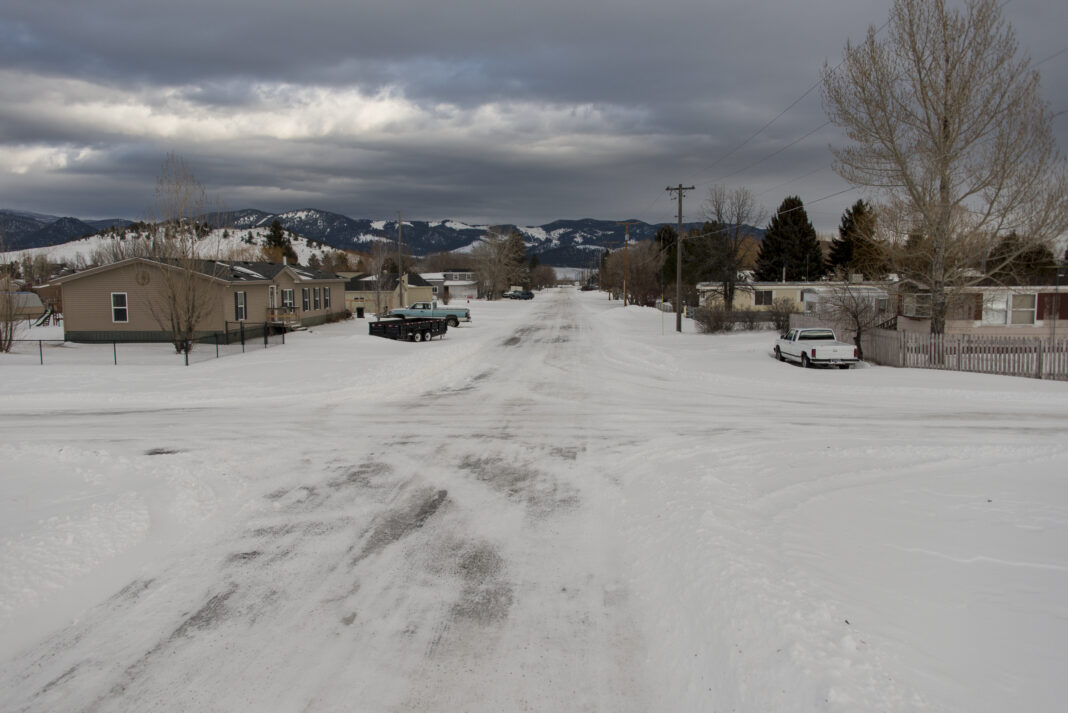
Unmarked intersections, technically called “uncontrolled intersections,” are intersections that wholly lack traffic control signage in every direction. In Boulder, that plays out in many places as three- and four-way intersections without any stop signs or yield signs, offering drivers no posted visual indication of who has right of way. The intersection of West First Avenue and North Jackson Street is one such intersection. McCracken wrote that he believed uncontrolled four-way intersections operated essentially like four-way stops: The first vehicle to arrive at the intersection has the right of way; in the event of a tie, the vehicle to the right has right of way.
According to Jefferson County Sheriff Craig Doolittle, McCracken was “pretty correct.” Doolittle referred to the Montana Driver Manual for further explanation. The manual, produced by the state, specifies that the first driver to a four-way stop has right of way—only after they make a complete stop, of course—and that drivers approaching an uncontrolled intersection should yield to any drivers coming from the right.
But what if two drivers arrive at an uncontrolled four-way intersection from opposite directions, meaning that neither is to the other’s right? If the vehicles are both traveling straight, or if one or both are turning away from the other, then both vehicles can proceed, according to Montana Highway Patrol Sgt. Jay Nelson, a special operations commander who is also a spokesman for the patrol. If one vehicle is turning in front of the other, he said, it must yield to the vehicle traveling straight. If a driver approaches an uncontrolled intersection and sees that there are no other vehicles around, he wrote in an email, they can proceed without stopping.
At an uncontrolled three-way “T” intersection where one street ends at a through street, such as where West Third Avenue hits South Jackson Street in Boulder, drivers on the street that ends at the through street must yield to traffic on the through street—the street that doesn’t end—according to Nelson.
Nelson wrote that the Highway Patrol often fields questions about uncontrolled intersections, and he added that it is always “required for all vehicles to drive in a safe and prudent manner for the existing conditions.”
Or, as McCracken opined, “I’m tired of dodging dumbasses.”