
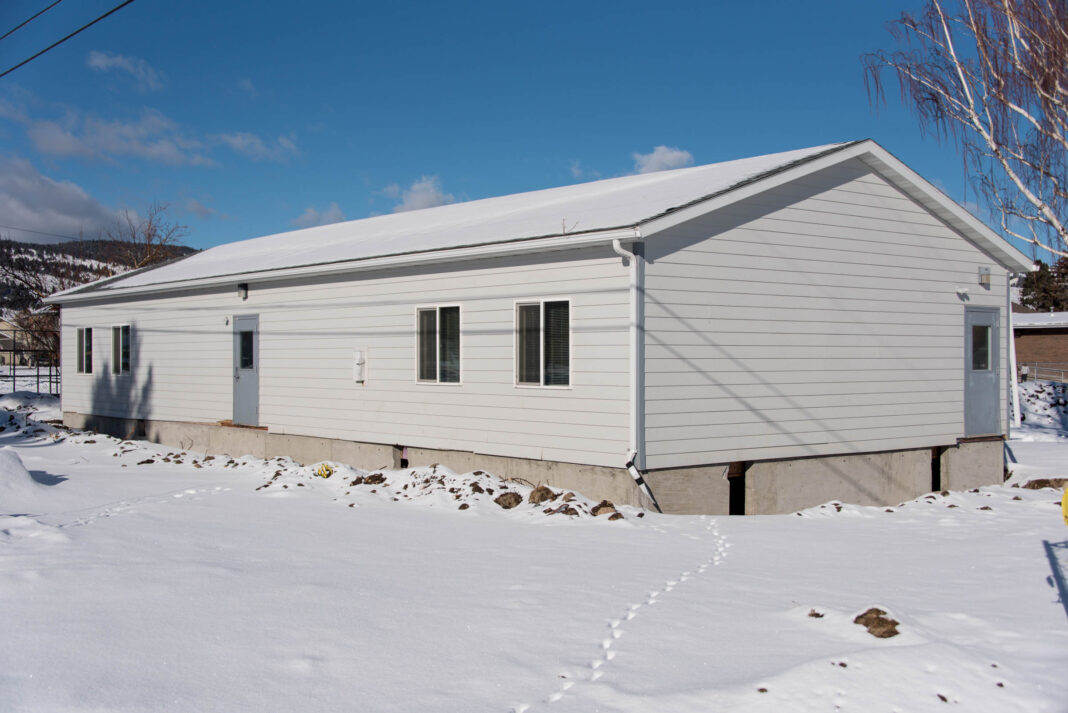
The city of Boulder plans to retain ownership of the building it purchased and relocated from north of Helena to Boulder last year with the goal of providing a facility for affordable child care, and the city now has a draft plan for how it hopes to manage building maintenance and costs depending on the success or failure of an eventual child care operation in the space.
At the first City Council meeting of the year, on Jan. 18, Council President Drew Dawson presented a “draft concept paper for … the future of what we’re going to do with Southwest Montana Youth Partners,” a nonprofit recently formed by the child care working group that Dawson chaired, which itself was spun off from the Boulder Transition Advisory Council with the goal of bringing affordable child care to Boulder. Dawson prefaced the presentation by telling Mayor Rusty Giulio and the council that he serves as a director for the nonprofit and would recuse himself from voting on any issues before the council that involve Southwest Montana Youth Partners, including the draft.
“We’re getting Southwest Montana up and running. It’s not a quick process to get a nonprofit corporation up and running and get them into a position to accept money and contract with someone, and get a building up and running,” Dawson said, explaining that the nonprofit’s goal is to find a child care provider that will establish a licensed child care operation in the building, which the city purchased using American Rescue Plan Act (ARPA) funds from Jefferson County.
Neither the city nor the nonprofit will be operating a child care business, Dawson said, but the city will retain ownership of the building: “The idea is that, once we’re in a position to do this at Southwest Montana, that the city of Boulder would lease the building to Southwest Montana for a period of two years at $10 per year, in an effort to sort of jumpstart this and get a day care provider in here that can provide services at an affordable cost.”
The city will pay utility costs and taxes on the building for the first two years using ARPA money, Dawson said, though there is also money in the city’s budget to cover those costs if needed. The building and its transport to Boulder—it is located at Boulder Elementary School—are already paid for, primarily with ARPA funds.
If Southwest Montana Youth Partners is successful in attracting a child care provider in the building that proves to be successful in the first two years, then “we would change the lease to an assignment, so they would sort of run the building … but they don’t own it,” Dawson said, explaining that assigning the building to its occupant would make the occupant responsible for all of the building’s upkeep and expenses while the city retains ownership.
Dawson said that if the nonprofit fails to foster a viable child care operation during the first two years, then the city would make another attempt at finding a child care provider in the space.
However, if an eventual child care operation fails in the long term—after a decade, for example—then the building would become the property of Boulder Elementary School, according to the terms of the draft plan. That’s because, Dawson said, Boulder Elementary “will always be interested” in the care and education of children, and that aligns with the objectives of the ARPA funds that originally purchased the building.
“Because the building is on their property, they have a vested interest in using the building for the education of children. It’s right there, it’s part of what they do every day. At that point it just makes more sense [that] it’s integrated into their daily business,” Dawson said. Plus, “we don’t want a city building sitting on elementary school property. The elementary school doesn’t want a city building sitting on elementary school property that they can’t control.”
Additionally, Dawson said, although Giulio and the council share a desire to bring affordable child care to Boulder, “10 years from now we don’t know what the administration will be like, we don’t know what the commitment of the city will be to child care.”
Dawson reiterated that, although the draft concept for administering the building contained contingencies for a failure to establish child care, “we have every reason to believe” that the city and nonprofit will succeed in bringing affordable child care to Boulder in the building.
“This is a new model that’s never been tested anywhere, as far as we know, ever. So we want to be careful,” Dawson said. “There’s every reason to believe that everything will be successful, but we also want to be cautious, and there’s failsafes in here.”
Dawson said that he wasn’t sure when a child care operation could begin in the building.
With Dawson abstaining, council members Pat Lewis, Bear Taylor and Gyle Nix voted to move forward with the draft concept.
Other City Council news
- The Jan. 18 meeting was the City Council’s first of 2022 and its first with Lewis, who was elected last year to replace Sherry Lepley, who did not seek reelection. It was also the first meeting of second terms for Dawson and Giulio, who each ran for reelection unopposed last year.
- Taylor nominated Dawson to continue as council president for another year. Nix, attending by phone, seconded the nomination and the two, joined by Lewis, voted to approve Dawson as president. Dawson abstained from the vote.
- The council approved Taylor as an authorized bank signer for the city, replacing Lepley. Taylor abstained from the vote. The council appointed Nix to the planning board; he abstained from the vote.
- The council unanimously approved a new five-year contract with current city engineer Morrison-Maierle.
- The City Council will hold a workshop on the city’s growth policy to address recommendations from the Planning Board. The workshop will take place at City Hall at 6:30 p.m. on March 7.