
After a dry fall and a slow start to snow accumulation in the mountains around Boulder and Jefferson County—and remarkably severe and widespread drought conditions in 2021—the current snowpack in the area is about normal for this point in winter, although the water content of snow in the Elkhorn Mountains is significantly less than in most years.
On Monday, a storm system dropped about 6 inches of snow on the mountains, and an inch or more on valley floors, boosting overall snow depths in the mountains to at or above their historical median values for Jan. 25.
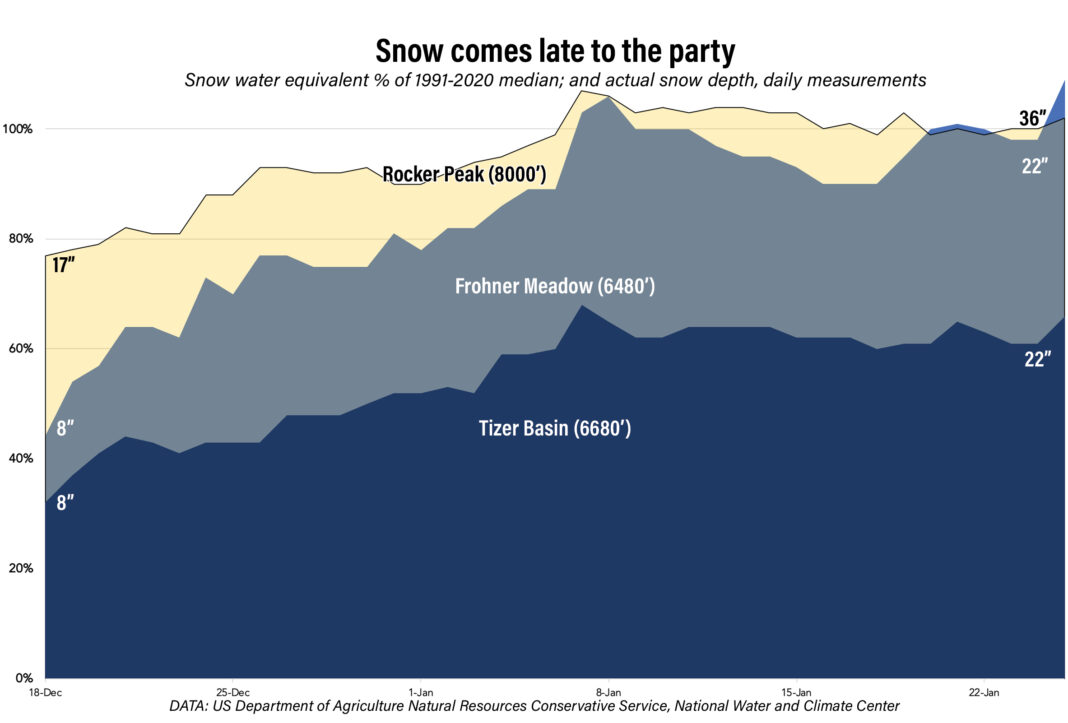
The Rocker Peak SNOTEL station, maintained by the U.S. Department of Agriculture’s Natural Resources Conservation Service, measured 36 inches of snow at the end of Monday, 6 inches of which fell that day. The median snow depth at the station, which sits at an elevation of about 8,000 feet near a saddle west of Rocker Peak north of Basin, is 35 inches for that day. The Frohner Meadow station, located at 6,480 feet at the top of the Lump Gulch drainage northwest of Jefferson City, reported 22 inches of snow, including 4 inches of new snow, on Monday—or 110% of the 20-inch median there.
Across the valley, the Tizer Basin station, located north of Elkhorn Peak at about 6,880 feet, reported 22 inches of snow at the end of Monday—6 inches more than the previous day, and the same as the median value for that day.
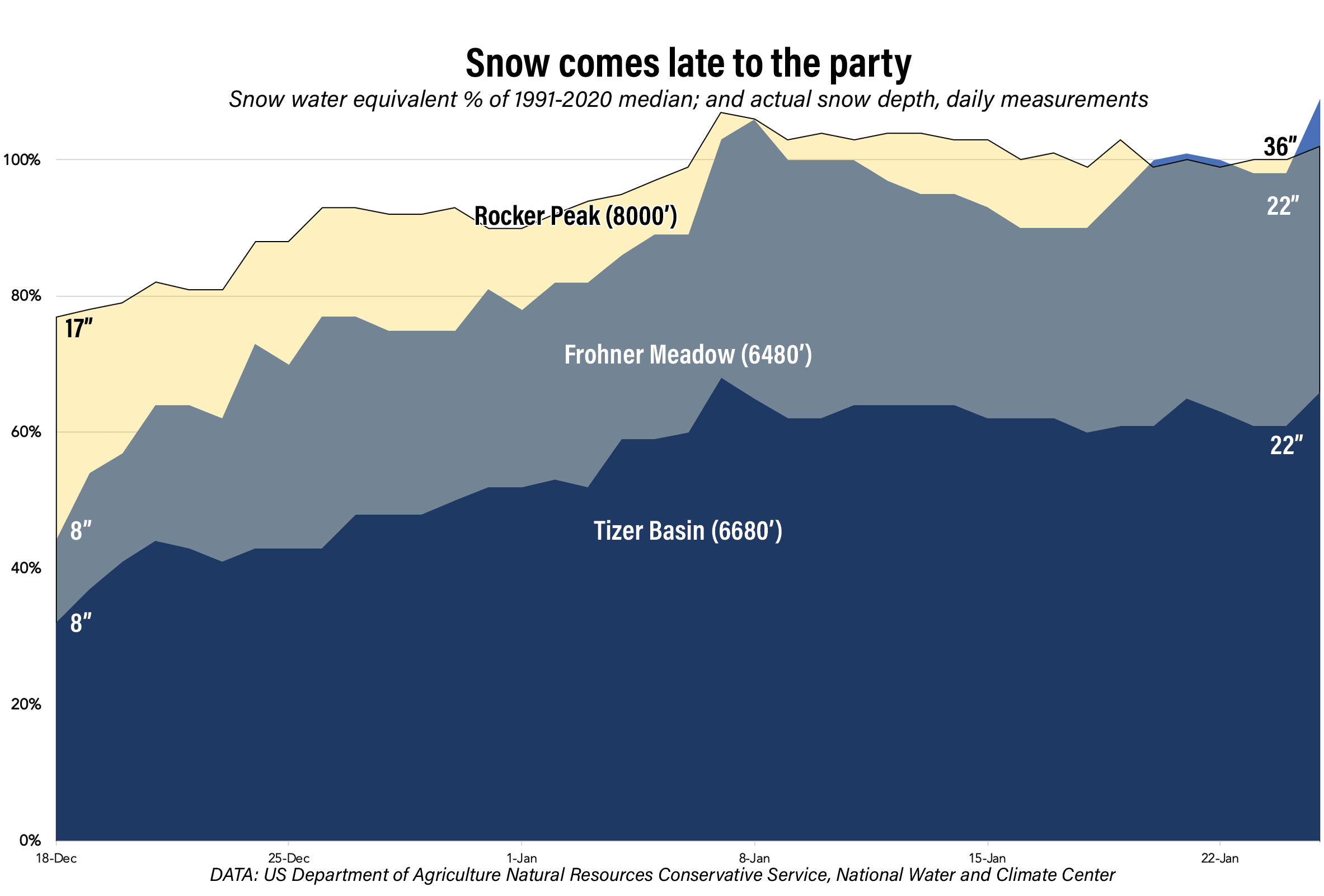
But although snow depth in the area is consistently about normal, water content in the snow is not: The mountains west of Boulder have about normal snow-water equivalent while the Elkhorns are particularly dry, according to SNOTEL data. Rocker Peak reported 8.4 inches of snow-water equivalent—the amount of liquid water contained in the snowpack— or 99% of its median. Frohner Meadow reported 4.8 inches—107% of its median. That means both stations measured a typical amount of water content in the snow for this time of winter.
But the Tizer Basin station reported 3.8 inches of snow-water equivalent on Jan. 25—just 68% of the median value of 5.6 inches. That could be cause for concern if the trend continues, according to Jeff Mosley, Ph.D., an MSU Extension range management specialist who holds a doctorate in range science.
“Any time you get to late winter, early spring and the SWE is 85% or less than normal, I think it is potentially significant [for] agriculture. The biggest impact is the irrigation and how much of it will be available into the summer,” Mosley said. “It’s also a pretty good reflection of the availability of stock water, and it’s a pretty good indication of stored soil moisture that will help initiate the spring growing season.”

Growth of forage on native, or unirrigated, rangeland is determined more by rainfall in April, May and June, he said, but water content in snowpack is vital to irrigation for pastures and hay crops, as well as stock water availability. A healthy snowpack and spring rainfall “both have to kind of coalesce together” to create favorable growing and grazing conditions on farms and ranches and out on rangeland throughout the season. Another factor, he said, is how fast the snow melts in the spring: Warm weather too early in the season can melt the snowpack before forage and crops are growing.
But, given last year’s exceptional drought, Mosley said, “I think most people would be happy to get an average year.”
Fifth-generation rancher Leah Lewis, who operates her family ranch near Boulder with her husband, sister and brother-in-law, said that “last year we had not great snowpack and it melted off really fast,” and that “We kind of need above average to catch up from last year.”
But catching up could be tough. Mosley and Hayes Goosey, Ph.D., an MSU Extension forage specialist who holds a doctorate in animal and range sciences, said that last year’s profoundly arid conditions have inhibited the growth of spring and early summer forage for the upcoming season.
Goosey noted that, although drought conditions right now are less severe than last summer, about three-quarters of Montana remains in a “severe” to “exceptional” drought—or levels D2 through D4—according to the U.S. Drought Monitor.
“If we don’t get some pretty good moisture, we’re going to have to come up with some new superlatives to describe what’s after D4,” Goosey said, adding that “It’d be nice to be 100% in snowpack, or just even snowfall, in all these other places that are short on moisture.”
But with snowfall—and, in many areas of southwest Montana, snow-water equivalent—at about normal so far this winter, “I think it’s a little too soon to worry, but it’s never too soon to plan. Now’s a good time to plan different options for the summer grazing season, summer growing season,” Mosley said.