
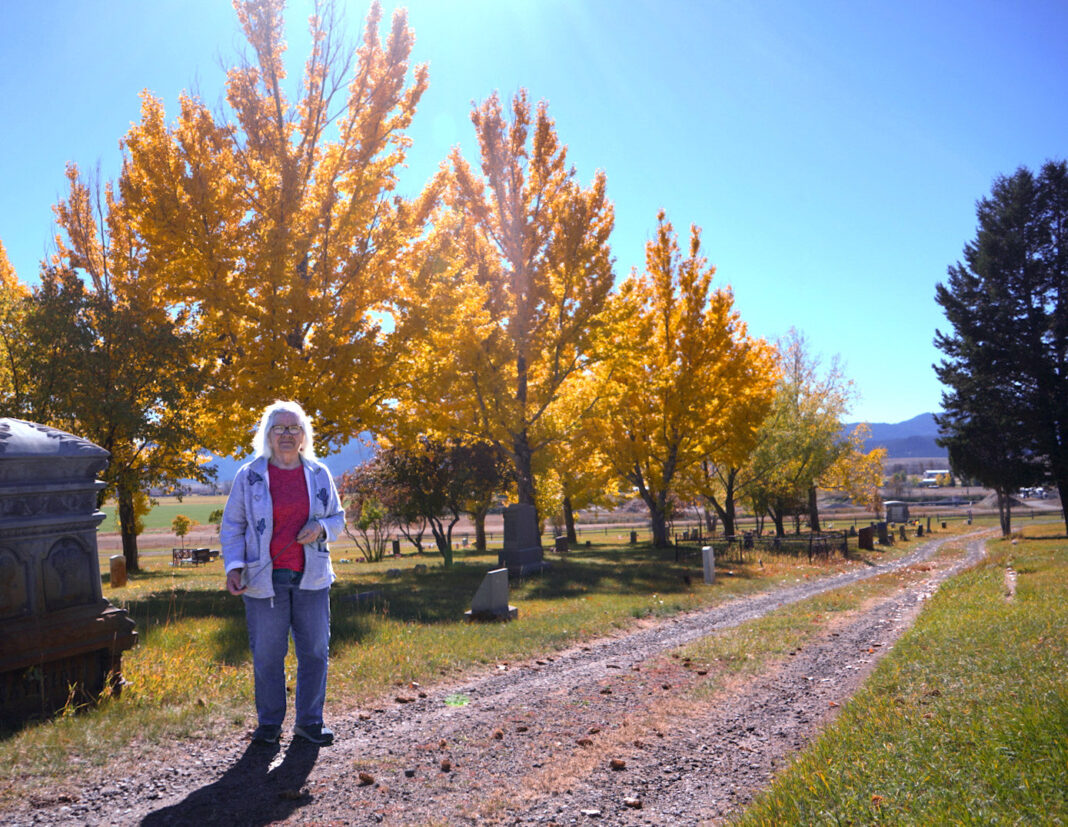
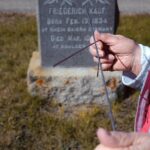
“I have always been a very curious person,” Nancy Alley says slowly, adjusting the angled metal rods held loosely in her hands. As she takes a step across the cemetery, the rods appear to pull toward one another, crossing to form an X. She pauses to note a possible unmarked grave. “And when I find something that piques that curiosity, I do it.”
Alley, a longtime Boulder resident, is a dowser, part of a very curious practice indeed. A phenomenon spanning centuries and continents, known by a dozen different names (among them witching, divining, doodlebugging, or “the gift,” to name a few) and associated with as many possible explanations, the ancient art of dowsing uses divining rods to pinpoint and uncover a variety of items of interest tucked beneath the surface of the earth.
The preferred tools and methodology for dowsing vary from dowser to dowser. Alley fashioned a few sets herself from marking stakes bent into an L shape. Others may use brazen rods, lengths of thick copper wire, or forked branches of yew, willow or witch hazel. The equipment is simple, uncomplicated and accessible to beginners – perhaps the only easily understood part of the practice.
To those familiar with the tradition in passing, the term “dowser” likely conjures up images of a gold-seeking frontiersman armed with a prospector’s hat and forked bough, or perhaps a nineteenth century farmer wandering the rangeland in search of drilling sites for watering cattle.
But the art of dowsing far predates Western expansion. Depictions of dowsers have been found in works of prehistoric art throughout Asia and Africa; they are cited in the writings of Agricola and Homer. A trail of anecdotes, folk stories and personal accounts chronicles its use in German silver mines and Norwegian avalanche rescues. Some consider dowsing to have Biblical reference, citing Pentateuchal depictions of Moses using a rod to draw water from rock.
Today, the American Society of Dowsers considers all things “water witching, the discovery of lost articles or persons, and related parapsychological phenomena” to fall under its professional umbrella. Witchers across the globe continue to use divining rods and techniques to seek various items of interest beneath the surface, from hidden aquifers and veins of gemstones and ore to uranium deposits, artifacts and even buried pipework and electrical wires.
Alley’s own interest in the practice came at its convergence with another fascination of hers, likely known to anyone familiar with her work at the Heritage Center: genealogy. It emerged in the form of “grave dowsing,” a brand of witching that seeks to solve genealogical puzzles through locating and gathering information on unmarked, lost or forgotten graves.
Alley first held a pair of “witching sticks” (a term likely derived less from witchcraft and more from the witch hazel branches employed by early practitioners) several years ago at a Lewis and Clark Genealogical Society event, held at a Helena area cemetery. As she remembers, the sticks shot sideways in her hands; she looked down and found herself positioned directly above a water hose.
That experience — as well as witnessing the dramatic activity displayed by the rods in known burial areas — was enough for her to “continue witching around.”
But how does it work?
“I suppose it has something to do with anomalies beneath the surface,” Alley muses. Her reasoning is consistent with many interested in the phenomenon. Engineering professor and groundwater expert Thomas Zimmie told The New York Times, ‘’We do know that water moving underground creates a very small electrical potential… Maybe there are certain people who are extra sensitive to that very small voltage.”
Other scientific explanations have included soil disturbances, magnetic and radiation fields, or, in the case of grave dowsing, the piezoelectric properties of bone — allowing electrical charges to accumulate with stress, pressure and heat. Still others consider dowsing to be a form of intuition or clairvoyance.
When asked where she would position the activity on this spectrum of the mystical to the methodical, Alley simply laughed, replying, “all I know is that it works”.
Alley is something of a curiosity herself: Dabbling in grave dowsing is just the latest in a long list of interests, activities and personal curiosities — a function, she says, of coming from a long line of strong and inquisitive women. She has made multiple solo cross country trips (accompanied by only a stuffed “guard dog”), and spent 13 years in the remote community of Barrow, Alaska — the northernmost part of the continent.
The mother of four, grandmother of seven, great grandmother of fourteen, and great-great grandmother of one, she first made her way to Jefferson County in 1996, following her favorite aunt to Basin. She taught quiltmaking to students at Boulder Elementary School for 14 years, and still runs into students she introduced to the craft.
One of Alley’s favorite dowsing experiences came a few years ago while exploring the fields near Boulder Hot Springs with a group of bottle diggers, each bringing their own equipment — the diggers a metal detector, and Nancy her divining rods. While working slowly through the field just off Whitetail Road, Nancy’s rods swiveled, signaling something beneath the surface. Upon later investigation through Google Earth and older satellite imagery, it was confirmed that she had come across the buried remnants of a structure’s foundation.
Dowsers of the water-seeking variety are often employed by those in rural and suburban areas seeking to build wells. As the drilling and development process often costs thousands of dollars, land owners hesitant to gamble on choosing a dry location may choose to put faith in the insights water witchers offer without so much as digging a hole.
Even the military has occasionally leaned into dowsing techniques: there are World War 1 accounts of a British dowser’s uncanny ability to find water for the troops; during the Vietnam War, news accounts emerged of a group of United States Marines using dowsing techniques to pinpoint tunnels and weaponry.
Ultimately, the success of modern dowsing’s attempt to marry its surrounding folkloric tradition with any purported scientific backing depends on who you ask.
While some are willing to place their bets on explanations of underground anomaly or electric activity, others hold fast to divining as a matter of extrasensory perception, intuition or giftedness. Others still are quick to claim dowsing as a product of psychological phenomena; confirmation bias perhaps, or unconscious muscular action spurred along by anticipation.
Call it a gift, a science, or a pseudoscience if you’d like — but if you ask Nancy Alley, she’ll just call it witching.