
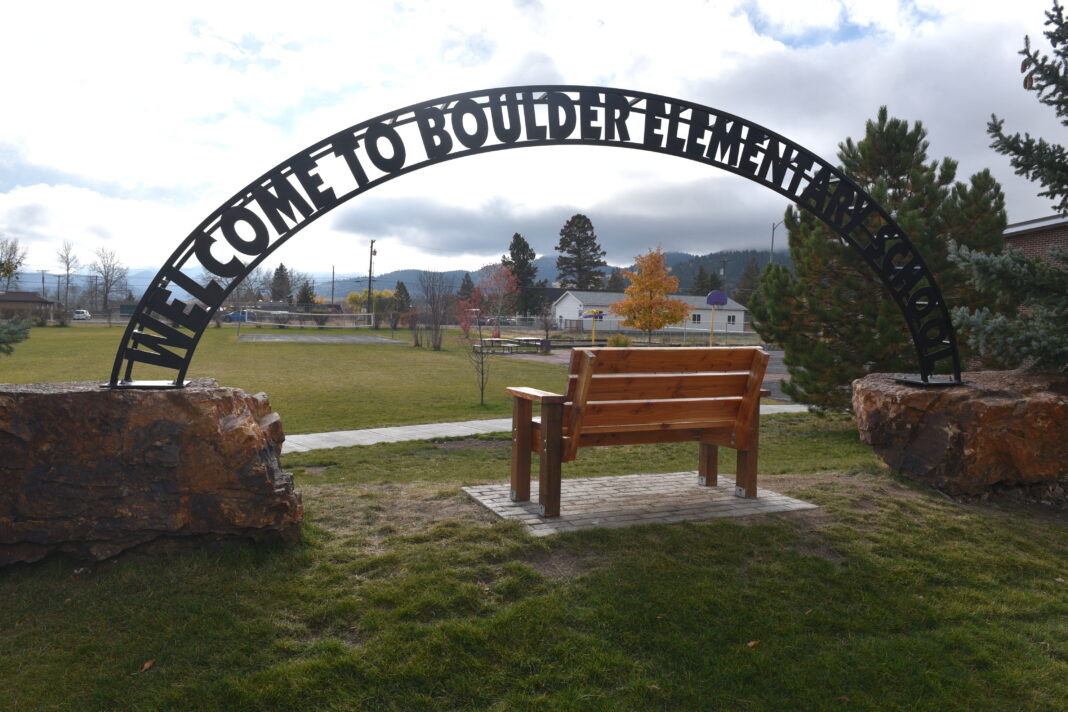
On the afternoon of Oct. 18, some 37 third and fourth graders were enjoying their recess in the autumn sunshine on the asphalt area near Boulder Elementary School’s football field. Some were playing volleyball. A breeze was blowing.
Nearly half a mile to the southeast, the Montana Highway Patrol was conducting a routine training exercise for officers at its headquarters on the former Montana Developmental Center campus.
Their worlds collided unexpectedly when riot control agents deployed at the Highway Patrol training apparently drifted to the elementary school.
“Both students and adults started to complain of a funny smell while some started complaining of it hurting to breathe and their eyes and nose hurt,” Boulder Elementary Superintendent Doug Richards wrote parents in a text message and email later that afternoon. Kindergarteners and second graders playing in a different section of the school campus did not seem to be seriously affected, he said.
Richards told The Monitor that, in the moment, “we were running 9000 miles an hour, trying to figure out what was going on.” He called officials at Jefferson High School, across the street, and learned that the Highway Patrol was conducting exercises in an outdoor area east of the high school. He then contacted the Highway Patrol.
Sgt. Jay Nelson, the Highway Patrol’s public information officer, confirmed that the agency deployed a single cannister of so-called CS tear gas, part of an exercise geared to expose troopers to the use and effects of riot control agents. About 15 troopers participated in the training, which is required for their annual certification, according to Nelson.
Nelson noted in an earlier statement: “This is the first report we have received of an issue that may be related to this training. The area where the training took place is about 1,800 feet from the elementary school, well beyond the area that the materials would typically reach.” Nonetheless, on Oct. 24, Nelson said the Highway Patrol would discontinue the riot control agent training in Boulder.
Richards said that, when he explained to Highway Patrol officers what was happening to the students, “they were very, very respectful, and very sorry.”
The third-grade and fourth-grade students, along with several para teachers who were minding the recess, moved inside the school building. Richards said that 12 children were given milk to soothe irritated throats. Others washed their faces and blew noses to remove the chemicals.
Jefferson County Public Health Director Pam Hanna confirmed that two nurses treated staff and students — one nurse who is assigned to the school and a second who splits time between the elementary school and Jefferson High.
Riot control agents such as those used by the Highway Patrol — commonly called tear gas and pepper spray — are intended to distract or weaken people by causing irritation to the eyes, mouth, throat, lungs, and skin. Hanna noted that the effects are short-lived after the affected individual is removed from the source and cleaning is completed.
Parents said they appreciated the school’s response and its communications — on Thursday, the day following the incident, Richards called each third and fourth grade family to check in — but were unhappy that their children had been exposed to the gases.
“I am beyond outraged,” said Samantha DeWit, whose child was among those at recess and, DeWit said, experienced stomach sickness that evening. “Our children should have never been put in this situation.”
Andrea Sarchet, secretary of the school’s parent-teacher association, said her third-grade daughter told her that classmates were upset by the episode, some of them screaming or crying. “Some people had pretty strong reactions.”
Sarchet said: “When you send your kids to school you assume they’re going to be safe. This could have been completely avoided, if they hadn’t done these exercises in the first place, or if they’d taken the proper precautions.”
The incident was unusual, but perhaps not unpredictable. Weather data indicates that winds that day ranged from zero to 8 miles per hour; in Boulder, winds most often blow from the north, but they sometimes shift in ways that could have carried the riot control agents northwest from the Highway Patrol campus.
Sven-Eric Jordt, an associate professor, Duke University School of Medicine who studies the effects of riot control agents, said that, “depending on the type of agent used, the design and numbers of the munitions used, the wind/weather situation and the local terrain, the aerosol clouds can travel such a distance and, even when diluted and dispersed, cause irritation.” He noted that children are more vulnerable than adults, since the aerosol fog is heavier than air and stays close to the ground.
Boulder Elementary parents also criticized the lack of communications from the Highway Patrol before the incident. “I’m frustrated that the Highway Patrol doesn’t feel a need to put out a statement that we’re doing training on this day,” said Christine Glueckert, the parent-teacher association president, whose second-grade daughter was on the playground. “There’s so much they can do to get the word out. And If there’ a school in town, they need to know.”
Jefferson High is typically notified by the Highway Patrol when trainings occur. The Jefferson County Sheriff’s Office also is normally contacted as well, although Public Information Officer Doug Dodge said it was not on this occasion. Nelson said that, in the future, Boulder Elementary would be notified, as well.
Nelson noted that the Highway Patrol runs a variety of trainings on its 37-acre campus, including those involving the use of non-lethal weapons and driving cars with lights and sirens.
“We’re examining all of our training to make sure we can be a good community partner but still fulfill our mission to provide quality training,” he said.