
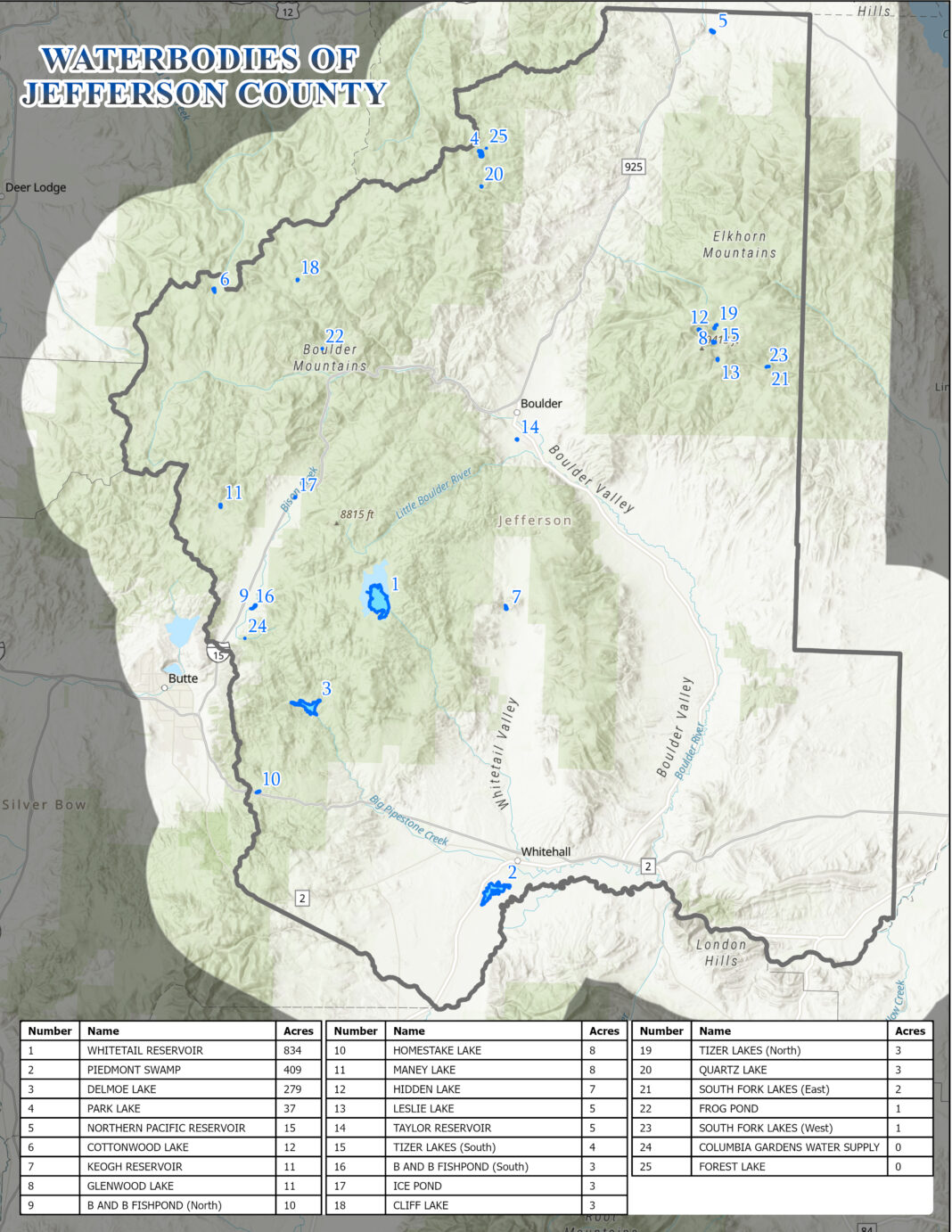
Jefferson County isn’t regarded as a land of lakes – great people of course, dead trees likely, but certainly lacking in the category of water sport. We aren’t barren, though. It’s just that most of our lakes aren’t served up on a platter, or even a paved road, or even a road at all. There are 25 distinct bodies of water in Jefferson County with an official name – the United States Geological Survey being the keeper of both our hydrologic datasets and our Geographic Names Information System. No doubt, there’s other bodies of water out there – watering holes for livestock, private storage for irrigation, sewage treatment – but those don’t have names you’d find on the map.
Most of our lakes are pretty dang small. The Pleistocene Ice Sheet that covered and subsequently melted over the Boulder Mountains revealed rounded summits and gradual catchment-topography and not too many places to accumulate water. The high Elkhorns, on the other hand, revealed a little more chisel on earth, and in the map you can see the density of some of our finest mountain lakes. Most of our lakes could be measured in areas of single-digit-acres, and those that are more expansive, are largely so due to enhancing their impoundment with a dam. The largest natural waterbody in Jefferson County is Glenwood Lake – its seven acres lying in the evening shadows of Crow Peak’s cirque.
I didn’t know what to think about including a swamp in this list. The USGS considers it both a waterbody and something with an official name. For as many lakes as we have, we’ve got fewer named swamps – just one in fact. Piedmont Swamp, near Whitehall, was formed a century ago when irrigation seepage was confined by a railroad bed, creating the marsh we see today. Is it a “waterbody”? I think one could argue that fact is on shaky ground – most of the time there’s not surface water across the majority of the 409 acres of its breadth, but in a technical sense, to the USGS anyway, it is a waterbody. I’d also wager that whether you see standing water outside of the ponds of the Piedmont, if you tried to walk across its expanse, you’d come out wet – and with a thousand mosquito bites.
The most substantial waterbody in our neck of the woods is the Whitetail Reservoir, and when we look at it on maps or aerial imagery, it’s obvious. Construction on its dam began in 1923 – and its history, its fishery, its cradle – they’re all scarcely entertained, but bewitchingly worthwhile. A fun and useless fact one may consider on its centennial is that Whitetail Reservoir is the 87th largest waterbody in Montana. No doubt our most popular lake is Park Lake – close to Helena, paved campground, clean and accessible water. It’s the only place in Jefferson County where you can catch a grayling. The last time that species was stocked in the lake was 1970. Modern fishermen thank their ancestors for the descendants.
Preceding the existence of the dam-builder, which came before the county itself, there really wasn’t much in terms of lakes here. Whitetail Reservoir, Park Lake, Delmoe – they were probably more wetland than pool – and it’s fun to think about when you are in their presence, the reservoirs that came and went. Just upstream from Bernice was once a man-made reservoir called Lake Wilder. It was a train stop and destination – big enough for boat races. But in 1908, mother nature’s ire let loose a severe downpour that washed Lake Wilder’s dam (as well as others) downstream. Not much remains but a low pan through which Bison Creek and the beavers meander. It makes one wonder, if a hundred years from now a lowly geographer were to consider the waterbodies of Jefferson County, will any of the reservoirs on the map be contemplated as a history of lakes long gone – ghosts on the map.