
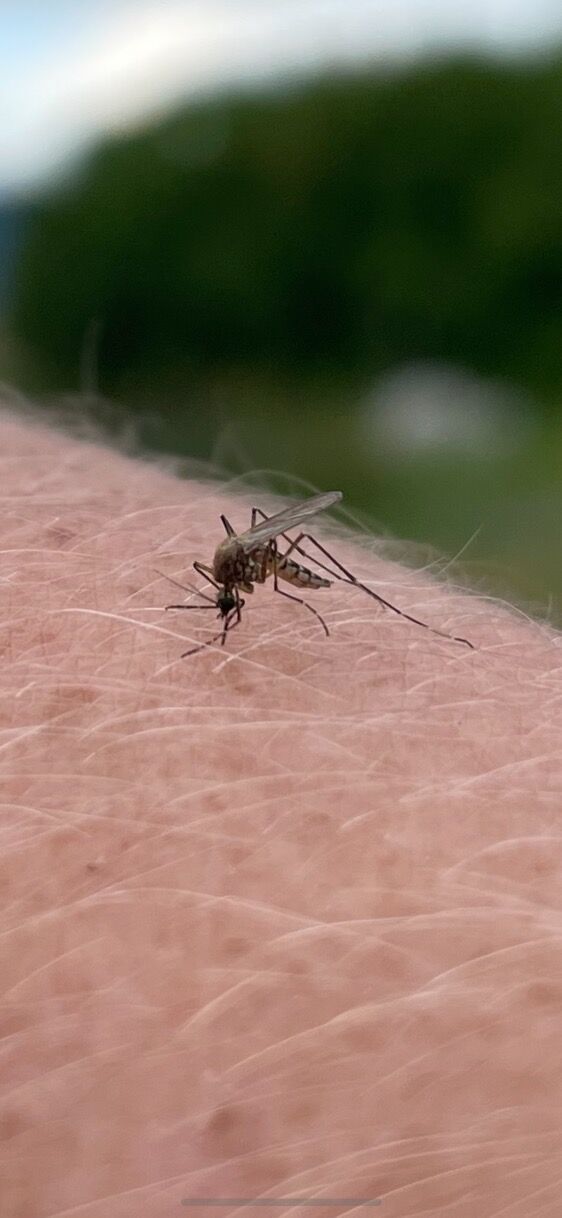


Three things are inevitable in Montana summers: sunshine, lasting memories and mosquito bites.
Mosquitoes are especially prevalent in Jefferson County this time of year – so much so that, in Boulder, an independently funded mosquito district was created specifically to keep the pests under control.
Jill Allen, director of Jefferson County Mosquito District #1 for six years and Jefferson County Noxious Weed Coordinator for 13 years, said the area around Boulder is the perfect breeding ground for mosquitoes due to the many bodies of water and flood irrigated fields – and this year has been one of the worst for the winged fiends due to the persistent, heavy rainfall.
So much so that Boulder resident Marianne Cragen dubbed the city the “mosquito capital of the world” in a Facebook thread discussing methods to attract natural mosquito predators.
Another staple this time of year is the insecticide fogger, which winds its way through the streets of Boulder on warm summer evenings coating grass, trees and shrubs with a contact insecticide.
Once sprayed, the insecticide can travel up to 300 feet, contacting and killing mosquitoes. This tactic, however, isn’t as simple as just driving and spraying. Fogging can only take place on nearly windless days when the temperature remains above 65 degrees Fahrenheit throughout the day, Allen said, adding that the district plans its fogging around local events.
And it’s not cheap either.
Each run with the mobile fogger requires about $500 in insecticide, a bill that doesn’t include fuel and labor to travel the nearly 60-mile route.
“It’s a very costly effort,” Allen said, adding it is taxpayer funded.
Allen acknowledged that some residents have concerns about effects fogging may have on their health, and that the district exercises precaution to help mitigate them.
“The label is the law,” Allen said, explaining that the product dictates approximately 72 hours between each use. She also cautioned residents to remove themselves from the area when they see the fogger rolling past; however, she said it’s all too common to see children riding their bikes behind the fogger.
Regardless of concerns, Allen said the Mosquito District is mandated by the Montana Department of Public Health and Human Services and is required to fog to prevent the spread of mosquito-borne diseases.
According to the U.S. Center for Disease Control, mosquitoes can transmit Zika, West Nile, Chikungunya, dengue and malaria; however, Allen explained that Montana’s summer season is too short and too cold for these viruses.
West Nile virus is the only mosquito-borne disease recorded in Jefferson County, Allen said, adding that the very few cases were reported prior to her taking over as director. The risk of mosquitoes transmitting West Nile will increase as the temperature rises and mosquito populations grow in the late summer weeks.
Some residents have suggested taking a chemical-free approach to mosquito mitigation by installing bat houses around town.
“How many mosquitoes would a bat have to eat in order to make an impact on mosquito control,” Allen questioned, adding that bat houses have been installed on sheep sheds on SkyTop Ranch.
The mobile fogger is only one of the mitigation efforts organized by the Mosquito District, others include “dipping” to check larvae stages in local bodies of water, aerial fogging, barrier treatments at high traffic areas, and mosquito traps – which lead mosquitoes into a net using the main substance they’re attracted to: carbon dioxide.
Once captured, the mosquitoes are transported to Carroll College to be counted and tested to identify their species and any diseases they may carry. This testing will also help Allen and her crew determine the path that the mosquitoes have traveled, which uncovers the more important question of where they’re hatching.
Information obtained early in the season showed that mosquitoes were initially hatching within city limits – a result of unmowed lawns and items left outside to retain water.
“Everybody has a responsibility to address and defend their own space,” Allen said. “It’s a community effort.”
Residential mitigation can be done in three categories: Drain, dress and defend.
It only takes a tablespoon of water, Allen said, for a mosquito to lay its eggs. Just four days later, those eggs hatch and grow into their despised adult stage.
Eliminating retained water in old tires, recycling containers, pet drinking dishes, bird baths and other puddle-collecting items is the first step, according to a Mosquito Prevention and Protection document from the Mosquito District.
“Even the smallest of containers that can collect water can breed hundreds to thousands of mosquitoes,” reads the document. “They don’t need much water to lay their eggs.”
After eliminating unusual mosquito breeding grounds, mother nature will still preside and mosquitoes will hatch in ponds, lakes and other natural bodies of water. When this happens, it’s up to residents to defend themselves from potential mosquito bites by dressing appropriately and using mosquito repellent.
Residents can reduce their appeal to mosquitoes by wearing light-colored, loose fitting clothes. Allen added that clothing infused with insect repellent is available.
The Jefferson County Mosquito District, Allen said, uses many of the same tactics as other districts throughout the state and are continually working alongside others to stay informed on new methods of mosquito mitigation.
Since taking on the role of Mosquito District Director, Allen said she’s learned a lot. Namely that mitigating mosquitoes is a complex task that requires a knowledge of their biology and a strategic approach.
In addition to the mosquito district’s mitigation strategies, Jefferson County locals have developed some of their own tactics to prevent and treat mosquito bites. Below you’ll find some of the methods shared with the Monitor via Facebook:
Prevention Tactics
For those living outside of the two active mosquito districts in Jefferson County – Whitehall and Boulder being the only active ones – applying a residential insecticide using a hand-held sprayer can knock down the mosquito population.
Paige Seitz, a Boulder resident, recommended Vets Best Yard Spray, an all-natural solution in. Seitz also suggested residents make a homemade bug spray using lavender and lemongrass.
Fellow Boulder residents Heidi Oetken and Sandra Sample also suggested unconventional mosquito mitigation products.
“Listerine (blue or green) sprayed around an area will help repel them,” Oetken said. “Apple cider vinegar and equal parts water will do the same.”
Meanwhile, Sample said she had heard that using garlic barrier spray during a period of two dry days will reduce the mosquito population near homes.
Jennifer Haight of East Helena explained that her mosquito mitigation efforts include hanging two patio eggs – which diffuse mosquito repellent 24/7 – and using Repel bug repellent when working outdoors.
For farmers or residents with water troughs breeding mosquitoes on their properties, Carla Gust Nordlinder of Whitehall suggested treating the troughs with non-toxic discs available at local hardware stores.
The most common mosquito mitigation strategies suggested by locals, however, was attracting natural mosquito predators.
“I think bat boxes would be great all over town,” Seitz said.
Bill Hagman recommended hanging nest boxes under roof overhangs to attract birds.
“Swallow thin them to where they are tolerable,” Hagman said.
Mechele Anderson of Boulder noted that dragonflies eat mosquitoes, but questioned what plants would attract them.
Conner McCauley, an insect enthusiast with a Natural Resources degree and ties to the Boulder community, explained that dragonflies eat both larvae and adult mosquitoes with a surprising 97% success rate when hunting in the air.
“They are one of the most efficient predators there is,” McCauley told The Monitor.
The ideal dragonfly habitat, according to McCauley, includes a slow moving body of water or an area of water that resists the current.
“They need [a] spot to lay their eggs and to hunt when they’re in their larval stage,” he explained.
LaDana Hintz told Facebook users that planting black-eyed susans will attract dragonflies as well. Seitz added that she planned to plant yarrow and coneflowers on her property to draw in the mosquito defenders.
Bite Treatments
Despite their many prevention tactics, locals still pointed out the need for having treatment methods on hand.
“We keep neosporin with us at all times,” Brandy Rintamaki said. “Rub a little on the bite and itch goes away. My kids are allergic, so they swell up if we don’t have it.”
Tate Thierault also recommended a homemade anti-itch treatment, which consists of just one tablespoon of baking soda and enough water to create an applicable paste.