
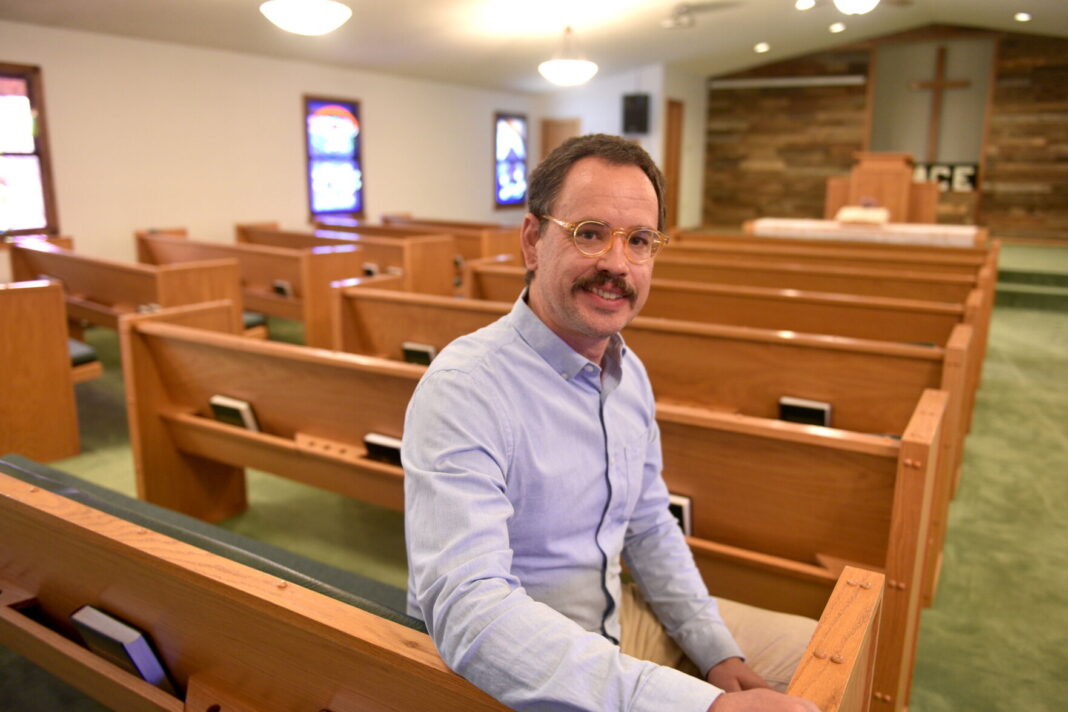
This is a story about faith. About faith in God, and also faith in community. And about how and where the two meet.
Grace Church, the Baptist congregation in Boulder, is trying to keep itself above the waterline. In the last few years, its membership has dropped from 50 to around 10 — a staggering number, even at a time when participation in formal religion is declining nearly everywhere. Its pastor, Matthew Wilson, and his congregants are wrestling with what that means, and with how they might better engage a community that itself is in flux.
I first learned of this effort when I received a survey from Grace in January. The church was trying to understand how it was perceived in Boulder.
“It was interesting,” Wilson says. “We asked about the church’s reputation, and the main thing we got was that people have heard good things about us, but we’re viewed as a dwindling congregation and disconnected from the community.”
“Anytime you hear things like that, you need to understand what people are saying — and also understand the context.”
* * *
Grace Church was founded in about 1971 as the First Baptist Church. As Lester Vossler tells it, his family had moved to Boulder from Circle, in northeast Montana, and his mother Adeline wasn’t happy with the lack of a Baptist church in town. She got to know Bucky Smith, a Southern Baptist church “planter” in Butte. At first, according to her daughter Lottie, the congregation met in the Vossler home; then, they found a spot on land owned by Mylo Fadness.
The new church rose over the course of several years. For a time, the congregation worshipped in the basement. Then, the group convinced John Cook to become its first pastor. Cook was an effective organizer, marshaling resources to get the building finished. Fueled by one fundraiser after another and by volunteer labor — church groups from Tennessee and Louisiana, among other places, visited Montana to pitch in — the new church opened around 1984.
Vossler himself crafted the pews. They’re beautiful, and they still line the church, but they’re mostly empty on Sundays. “This church was started,” he says, “to draw others to Christ. Churches unite people; you can do that as a congregation. Now, that’s all going away. Maybe it’s just a cycle. I don’t know.”
* * *
“Boulder is a hard community to penetrate,” Wilson observes, “whether reaching them with the Gospel or helping them in other ways.” Rural places can be like that, attracting folks who want to be apart. His predecessor in Boulder warned: “It’s tight-knit, but disconnected.”
For some, that disconnectedness has been intensified by increasing political polarization. “We hope to be a uniting force, but especially in the last few years, there’s been such division in our society. It’s very much, this is my truth, or you’ll be cast out. There’s no tolerance for disagreement. I see that as a risk for Christians, as well.”
And so, people have pulled back from engaging, on many levels. Civic organizations that long provided the glue — and a lot of the sweat — for our community struggle these days to find volunteers. Jeffco Food Share, which operates a monthly food bank, plans to close its doors at year-end, in part for lack of people to do the work, but also because far fewer people are using the service.
“There’s a stigma to asking for help here,” Wilson says. And that’s a challenge: For a church to serve its community, the community has to want to be served.
A similar isolationist tension has animated the Grace congregation, he says. Historically, some folks have been wary of what they see as the sinfulness of the secular world. They have decried the weakening of traditional social values, and have stigmatized a culture that they believe is leading people away from God.
“There’s a sense that if we go out into society, we’ll get infected [by sin] and be less clean,” Wilson says. “But the Bible says to walk with people. Jesus went to tax collectors and prostitutes: he wasn’t afraid of getting his hands dirty. The church needs to be engaged in the community and society.”
“Do we just sit here and talk about the culture, or do we go out into culture and be salt?”
* * *
The decline of organized Christianity in America has been well documented. The median worship attendance across U.S. congregations declined by more than half between 2000 and 2020, to just 65 persons, according to the Faith Communities Today survey. As of two years ago, 30% of Christians said they didn’t affiliate with any church, up from 5% in the 1970s.
For some — especially young people, those who are single, and self-identified political liberals — the pandemic accelerated this exodus. About a quarter of Americans reported not going to worship services at all before 2020, according to the AEI Survey on American Life. That increased to 33% by the spring of 2022.
Why? The causes are complex, but basically, “what we’d done before isn’t working,” Bob Smietana, a national reporter at Religion News Service, told the Evangelical Press Association’s annual conference, which I attended.
Churches in rural areas and small towns are especially at risk, the Faith Communities Today survey reported.
The demographics of Boulder are consistent with that national trend: Just 23% of area people surveyed agreed completely that they went to church regularly. And as Wilson points out, some active worshippers have moved to larger churches in surrounding communities; Baptist congregations in Helena, he says, are growing.
“That says something, as well — that we’re not seeing revitalization here.”
How to confront that? For now, Grace Church is taking small steps — hoping to show the community that it’s here and eager to serve, no strings attached. An open and generous presence in Boulder, Wilson believes, can create a foundation for engagement that, over time, spawns more active faith, and with that a more vital church.
During the Boulder Community Wide Garage-Yard Sales a few weeks back, Grace’s members staffed a table offering free clothes. No prayers, no evangelizing, and no shame; just clothing. Wilson was surprised by the number of takers: “Simple things Iike that are important.”
And through the end of this month, Grace is hosting “Christianity Explored,” a series of informal Wednesday evening dinners and conversations about faith. The idea is to meet people where they are, supporting their spiritual journeys without being confrontational.
It’s a simple, straightforward approach. “We’re not trying to become hip or cool.” Wilson says. “We’re not going to put in a coffee bar. It’s just about being out there, and about trying to fill a void that we believe God has put in our soul for himself.”
I think that’s a good start, and I hope it works. Churches are an important part of the fabric of small towns, and it would be tragic for Boulder to lose more.
At least as much as that, Grace’s struggle is Boulder’s. Can we relearn how to engage with each other? How to see each other with tolerance and love? As Vossler says, “God created the world so that people could come together.” This is the moment for us to go into the world and get our hands dirty. To find and celebrate connection. To be salt.