


When Krista Mark Weis opened her property assessment notice from the Department of Revenue two weeks ago, she found that the state’s valuation of her Clancy home had increased by 50% from two years ago.
Megan and Edward Boyd’s Montana City home, which they built last year at a cost of $900,000, had been assessed at $1.2 million, indicating an annual tax bill of $10,215. Holly Matkin’s house between Jefferson City and Corbin was valued at 37% higher than in 2021.
In Boulder, Sue Pasini’s assessment was up $80,000, indicating a 60% tax increase. Those living on fixed incomes and also facing inflation for many consumer goods, she said, “are being hit right and left.”
If you own property, you should have received a classification and appraisal notice recently. If you did, and if that property is in Jefferson County or the many other places in western Montana where housing markets have soared, chances are your assessment went up. By a lot.
“Everyone has sticker shock,” says Jefferson County Clerk and Recorder Ginger Kunz.
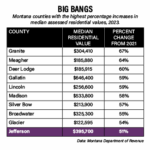
Government officials say that this year’s assessment hikes are historically unprecedented. Across Jefferson County, the median residential property increased in value by 51%, according to the Revenue Department, to $395,700 this year from $262,800 in 2021. For perspective, median property tax in the county went up by 30% total in the 10 years ending 2019.
Commercial property owners generally experienced more modest increases, with a median change of 31% from 2021, to $304,300.
Local officials have been busy trying to respond. Jefferson County Treasurer Terri Kunz said her office has been fielding 25 to 30 calls a day from confused, anxious and/or angry residents.
What she and others have been telling callers: Yes, the assessments are for real. They’re mostly a function of rapidly escalating home prices. But actual taxes probably won’t go up by as much as the notices suggest.
The Department of Revenue has scheduled a public meeting on July 12 at the Jefferson County Fairgrounds to explain their calculations and the process behind them. But basically, properties are reappraised by the state every two years; this year’s notices are meant to reflect the change in value between Jan. 1, 2020 and Jan. 1, 2022.
Sally Keener, the Revenue Department’s lead appraiser for Jefferson County, as well as for Madison and Park Counties, said that appraisers use exterior inspections and household surveys to make sure each property description is accurate – that their records reflect the right number of bedrooms, say, or the right heating system.
Then, they look at recent sales of comparable homes. “The closer a [recently sold] home is to yours, the more relevant the pricing information,” Keener said. In Montana City, for example, prices for homes on the west side of Interstate 15 behave differently than do those to the east — which in turn differ from those in Clancy or Jefferson City. Houses in one neighborhood may be a lot more expensive than those just a mile away.
The upshot: Assessments are more likely to jump in communities where there has been strong demand for homes, and more sales activity. In fact, increases this year have tended to be higher in the county’s northern communities, where residents say their valuations have been driven by new construction of large homes, or by sales of existing homes to new residents at higher prices.
Patti and Tom Russ have lived in a house on two wooded acres on McClellan Creek Road since 1987, with a wilderness management area in Clancy; they also own a nearby agricultural property that’s used for ranching, with a building they rent out.
Across from that ranch house, the Russes say, a property was recently sold in seven parcels, each priced between $350,000 and $400,000.
“That’s just the land,” Patti Russ said. “Those are all going to be multi-million dollar homes.
The apparent result: The assessment on the Russ’ residential property increased 52%, to $466,000. The ranch property also went up, but by a more modest 26%.
“I understand how this happened,” Patti Russ said, echoing an observation made by other county residents. “It’s a domino thing. Ag land gets turned into housing for wealthy people from out of state. And their prices drive up ours.”
The actual tax impact of assessment increases will be determined by a complex patchwork of laws and budgeting approaches.
Most municipal taxes, including those levied by Jefferson County and the City of Boulder, won’t go up. State law limits increases in local government expenditures to one-half the rate of inflation over the previous three years. (Efforts to amend that in the last legislative session failed.)
As a result, said County Commissioner Bob Mullen, the county’s total levied appropriations for the 2023-24 budget year, starting Sept. 1, will be close to the $16.4 million of the current fiscal year. The county will adjust its mill rates — the percentages applied to property values to adjust for this year’s higher assessments. “If property valuations double, then our mills should be cut in half”, Mullen said. The total county non-voted mill levy for 2022-23 was 204.35.
The statutory limit on levy increases applies broadly, including to weed and mosquito districts, road and bridge maintenance, libraries, and public safety, according to Ginger Kunz. It does not apply to voted levies, or to fees charged to users — such as those imposed by the Jefferson Valley Rural Ambulance District.
It also does not apply to statewide levies that support Montana’s university system and equitable funding for lower-income school districts. Those levies, which are fixed at a total of 101 mills, will result in higher taxes for those with higher assessments, according to Terri Kunz.
Local school districts, which in Jefferson County account for between 45% and 71% of total property taxes also are exempt from the levy limitation. But their core budgets are set by the state Office of Public Instruction, based primarily on the number of students they serve — with little variation from year to year.
“Those assessments may have gone up, but we’re pretty stuck with that [OPS-stipulated] amount,” says Erik Wilkerson, superintendent of Jefferson High School. He expects that, as with municipalities, school districts will lower their mill rates for the next budget year. Schools do have the option of seeking permissive levies, but those must be approved by voters.
The assessment surge is playing out just as a new property tax rebate comes into effect. As a result of legislation passed this year to give back a state budget surplus, homeowners can receive up to $675 for taxes paid on a principal Montana residence in 2022 and 2023. Residents must apply for the rebate via the state’s TransAction Portal, or with a paper form, starting Aug. 15.
Representatives from the Montana Department of Revenue will hold public meetings geared to help taxpayers understand the property assessment process on July 12, 5 to 8 p.m., at the Jefferson County Fairgrounds; and on July 18, 5 to 8 p.m., at the Whitehall City Courtroom. For information, go to https://mtrevenue.gov/property/. For an illustrated explanation of how property taxes work in Montana, see this Montana Free Press article.