
Nancy Alley of the Heritage Center has her own history to share, and it’s now on display.
For 13 years – from 1983 to 1996 – Alley lived in the Inupiat community of Barrow, Alaska, the furthest north point of the North American continent, and one of the oldest permanent settlements in the United States.
Barrow is located in the North Slope Borough (similar to a county), the largest municipality in the U.S. (95,000 square miles).
It was family that brought Alley to Barrow, as she had a cousin there who managed a grocery store, where Alley worked her first year and a half in Barrow.
From the get go Alley said the the Iñupiaq people (most commonly known as Alaskan Inuit) fascinated her, as did being a minority for once in her life. In Barrow, Alley was a minority, as 64% of those who live in the area are native. There is a bit of a language barrier, she said, as many in the area still speak Inupiatun.
This sometimes posed a challenge while Alley worked in the accounting office for the health department.
Alley said she enjoyed the small-town aspect of Barrow, but there were a lot of challenges that went beyond the cultural differences.
“It was pretty cold there,” Alley said. “The record cold was around 56 below. It’s been that cold here, too, but the winter lasts longer.”
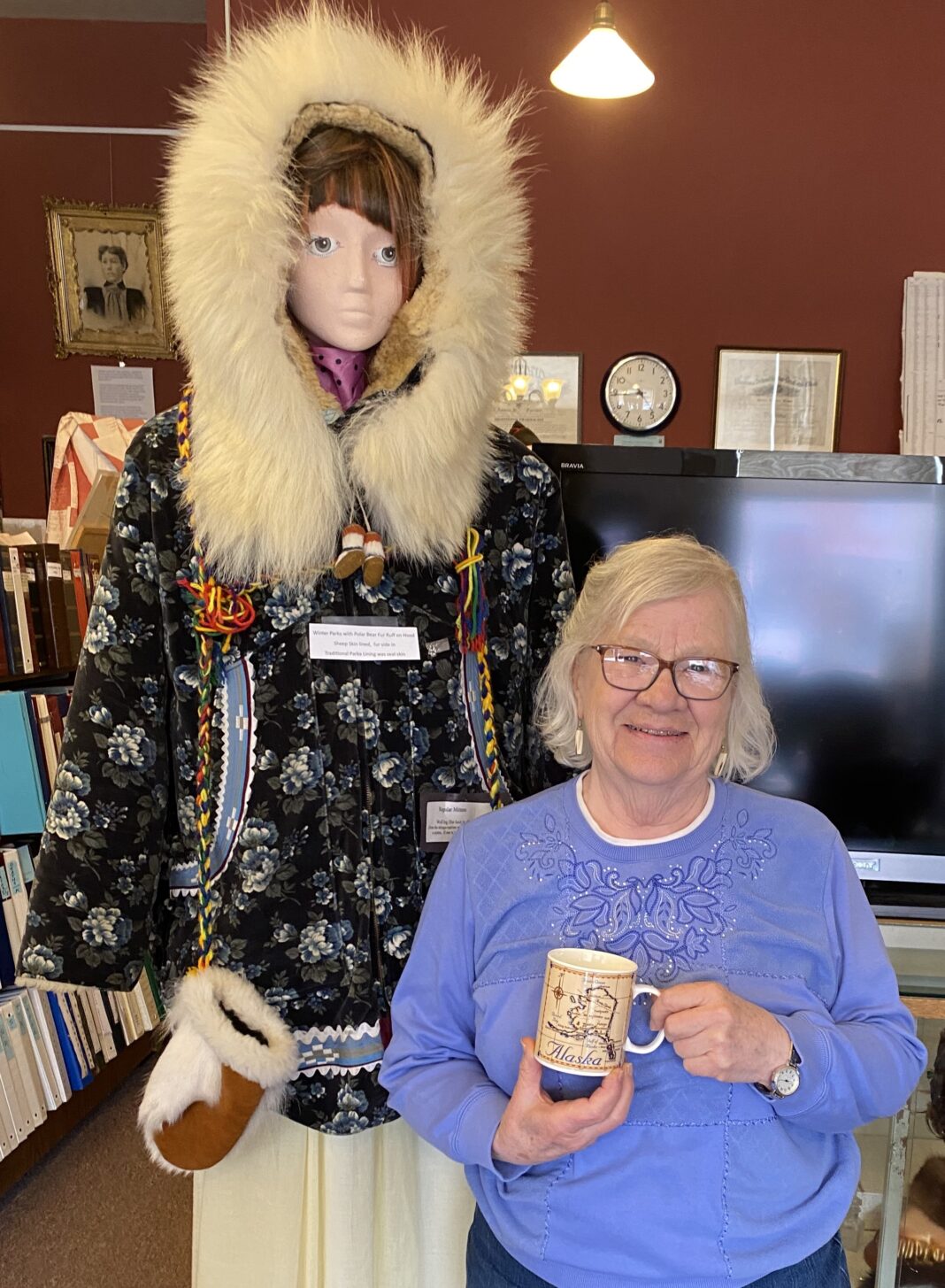
Fortunately, Alley made a parka that kept her warm. It’s now part of the exhibit at the Heritage Center. She stayed comfortable, she said, although she admits polar bear fur “isn’t real soft.” However, the advantage of polar bear skin, she said, is that the frost doesn’t stick to it.
“You can pull it down around your face and stay warm,” she said.
To add comfort, Alley lined the hood with sheep skin. The parka itself is lined with seal skin.
Alley also made mittens out of wolf fur, which she kept on strings. This was a necessity, she said, because “if you lost your mitten, you probably lost your hand.”
“Even men who went out hunting kept mittens on a string,” she said. “Also, men’s winter parkas are big enough of them to pull their arms inside out of the sleeves to keep them warm.”
Other items on display from Alley’s days in Alaska include a kuspuk she made, a traditional shirt worn by Alaska natives, often called a snow shirt. The display also features items made from walrus tusks, an ulu (knife) and a baleen plate from the mouth of a bowhead whale, one of the largest toothless whales in the ocean, which spend much of the spring and summer feeding along the arctic coast of Alaska. Eskimos have hunted and eaten them for centuries.
Baleen has many uses, Alley said, adding that there are some woven baskets in her display made from the baleen. “You can break it down real fine,” she said.
Alley said she looks back fondly on her time Barrow, despite the challenges of living there. For example, Alley said the days were long in the summer and practically non-existent in the winter.
“There are three months in the summer with no sunset and three months in the winter with no sunrise,” she said. “You get used to it, but it’s a little unusual.”
The lack of sunset was especially unusual for visitors. Alley has one fond memory of her grandson, Jeremy, taking advantage of the long days.
“Jeremy was not going to go to bed until it got dark,” she said. “We had to tell him, ‘oh, yes you will.’”
Other challenges included inflation and travel. Food and other goods at the grocery store – as well as other important resources – were flown into Barrow, as there’s no road to Barrow. This created high export prices. Milk, for example, was $10 per gallon. And getting out of Barrow was only possible by plane.
Those interested in seeing the display can visit the Heritage Center at 210 North Main Street seven days a week from 11 a.m. to 4 p.m.