
I am what is often referred to as a cradle Episcopalian. That is to say, I was born into a family that was Episcopalian, was baptized, confirmed, served as an acolyte and sang in choir, and eventually was ordained, the whole of my life having worshipped in the Episcopal faith.
The Episcopal Church is part of the larger worldwide Anglican Communion, with branches all over the world. We trace our heritage back to the Church of England, and share our fundamentals of faith with those of the Archbishop of Canterbury. We are Anglo Catholics, as opposed to the common Catholic moniker which really represents those who are Roman Catholic. We all claim to live out the traditions of the one Holy Catholic and Apostolic Church.
Most of my study and discernment about my spiritual life has been in the context of the Christian Faith. Salvation comes through Jesus Christ; within the confines of the Christian belief, there is no other path. How then, do I reconcile all the countless millions of just and upright people who are not Christian? Are they doomed to a life outside of salvation because they were born cradle Muslims, or cradle Buddhists, or cradle Jews? As the modern Christian church seems to lose relevance for so many today, what about the eternal future of those who fall away and have no specific belief system? Is there no path for all of these if “Jesus is the only way?”
A classic conundrum for Christians is the question, “Can Mahatma Ghandi be saved?” Ghandi was an Indian lawyer, anti-colonial nationalist, and political ethicist who employed nonviolent resistance to lead the successful campaign for India’s independence from British rule. He inspired movements for civil rights and freedom across the world. Assuming leadership of the Indian National Congress in 1921, Gandhi led nationwide campaigns for easing poverty, expanding women’s rights, building religious and ethnic amity, ending untouchability, and, above all, achieving swaraj or self-rule.
While attempting to do all of this through non-violent means, Ghandi was Hindu, not Christian. Had he been Christian, the Christian church might revere him today in a way similar to its celebration of Mother Teresa or Martin Luther King, Jr.
So can Ghandi be saved?
Over the years I have wrestled with this and come to the conclusion that yes, I hope and pray that Ghandi has been saved. My Christian faith tells me that I only know one path to salvation, and that is through Jesus Christ. But just because that is the only path I know, and therefore the path I live, study, teach, share and believe, I cannot rule out that there are other paths, or, for that matter, other ways that Jesus reaches people besides the “Christian” faith. After all, God is infinite, so how can I justify limiting salvation?
Throughout my life, exposure to Native American culture and beliefs has very much influenced my practice of faith. Having lived in Arizona, Oregon and Montana, this was not difficult. In many instances, I found a blending of Native American spirituality within the Episcopal church. I personally knew the first Navajo tribal member to become an Episcopal Priest. My own priest at my church in Arizona served on a special commission years ago to help resolve disputes between Hopi and Navajo peoples over land use. A favorite place for my wife and I to go in Oregon was Kah-Nee-Ta, the resort owned by the Confederated Tribes of Warm Springs in central Oregon. We loved experiencing the tribal culture.
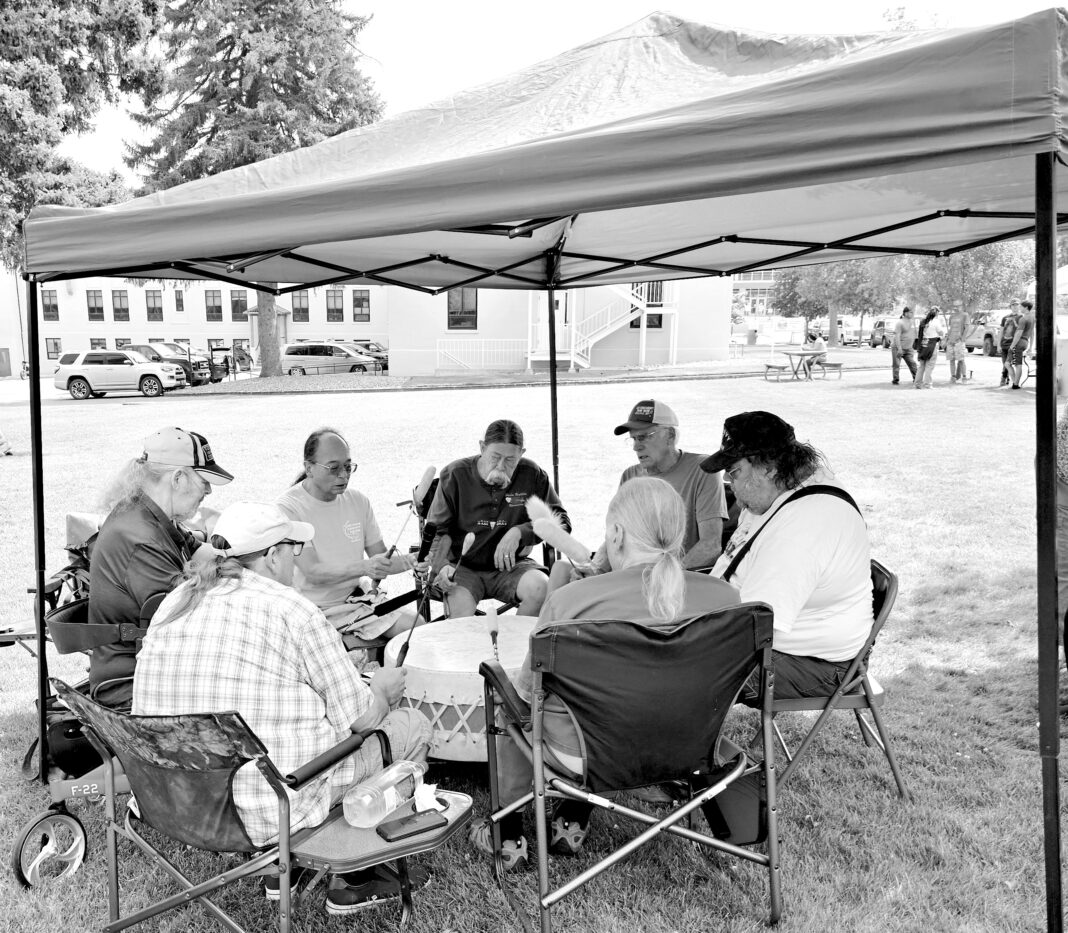
But the most profound experience of Native spirituality has been since coming to Montana, and experiencing worship within the Togendowagan Society. Togendowagan is a Lenape word for “awakening.” The Togendowagan Society is an inter-tribal “Spirit Society,” comprised of both Native and non-Native traditions and persons, journeying together to Creator. Its ceremonies incorporate many traditional Native spiritual practices such as smudging, the Honor Circle, sharing of Sacred Stories, the Burden Bundle, and the Pipe Ceremony. All of this is combined with the music of the Sacred Drum that is the heartbeat of the Community.
The Society meets at St. Peter’s Episcopal Cathedral in Helena on the second and fourth Saturdays of October through May at 5:30 p.m. for Prayer Circle and Holy Eucharist followed by a community meal. My wife and I have come to attend this service regularly, even in preference to our more traditional Episcopal services offered on Sundays. The haunting music of the Sacred Drum is offered at each service by the Magpie Singers.
All this is to say that I have come to believe faith and spirituality are more than what I grew up knowing within my own limited church tradition. There wasn’t necessarily anything wrong with what I learned. I just think it was too limiting. God (Creator) is more, and in the course of a lifetime there is always more to learn and experience of God’s creation, wisdom, love, teaching and spiritual nature, and part of that goes beyond traditional Christian teachings. And I feel enriched because of that. There is just so much out there.
So as we move through life and encounter other faith traditions, whether Muslim, Hindu, Buddhist, Jewish, Native American or any number of others, it may be that we can learn something that will help us better understand who we are, what we believe, and how to live better as spiritual people in this created order.
Perhaps that is what Creator has always intended.
Roger Reynolds is a retired engineer living outside Jefferson City. He is also an ordained deacon in the Episcopal Church.


