At its Sept. 11 meeting, the Montana City School board heard from Superintendent Tony Kloker about an unusual discovery in the school’s budget.
Under Montana law, public schools receive guaranteed tax base (GTB) funding from the state, calculated via a complex set of formulas and calculations. If funds from the state do not meet operational budget requirements, schools are allowed to request a local tax increase to make up the shortfalls.
During a routine comparison of expected revenues for the 2023-24 General Fund Budget last fall, Kloker told the board, school officials noticed that GTB revenue received from the state was $91,380 less than in the previous year.
“This resulted in an increase in local taxes to make up the difference due to the GTB formulas that were changed in the 2023 legislative session,” Kloker told The Monitor. As a result, Montana City taxpayers ponied up $91,957.70 more than the year before.
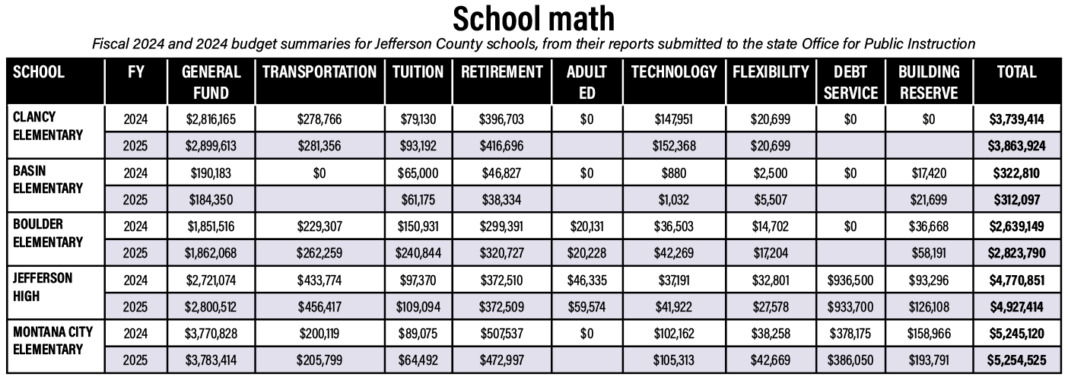
When the budgeting process began for the current school year this spring, though, school administrators got another surprise: An unexpected $89,937 had been placed in the school’s debt service fund account.
Kloker noticed the similarities in the numbers. “This amount is close to what we lost from the state in GTB going toward the general fund,” Kloker said. “But it is limited to only pay on the bond principal and interest for our building project approved by the voters in the 2012 bond issue election.” Which means the money cannot be used for school operations.
That presents Montana City School with a dilemma: It raised local taxes to match the reduction in general fund revenue — but the school did not actually receive less money from the state. The GTB funding, it seems, was simply reallocated to a more specific-use fund.
“We are still in the process of determining if there is a correlation between receiving less in our general fund and an extra amount in the debt service fund,” Kloker said.
It turns out, other county elementary schools have experienced changes in their GTB revenues, too. Clancy Schools saw a $54,807 reduction. “This is due to language from the last legislative session,” Superintendent Daryl Mikesell explained. “The general fund is calculated through a funding formula to determine a set dollar amount. If there is a deficit by the state, the local taxpayers are assessed the difference in the form of increased county taxes.
Boulder Elementary, on the other hand, received an $65,995 increase in fiscal year 2024 from the previous year. Boulder Superintendent Dave Selvig confirmed that the school got an additional $26,492 boost to its General Fund in fiscal year 2025.
The question is, why?
Brian O’Leary, a spokesperson for the state Office for Public Instruction, which manages the state allocations to schools, said the changes are related to the property reassessments that took place last year, which produced big swings in valuations.
“It appears that because of the increase in property valuation in Montana City, which led to an increase in property taxes, the guarantee tax base aid from the state decreased,” O’Leary said in an email. “The guaranteed tax base dollars act as an equalization of funds across the state.”
O’Leary pointed out that Montana City Schools actually received more dollars between the two fiscal years in question.
Which leaves the Montana City School board left with the question of what to do with the “extra” money that has been discovered. The options discussed at its Sept. 11 meeting included using the funds to pay down the debt on the school building, as was apparently intended by the state;returning the money to local taxpayers as a rebate.
The board agreed to continue discussions at future meetings.