
Last year, roughly 116,000 acres in Montana burned in wildfires. While this was significantly less than the 1.1 million acres scorched in 2017, which was the most severe wildfire season in recent memory, the unpredictability and potential impact of the state’s wildfire season has left communities and property owners struggling to acquire affordable homeowners insurance.
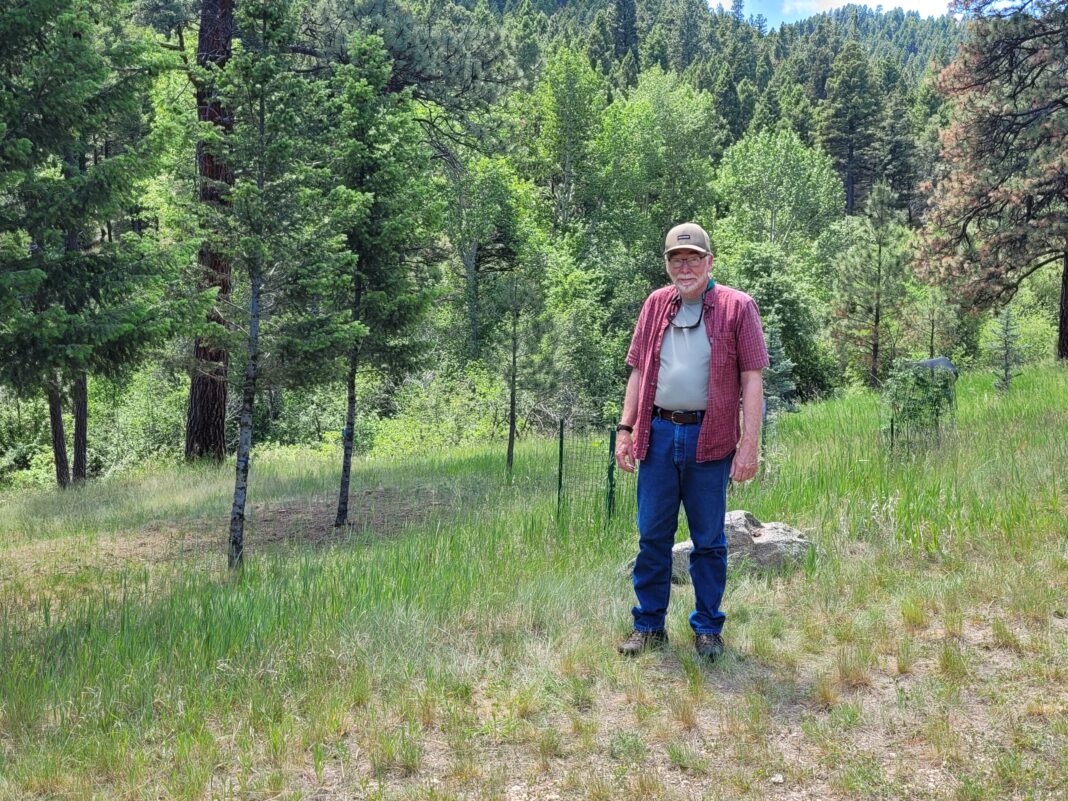
In the face of an insurance industry ever more reluctant to provide coverage to those living in elevated risk areas, soaring premium costs state-wide, and the increasingly visible impacts of climate change on Montana weather patterns and wildfire behavior, some, like Clancy resident Jeff Chaffee, are taking measures to lower their property’s fire risk profile and improve the insurability of their homes.
With assistance from the Tri-County Firesafe Working Group (TCFWG), a private organization dedicated to preparing Jefferson, Lewis & Clark, and Broadwater Counties for wildfire season, Chaffee arranged for his property to receive a fire mitigation plan, a tailored program that aims to identify natural and man-made fire risks and outline the interventions necessary to reduce or eliminate them. Through grants from the U.S. Bureau of Land Management, the state Department of Natural Resources, and the American Rescue Plan Act, TCFWG is significantly reducing the financial burden homeowners face in protecting their properties from wildfire.
“While we haven’t been given any indication that we’re at risk of losing our policy, this [the fire mitigation plan] sets us up nicely to argue that we are insurable, should need arise,” said Chaffee, who, after himself experiencing incremental insurance cost rises over the course of several years, pursued fire mitigation after attending an informative meeting hosted by TCFWG. “There are increasing [insurance] costs all over the west; we can see the storm clouds on the horizon. We’re trying to get ahead of what I think are big problems our communities are facing, and will continue to face.”
Chaffee approached TCFWG this spring and arranged for his property to receive a free wildfire risk assessment, which determines a home’s ignition risk and is the first step of a fire mitigation plan. The assessment evaluates a 200-foot zone around the residence, driveway, and other significant structures over the course of a month, and identifies risks such as fast-burning trees and foliage, vulnerable construction elements like attached decks, flammable wood types, debris-collecting gutters, and single-pane windows, which are prone to breaking in wildfire conditions, and whether or not fire department personnel can easily identify and access the property should a fire emerge.
“Most homes out here [in Jefferson County] are in vulnerable places, where fire can move fast,” said Craig Cockler, the TCFWG fuels mitigation specialist who conducted the assessment on Chaffee’s property. “You really just never know what a wildfire season will bring. Even with all the mitigation you can think of, you still have to be diligent.”
Since joining TCFWG in 2022, Cockler has conducted wildfire risk assessments on over 50 properties in Jefferson County. Cockler is also responsible for creating fuel specifications project plans, which, as the second step of the fire mitigation plan, evaluate innate ignition risk resulting from the surrounding terrain topography and exposure to fire weather.
Once both evaluations are complete, TCFWG provides the property owner with recommendations for clear, actionable steps they can take to improve fire safety, and a list of partnered vendors that can be contracted to complete the fire mitigation plan. Once a partnered vendor is selected by the homeowner and they are provided with pricing, TCFWG and the property owner normally sign a financial agreement which will allow for reimbursement of up to 75 percent of the project’s total cost.
Chaffee was reimbursed for $1800 of his $2400 mitigation plan expense. But now, having nearly depleted its current grants, TCFWG has paused project reimbursement until the fall, by which time it expects to receive additional funding.
“We are by no means discouraging applications, but until we refresh our grant funding, we’re, at this moment, only doing the assessment portion of the mitigation plans,” said TCFWG president Louis Olsen. “We’re very competitive in our grant applications, so we expect to restart reimbursement soon. But these things take time, and there’s just so much interest in Jefferson County.”
Despite a high degree of interest, and more than 50 Jefferson County residents having completed fire mitigation plans with TCFWG, the community, both those participating in TCFWG fire mitigation projects and the County more broadly, has, according to TCFWG officials, yet to see a significant impact on insurance prices. Olsen and Cockler believe this is because only individual properties complete fire mitigation plans, as opposed to contiguous neighborhoods.
“Sometimes, no matter how prepared you think you are, it’s your neighbor’s land that burns your house down,” said Cockler. “If we can get multiple landowners living in close proximity to do fire mitigation, then we can create a line of protection along their properties. That’s the only way we’d be able to lower insurance costs for a community.”
While individuals completing fire mitigation plans can improve their insurability and see a nominally positive impact on their insurance premiums, there can be no significant and broadly shared impact without community level interventions. Jefferson County encompasses over 1600 square miles, and contains over $600 million dollars worth of residential property threatened by wildfire risk, according to the 2020 TCFWG Regional Community Wildfire Protection Plan. According to the Jefferson County Pre-Disaster Mitigation Plan, the county government has completed several fire mitigation efforts since 2011, but these were largely targeted interventions along designated evacuation routes and along the borders of certain wildland-urban interfaces, which are zones of transition between wilderness and residential areas.
Most Montana fire safety organizations like TCFWG are formally affiliated with county governments, allowing for a high degree of coordination between public and private fire mitigation efforts. While TCFWG does have a formal, working relationship with Jefferson County, it is difficult for Jefferson County to involve itself in private fire mitigation plans and actively create lines of protection for neighborhoods and residents as it can only address fire risk on public lands.
“It’s difficult for the county to involve itself in private fire mitigation,” said Jefferson County Commission Chair Cory Kirsch. “We can’t force people, and wouldn’t want to. Without articulating some new policy either in zoning
or subdivision regulations, I think the insurance companies would have to get involved by saying you have to do mitigation in order to keep your policy. But for a county government to make that happen would be a big jump.” Kirsch explained that most of Jefferson County’s fire mitigation work focuses on clearing designated emergency routes of brush and debris, and also in collaborating with the Bureau of Land Management and U.S. Forest Service on clearing state and federal property that borders county lands and infrastructure.
However, some communities have managed to create stakeholder groups that pool resources to address particularly dangerous risks. For example, before the 2023 Colt Fire burned more than 7,500
acres in the Seeley Swan area, the Southwest Crown Collaborative (SWCC), a forest management and environmental conservation group operating under the U.S. Forest Service’s Collaborative Forest Landscape Restoration Program, helped coordinate public and private entities, such as local timber companies and the Seeley Lake Fire District, to complete a fire mitigation project that removed a significant volume of dry fuel from area forest floors and created breaks in tree canopies running contiguously to residential areas. SWCC, through a series of stakeholder meetings held over the course of several years since 2009 and involving recreation, environmental, conservation, and wood products industry groups, coordinated with state and local agencies to identify areas and tasks suited for collaboration on community fire mitigation efforts. While many communities have wildfire protection plans in place, as does Jefferson County, collaboration spearheaded by SWCC allowed for Seeley Lake to more vigorously implement proposed mitigation plans. According to subsequent analysis from Montana State University, this prevented the Colt Fire from impacting a significant volume of residential acreage, and, though experiencing a significant fire event, actually led to the Seeley Swan community receiving an improved fire rating, which lowered insurance premiums for residents by as much as $100.
As, according to insurance comparison firm Insurify, insurance premiums are expected to rise statewide by an average of 12 percent in 2024, and with the year’s wildfire season expected to burn thousands of additional acres, identifying potential community mitigation projects and pooling shared resources to execute them is critically important to ensuring both insurance affordability and fire safety for Jefferson County residents, say TCFWG officials.