
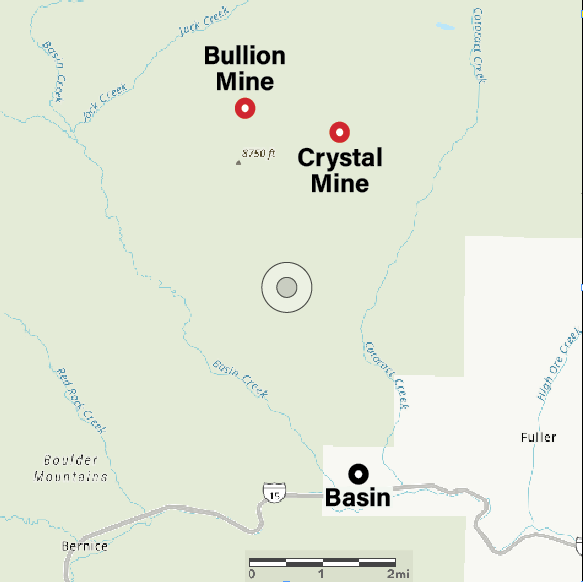
The Basin Mining Area Superfund site cleanup, already a quarter-century in the works, has been delayed by at least two years due to poor road conditions and delays in necessary preparations.
In an email to The Monitor, William Howard George, the Environmental Protection Agency’s (EPA) remedial project manager for the Basin site, stated that both mine areas being targeted for clean-up are currently inaccessible. Road construction is tentatively scheduled for next year, with cleanup expected to begin in 2026.
In March, 2023, the Basin site received $31 million for the cleanup of the Bullion Mine and the Crystal Mine areas. That funding, part of the Bipartisan Infrastructure Act, had originally set the cleanup to start in spring, 2024. The law also funded cleanups at two other mining sites in Montana.
At the time, a Montana Department of Environmental Quality spokesperson told The Monitor that the cleanup might take three to five years once started.
The Bullion and Crystal mines, located approximately 10 miles north of Basin on the north side of Jack Mountain, are currently inaccessible due to degraded road conditions, George said. Jack Creek Road, which provides access to both mines, was improved in 2015 for cleanup work but has since fallen into disrepair.
Road work is scheduled to begin in spring 2025, contingent on snow melt and finalizing road design in partnership with the U.S. Army Corps of Engineers. “EPA is working diligently to get work started and will ensure that these efforts are done safely and effectively to protect human health and the environment,” said George.
The actual cleanup process is planned to start in 2026 following the completion of road construction. The cleanup is divided into three phases — remove the hazardous substances, treat the wastewater and stabilize the mining sites back to healthy condition to prevent further environmental damage.
The actual cleanup process is set to begin in 2026 after road construction is completed. It will be divided into three phases: removing hazardous substances, treating wastewater, and stabilizing the sites to a healthy condition to prevent further environmental damage.
After removing the hazardous wastes, EPA will construct water treatment systems on both superfund sites that would filter pollutants, neutralize acids, and remove metals before releasing the water back into the environment.
Both the Bullion and Crystal mines have old tunnels that release acidic, metal-laden water into Jill Creek and Uncle Sam Gulch. The EPA’s treatment systems are geared to ensuring the water meets state quality standards, according to George.
For the last leg of the cleanups, the sites will go through separate processes. The Crystal Mine cleanup will include building a designated area as a repository to safely store the waste, removing about 85,000 cubic yards of contaminated material, and restoring Uncle Sam Gulch to a healthier and more natural state.
At the Bullion Mine, surface work will involve planting vegetation in affected areas and establishing final access controls.
Basin has a long history in hard rock mining, starting in the 1870s when Irish immigrant Michael O’Donnell located what would become known as the Katie and Hope mines. Mining continued in the area until the late 1960s. Such activity, the EPA and DEQ has determined, released such hazardous substances as arsenic, cadmium, lead, zinc, silver and copper. The Basin area was placed on the Superfund National Priorities List in 1999. Remedial designs for the cleanup of Crystal and Bullion mines were completed in 2015. Back then representatives from the EPA and the DEQ told the community to “anticipate remedial action pending availability of federal funding.”