
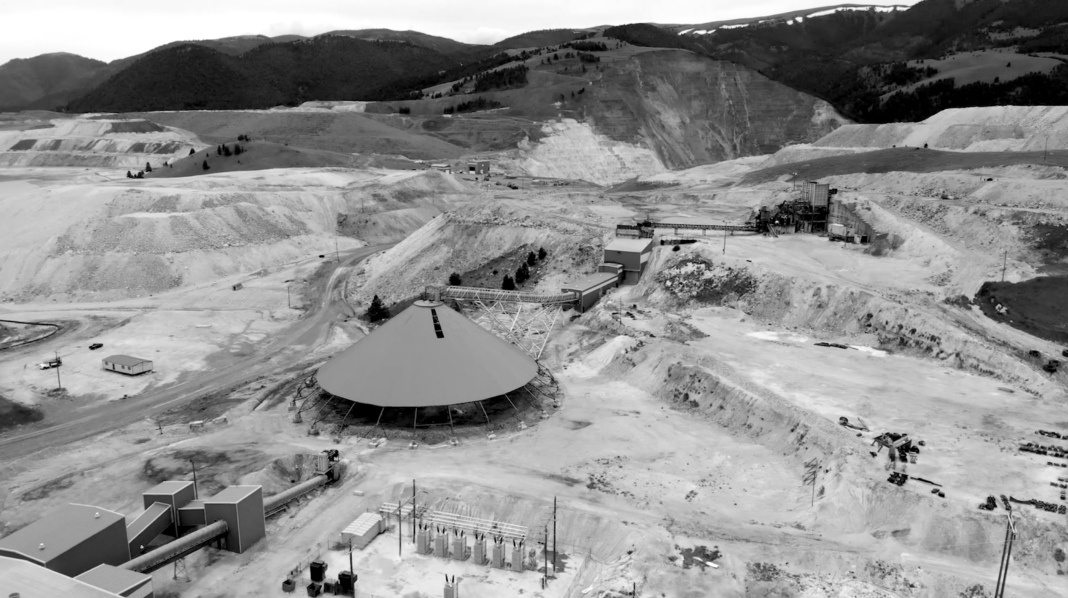
In a 2019 promotional video, Patrick Imeson, the CEO of Montana Tunnels Mining Inc., reviewed the state of play for his company’s mine outside Jefferson City. It had been inactive since 2008 — but now, he said, things were looking up. Mineral prices and capital markets were primed for a recovery. After years of delays, the company had received a permit to open a big new pit. It was preparing to scrape off the top of a hillside to get at gold, silver, lead and zinc it reckoned was worth over $1.4 billion.
“We feel really comfortable with where we’re headed at this time,” Imeson said.
Awesome! The problem was, Montana Tunnels at that moment still owed the state about $16.8 million to meet a bond meant to cover the expense of correcting potential environmental damage from its operations. As a result, the Department of Environmental Quality (DEQ) had suspended its operating permit. In July, 2021, the DEQ noted that Tunnels had failed to start in on the activities promised in its plan for reclamation.
So has gone Imeson’s magical mystery tour, on and on and on. Today, his mine remains shuttered. It has become a debacle for Jefferson County, and a bitter reminder that laws don’t always do what you’d hope.
Montana Tunnels still owes the county over $3 million in back metal mining taxes, most of which should have gone by now to Jefferson High and Clancy Elementary Schools. There’s no immediate prospect of new mining tax revenue. And the mine, which employed close to 200 workers before it closed, now has just two employees on site.
Worst of all, the environmental risk that existed in 2019, and for years before that, is still with us. A section of Clancy Creek still runs through a pipe to divert it from what may be a failing mine pit wall. The bond is now $17 million short. The reclamation work still hasn’t started — and probably won’t anytime soon.
Whose fault is this? Well, plenty of people blame Imeson — and for sure, he deserves it. “I’m well aware of the trail of broken promises” that Imeson has blazed over 15 years, noted Benjamin Hursh, the U.S. Bankruptcy Court judge who presided over Montana Tunnels’ long (and kinda gripping, if you’re into arcane legal drama) Chapter 11 proceedings.
The thing is, Imeson appears to have done nothing illegal. He has employed smart lawyers, and he has cannily navigated corporate and tax law to his benefit. Just not ours.
In December, 2022, when he couldn’t find capital to pay the larger DEQ bond that his expanding ambitions required, he steered Montana Tunnels into Chapter 11, a feature of the U.S. Bankruptcy Code that offers companies protection from creditors while they work through their problems. Under Chapter 11, Tunnels came up with a plan to repay its debts — and then, within months, abruptly halted the promised payments after a key investor apparently bailed.
And here was the critical detail: Montana Tunnels’ plan stipulated that if it were to default — that is, if it didn’t make its payments to DEQ, the county and others — “this case shall be dismissed immediately.” That is, the Chapter 11 case would go away, and Tunnels and its creditors would return to where they stood beforehand.
Lawyers for the DEQ apparently overlooked this provision or didn’t think it important — so they didn’t object in the moment. Only when Montana Tunnels, inevitably, did default did they realize that dismissal would be hugely problematic.
Why? Because in 2021, Jefferson County issued a tax lien on a crucial land parcel owned by Montana Tunnels, which included the main mine pit. Tunnels had failed to pay $6 million in property taxes. (See a pattern?) So Imeson created a new company, called Goldfields Funding Partners, to come up with the money and acquire the lien.
Side note: This is another pattern. Imeson controls many companies. Montana Tunnels is a subsidiary of Montana Goldfields, Inc., which itself is owned by Black Diamond Holdings, LLC. Two other Imeson-controlled companies, Black Diamond Acquisition Partners and Elkhorn Goldfields, Inc., are among those owed money by Tunnels. This is not illegal. But since they’re all privately held, it’s difficult to understand how they fit together — which may be the intent.
Anyway, on Aug. 3 — this Saturday — assuming that Montana Tunnels doesn’t somehow pay back the $6 million in taxes, Goldfields Funding Partners will take ownership of the mine property deed. Yes! Which is why DEQ’s lawyers tried madly, belatedly, tragi-comically, to steer the bankruptcy case into a Chapter 7 liquidation. In that scenario, DEQ and Jefferson County probably would have collected most of what was owed them. With dismissal, and with Goldfields Funding Partners, who knew?
No dice, said Judge Hursh, ruling, basically, that a deal was a deal, no backsies, and everyone had to man up and live with it. (His actual decision was considerably longer and more thoughtful than that, with many footnotes.)
What is Imeson’s plan now? I don’t know for sure, since neither he nor his attorney responded to my messages. He’s apparently stonewalling others, too: Mary Mooney, a partner in the Mooney Group, a Florida-based company that’s interested in buying the Montana Tunnels mine, says her group’s efforts to contact Imeson “unfortunately haven’t been answered. He’s seemingly uninterested in engaging.”
At Tunnels’ final bankruptcy hearing on June 5, Imeson did offer hints as to his intentions. Montana Goldfields, he said, already pays all the operating costs of the Tunnels mine — and it would continue to do so.
Imeson said he was talking to several investor groups about funding a related mining project for Elkhorn Goldfields. If that comes to pass, the resulting ore would be milled at Montana Tunnels, yielding revenue that could pay creditors. He also noted that capital markets had recently become more amenable to metals mining, and that the company “could make a filing at the current time” for an initial public offering of stock that would raise funds.
I’ll pause a moment here to allow us all to reflect on Hursh’s words: “trail of broken promises.” We’ve heard this sort of talk before.
When Montana Tunnels defaulted on its bond in January, DEQ suspended its operating permit. As a result, no company that Imeson controls can run a mine in the state of Montana — so it’s hard to see how Imeson’s plan, such as it is, can happen. (Although: A DEQ statement didn’t say that Goldfields definitively couldn’t operate the mine if it, or some other entity, paid the full bond amount. So, this may be a situation that one day tests statute.)
As for reclamation? The law gives DEQ five years to find another entity that is prepared to take over the mine’s permit. “This allows an opportunity for a successor to post adequate bond and ultimately take charge of reclamation in lieu of the state bearing the burden,” DEQ wrote in response to my question.
In other words, don’t count on fixing Clancy Creek anytime soon. Which is either a fiscally prudent decision or the state shirking responsibility – but either way, it’s the law. All of this is the law, technically correct and above board. But it’s a poor outcome for residents of Jefferson City, for schools, and for the county.