
On June 3, workers from the state Department of Transportation (DOT) and Helena Sand & Gravel began excavating sidewalks and placing traffic control signs on Main Street in Boulder — the first, long-awaited steps in what will be a months-long project to renovate the city’s central artery. Again.
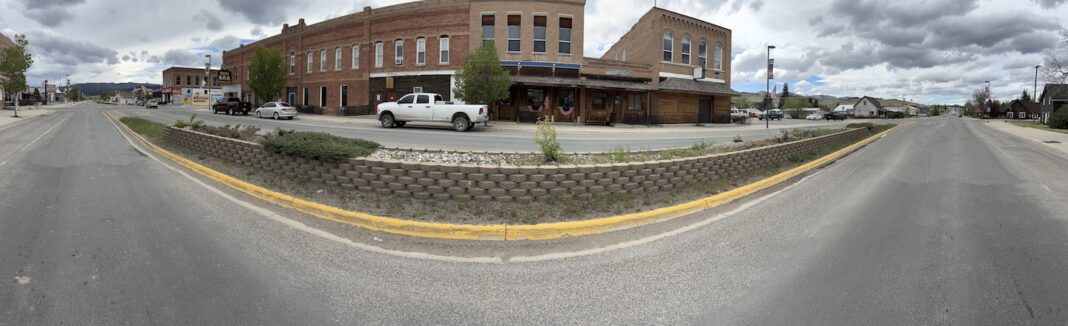
Over the next three months or so, workers will replace pavement, install new crosswalks, improve drainage, and make repairs to the Boulder River bridge. They also will dismantle the median planters, removing the most distinctive – and most contentious – feature of the design put in place 21 years ago.
Most will say, about time. Residents polled on Facebook largely welcomed the improvements, with many focused on the angled brick median beds that for two decades have been home to various forms of vegetation — currently, sawed-off juniper stumps, awaiting disposal:
If they had had water to them and could have been planted (and maintained) with more attractive shrubs and flowers, I think they would have been beautiful, but it’s the safety issue with snow removal that is the concern now. — Mechele Anderson
Happy to see them go. As someone that regularly walks Main Street & crosses with a stroller it’ll be great to not have to dash to the other side in fear of someone not being able to see us. — Chantel Lyon
As someone who worked DOT maintenance, I can tell you they are a maintenance nightmare. I sure won’t miss them. — Bruce Giulio Sr.
Boulder has never been very happy with the current iteration of its Main Street. As work began on the last upgrade, in the spring of 2003, the Transportation Department looked forward to mounting a “showcase project” — replacing boardwalks with wider sidewalks, shifting parking from angled spaces to parallel, creating discrete left-hand turn lanes, and replacing the Boulder River bridge.
And those medians: The idea was to provide a landscaping feature that would complement the left-hand turn lanes and bring greenery to the city center. The layout was to be, and remains, a striking sight as you enter downtown from Interstate 15 — “the prettiest entryway into town, anywhere,” says Sally Buckles, who at the time served on a citizen committee charged with reviewing and responding to the DOT proposal.
But things went awry even before the work was done. Some residents complained that the new sidewalks were too wide, and the parking spaces too narrow, according to contemporary Monitor news stories. (Town Administrator John Leary resorted to a live demonstration, using his own pick-up, to show folks that the roadway was, in fact, wide enough to accommodate both parked vehicles and passing tractor-trailers.) Truckers complained that the median design couldn’t accommodate longer semis — which turned out to be true.
Worse, the medians were soon exposed as a design and mechanical blunder. It proved difficult to see oncoming traffic when turning left from crossing streets. Big trucks and horse trailers had special trouble navigating the intersections, despite modifications. And the state-installed irrigation system meant to sustain the planters’ trees and bushes failed after the first year.
“It was a pretty design,” says Leah Compton Lewis. “But it didn’t work that well in real life.” For three years, Lewis planted flowers in the beds, “just because I wanted it to look nice.” The 4-H club maintained a planter for a while, as did other civic groups. But they had to bring water by hand, and heat from the pavement dried out the plants quickly. Road salt contaminated the soil each winter, Lewis says, so that had to be routinely replaced.
Ugh, unintended consequences. So, farewell, planters. Which is too bad, because, as others have observed, the medians as originally contemplated were an innovative concept that, done right, could have anchored a more attractive and energetic downtown:
The planters are a huge upgrade. It makes more sense (or cents) to pay someone to do maintenance on them, than to tear them out. — Kate Miller
Boulder is so beautiful and the way the street looks is so quaint and unique. —Katie Ann Wareham
I like the planters. I love seeing them as we come down the hill into town. — Jeani Eldridge-Shea
I hope the demise of the state’s failed design doesn’t condemn Main Street to generic dullness. Perhaps now is the moment to return to some elements of the Downtown Master Plan, written in 2018 in the wake of the state’s closure of the Montana Developmental Center. It remains a thoughtful and forward-looking document (available on the city’s website) with some appealing and very doable recommendations that have yet to see the light of day: Improvements to building frontages; street decorations such as trash cans, seating, and flower baskets; new lighting; a pocket park; and public art spaces.
Some of those upgrades were included in the state-granted $500,000 Boulder Development Fund, only to be abandoned in 2020 after the city failed to attract any bids or secure additional grant support — what Council President Drew Dawson called a “frustrating and difficult” episode. Four years later, it’s time for the City Council to reconsider these possibilities in a pandemic-free contracting context.
We welcome a state project that should make Main Street safer and more accessible. (Well, mostly welcome: Get ready for a summer of noise and dust, y’all.) Now, let’s seize on this opportunity to invest in a place people will want to stop and stay a while.