
This past Friday, I was invited to the Lazy T Ranch to observe the season’s calving. Darby Minow-Smith, whose family has worked this particular stretch of Montana ranchland for generations, was my guide. Unfortunately (or, perhaps, thankfully), the evening birthed no cattle. Yet a great many other things came to life before me.
I left into the Boulder Valley just before 11pm. The surrounding mountains eat light, and I felt nervous driving through what felt as perfect darkness. Exiting from MT-69, the road to Lazy T quickly turns to dirt, which I crawled along to approach the ranch. I mistakenly turned into an early outlet, and saw in my headlights startled horses. I stared at them a moment, and they back at me. Clearly offended by my intrusion, they retreat beyond my light’s reach, and go back to sleep in the cold dark. I left quickly, and continued my way further down the road.
Soon arriving to the correct entrance, I am found by Darby. She wears a headlamp, and I can see her silhouette approach from behind the light of her brow. The lamp acts as a little announcement to curious wildlife, and to me, that she is working, and not to be interfered with. As I come near, I see she is bundled in thick clothes, and caked in mud. Two black cats intently follow her, as part both security detail and entourage. They have eyes like hers. She turns off her light and welcomes me.
We walk some distance through the property, and come to a paddock. Here are where the heifers are kept, which are female cattle giving birth for the first time. The estate raises more than 450 head of cattle at any given moment, but only a few, each season, are brought here. Darby releases the gate’s heavy iron lock, and takes me into the enclosure. I moo loudly at the mothers-to-be, so as to clearly announce my friendly intentions. They do not acknowledge my mooing, and, gracefully, neither does Darby.
As we head further through the mud, Darby very deliberately stops us. “Are you squeamish?” she asks. “No,” I say. “I am not.” She nods, and we go along further, coming to a hooded barn where the heifers are brought when in labor. A wooden bench lines the first stable’s exterior wall, and on it, lies a dead calf skinned neatly and wrapped in a sheet. I can only see the calf’s feet, which retain skin to the ankle and then are blooded bare up the rest of the leg. This would be my night’s most serious encounter with the more gruesome aspects of commercial ranching: calf grafting. In order to encourage mother cattle who’ve lost their own calves to adopt and nurse living ones, the skin of the dead calf is stripped and tied to another. Darby explains this solemnly and succinctly, before moving us on. There are hard realities within the work of raising beef, but the solutions are necessary and fair-minded. People who live in close proximity to ranching seemingly develop a sort of armor, one that allows them to both continue the work and, once finished, depart from it. Darby says to fetch hay, so we can feed the mothers and babies. I fetch the hay.
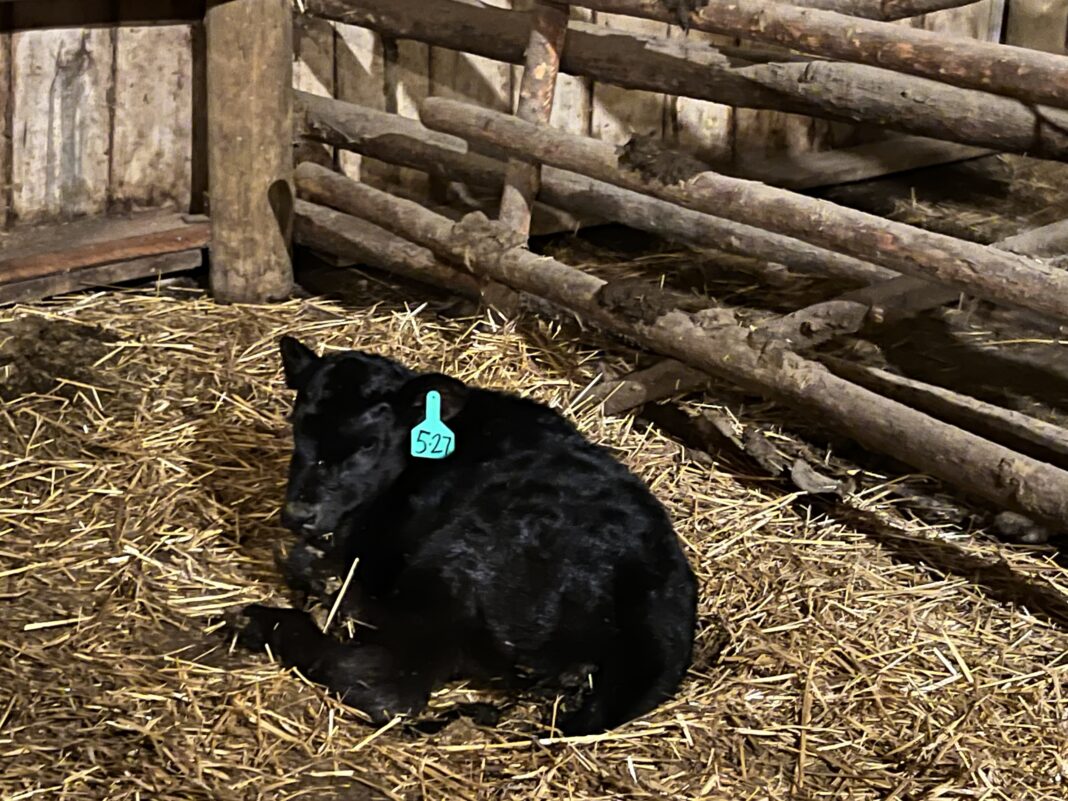
Using the hay to coerce one of the mothers out to a more open stable, Darby encloses us behind a gate with a very young calf. It is sleepy, and has fur still matted and damp either from birth or its mother’s grooming. I get down on my knees and pet the sweet animal, suddenly adopting a Hindu-like deference to the little cow before me. I lay my hand on its head, and try my best to pet soothingly. Darby pets the hind, and we coo to it as it rests. It was a holy moment, and will live in my memory forever. After a while, the mother turns from the hay and stares at us through the gate, accusingly. We apologize to her, say our goodbyes, and head about our evening.
We wander back through the paddock to where I’d parked before, and climb into a side-by-side. I instinctively clamber about for a seatbelt. Darby laughs. There are none. We take off into the fields to see the rest of the herd, as part of both my tour and Darby’s nightly responsibilities. I feel as if I’m in “Jurassic Park”, with large animals lumbering in the night and us having only a few feet of visibility to preempt them. We find the herd, and Darby deftly drives us between the smaller sleeping groups that have formed in the grazing pasture. I am in awe of all before me, but can only give it a fraction of my attention as Darby has drawn me into a conversation on the various flavors and presentations of literary utopia. Multi-tasking and ranching may well be synonyms.
She manages to opine and swerve at the same time, as though driving through the land, and through topics, were as simple and automatic as walking, or breathing.
She brings us safely back to the compound, and hands me an ax. She places a hefty block of wood on a slab before me, and has me chop it to burnable pieces. This is “Conor work”, as it were, and part of my fee for the night’s apprenticeship. After breaking enough of these blocks, we gather the wood and go to the small hut that Darby rests in between cattle checks. For weeks now, her life has become almost wholly nocturnal. Every few hours, pregnant cattle must be checked so that Darby can intervene should complications arise during the birthing process. It is ceaseless work. As we soak the wood in red diesel to burn in the stove before us, I realize how demanding the calving season is, and how constant a presence Darby must maintain in order to ensure the safety of her family’s herd.
I also come to realize that, while Darby has a lifetime of experience working on the Lazy T Ranch, it is work she has only recently elected to return to. Darby just so happens to be burdened by genius, and was, as of six weeks ago, teaching writing curricula in New York, as a faculty member at Columbia University. In the fall of 2023, she lived for several months on a tall ship in the Arctic Circle as part of a residency program and writing experiment. It is safe to say that she, at any moment, could be absolutely anywhere she chooses. And yet found herself with me, burning wood at 1am in a shack in rural Montana. Perhaps only duty returned her, but I don’t believe duty works that way. I think she finds immense beauty and meaning in places like Boulder, and in work that demands vigilance and constancy. I like to think that similar thinking brought me to The Monitor, and that such thinking might keep me here.
We chatted awhile, in her shack, about the great adventures and oddities of our lives. Mice scampered about us, and the cats, now returned, watched passively. This was a complete abdication of their duty, obviously. It bothered us none. As the last of the wood burned to a smolder, I took my leave. In the final moments, as Darby walked me to my car, a great music erupted from the dark! “Coyotes,” she said. I had never heard anything so mystical and grand, and as it swelled and howled around us I paused to breathe in all that the ranch, and this night, had given me. I looked a moment into the great stars above us. Soon, the coyotes were quiet. I thanked her, and left.