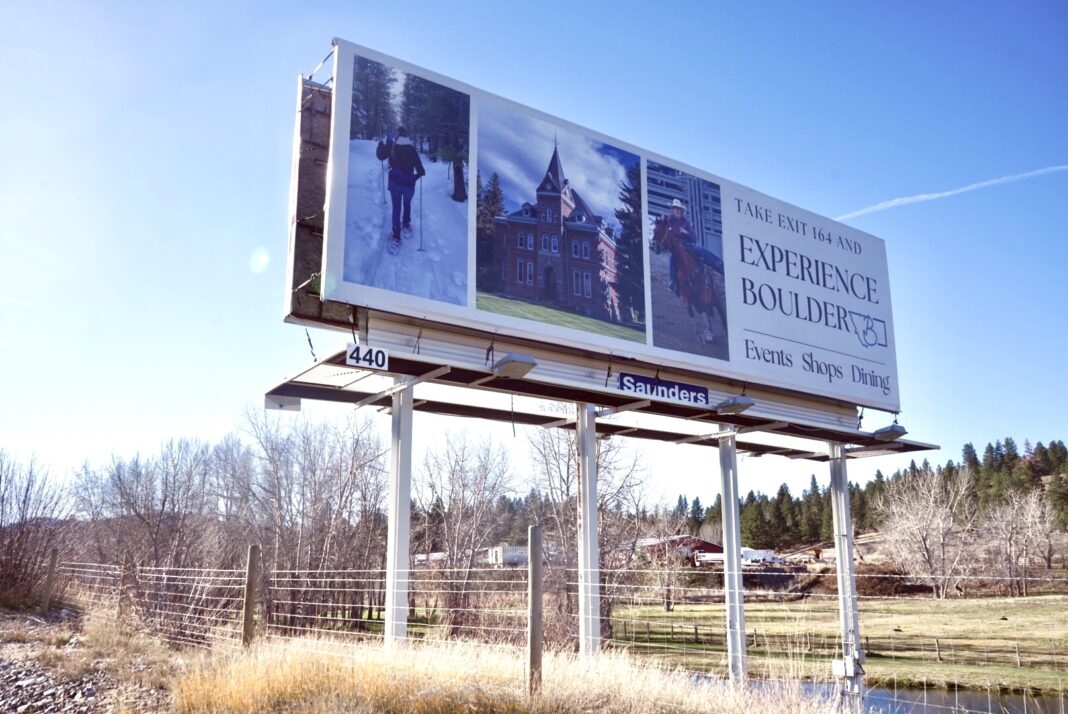
On Apr. 4, amid some contention, the Boulder Transition Advisory Committee (BTAC), an informal collective representing interests from across the Boulder community, voted not to pursue a state grant that could have brought up to $2.75 million over five years to expand local tourism.
That was the right call.
Nothing against free money: The Commerce Department’s Pilot Community Tourism Grant Program (PCTGP) might have delivered a sweet chunk of change. But BTAC members were justifiably concerned about their ability to get a credible application done by the Apr. 30 deadline. “I feel sad and disappointed, but at the same time relieved,” said Kerri Kumasaka of Boulder Hot Springs, who first suggested going for the grant back in February. There were also questions about who would take on the administration associated with the funding.
More to the point, it’s not clear that Boulder is ready to build a tourism economy. The $500,000 Boulder Development Fund, approved in 2017 by the Montana State Legislature in the wake of the closure of the Montana Developmental Center, yielded a fine planning document but, in the end, mixed results: Envisioned improvements to Main Street have mostly not panned out, and a river trail project has yet to be realized.
The city’s current Master Growth Plan is now more than five years old, and touches only nominally on tourism efforts. And the community has been publicly chided by the state’s Montana Main Street program for failing to keep up with the regular reporting required for membership — and for being, well, sorta random. “Are you all at the same table?” asked Micky Zurcher, the program’s coordinator, somewhat rhetorically, at a recent BTAC session. “There are a ton of you working toward a goal, but individually and not collectively.”
That’s not completely fair: BTAC has provided a useful clearinghouse, giving civic actors a window onto what everyone else in town is up to. (If you haven’t been to one of its meetings, you should; they’re at 8 a.m. on the first Thursday of each month.) But it’s not an effective coordinating or decision-making entity. And Zurcher is right that Boulder, though small, can be an impressively daunting multi-headed beast: City government makes some calls, the Boulder Area Chamber of Commerce makes others, and the relatively new Reimagining Boulder intentionally works in its own lane. Amid the complexity, it’s not always clear where the city is pointed.
By contrast, I’ve been impressed by an emerging collaboration in Whitehall that’s focused clearly on establishing that city as a regional center for performing arts. The Whitehall Chamber, the Ledger newspaper, and a non-profit organization called Gold Junction Presents have partnered to produce a stream of programming, anchored at the historic Star Theater, that’s geared to serve the people of Whitehall and to attract visitors from the surrounding region. It’s an early-stage but promising effort that hints at what a community in alignment might accomplish.
At least as important as Boulder’s readiness is its will. Do we want a tourist economy? Six years ago, as Boulder was preparing its plan for the Development Fund, a group of residents visited Philipsburg, a city smaller than Boulder that had turned its downtown into a vibrant tourist destination. One thing they learned: Folks in Philipsburg were mostly rowing in the same direction, committed to and excited about making tourism happen. And they had been for years: The success (and tourist dollars) didn’t happen overnight.
So: Do we actually want people to visit Boulder? And what might that look like? Would we like to see Main Street jammed with out-of-state license plates, and the Windsor and Dave’s packed with unfamiliar accents? Do we want more Airbnbs? Are we willing to share our trails and streams with out-of-towners?
I’ve always sensed ambivalence, if not outright division, about that. Kumasaka’s ad hoc steering committee had been gearing up to survey the Boulder community on its feelings about tourism — and a successor group, headed by Jefferson County Events Coordinator Bruce Binkowki and Planning Director LaDana Hintz and chartered to explore future grant opportunities, might do well to pursue that line of inquiry.
It also has to come up with a strategy — optimally, as Hintz has pointed out, in concert with development of the city’s new growth plan and with the county’s planning efforts. What would a successful tourism development effort look like? What activities would yield the greatest leverage toward that outcome? What resources would be required?
A state tourism grant would not be a panacea. The PCTGP funding is focused on research, planning and marketing, not capital investment and operations. It wouldn’t magically bring about a restaurant that’s open on weekends, say, or a fishing outfitter, or an ice cream shop.
Those will require other people’s money — and energetic entrepreneurs who are confident in the community’s vision, strategy and ongoing execution on a tourism development approach. So, let’s start into the hard work of making that happen, hoping (as Kumasaka does) that grant money will still be there when we’re actually ready to use it well.