
The U.S. Forest Service plans to create a logging unit across regional national forests, seeking to boost economic stability by committing to process timber only via local businesses.
The new Sustained Yield Unit – a concept created by 1944 federal law – would include 22 Montana counties and all of Helena-Lewis & Clark and Beaverhead-Deerlodge national forests, as well as most of Custer Gallatin.
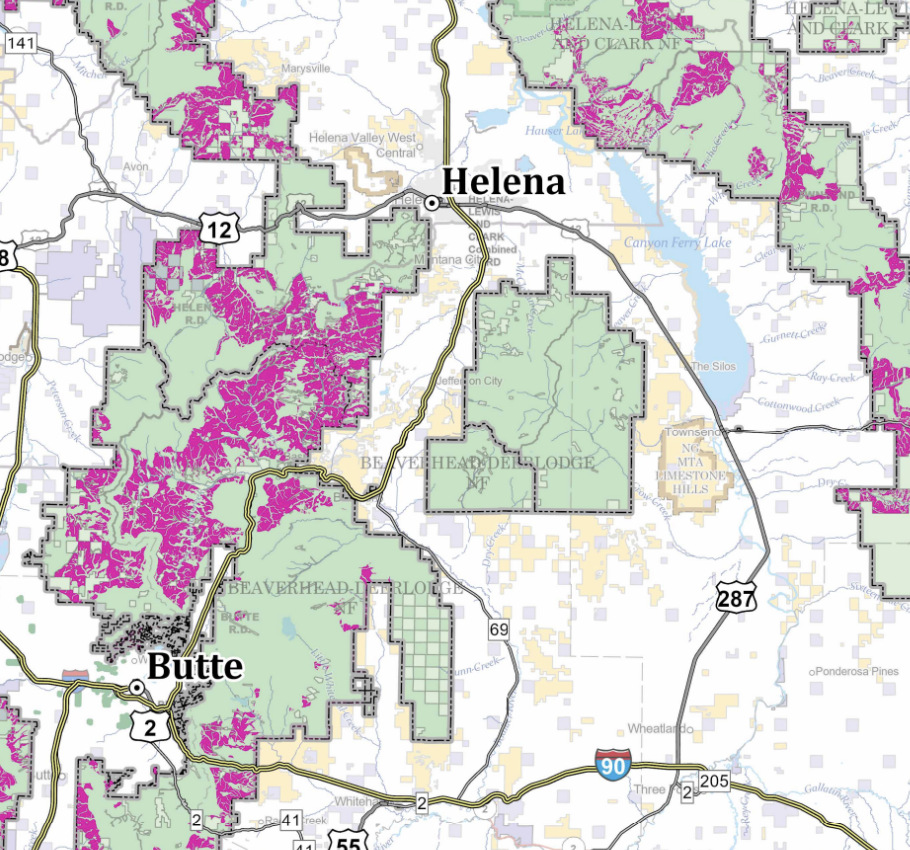
Some 925,000 acres of harvest area, described in the draft plan as “timber emphasis lands,” would include a broad crescent of BDNF in the Boulder Mountains, stretching from Elk Park to Montana City. The USFS says the unit’s creation is meant to align with President Donald Trump’s March 2025 Executive Order to expand timber production.
Yet the draft plan (available on the USFS website) outlines no additional harvesting or any change to existing forest management plans. Under the plan, 75% percent of the area’s target timber harvest, or an estimated 35 million annual board feet, would go to some two dozen timber-related businesses within the unit footprint.
In Jefferson County, Clancy’s Marks Lumber and Marks-Miller Post & Pole are included, along with Montana Mobile Cabins in Whitehall. In Lewis & Clark, Lincoln’s L&L Sawmill and Bouma Post Yard, some 60 miles north of Helena, made the list.
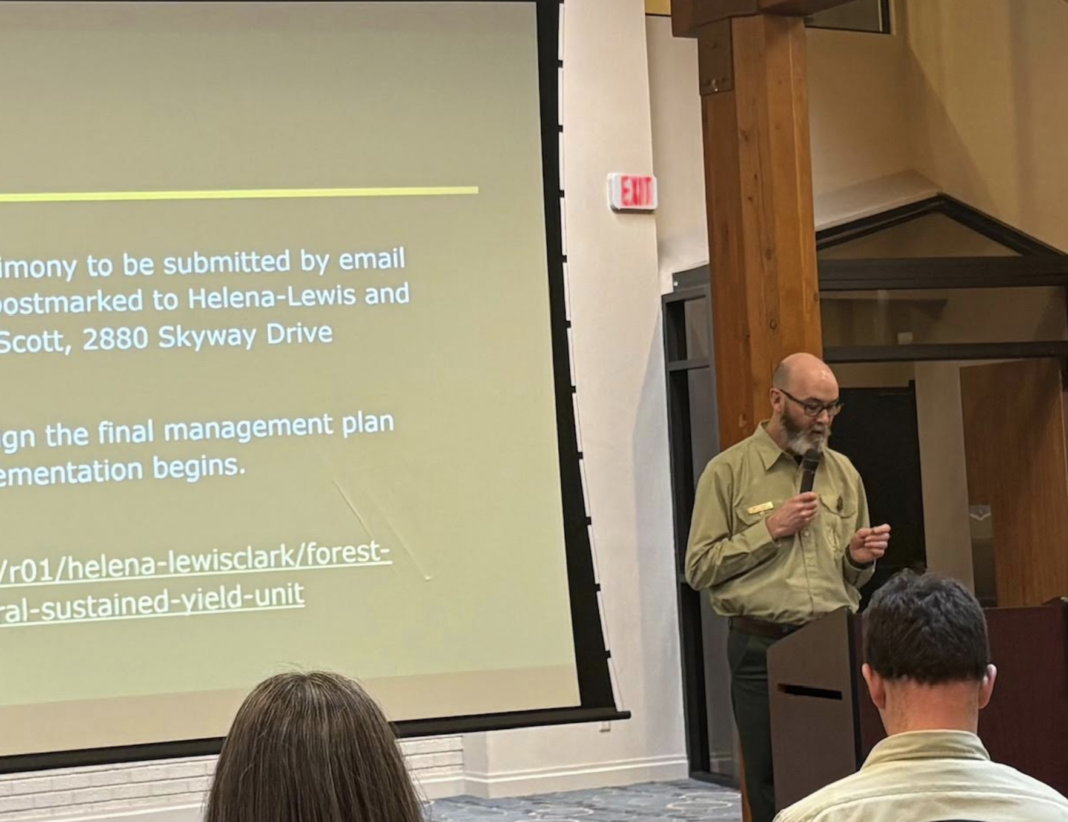
Speaking for the Governor’s Office at the Forest Service’s April 1 Helena event on the plan, Amanda Kaster, director of Montana’s Department of Natural Resources and Conservation, expressed the state’s strong support.
“The proposed state sustained yield unit represents a forward-looking approach, one that builds stability for forest industry jobs and helps ensure that timber harvested from Montana forests continues to support Montana communities,” she said.
The businesses listed in the plan would still need to competitively bid for Forest Service timber; inclusion only assures they would be considered for timber contracts. Steve Marks, head of Marks Lumber, and Gary Marks, president of Marks-Miller Post & Pole, spoke jointly to The Monitor on Monday.
Gary viewed the plan’s promise to timber businesses as largely meaningless because transport beyond the yield unit would be too costly. “No one in their right mind would haul it outside of that area, it’s too far,” he said, adding that he expected little change to his firm’s Forest Service output.
The draft plan estimates that the unit would directly support 192 jobs per year over the next decade, plus an additional 225 jobs via economic ripple effects. But the Marks saw the yield unit’s harvest plan as inadequately ambitious.
A single tree produces about 50 board feet, they explained, while the Forest Service is promising 35 million board feet across nearly a million acres. “There’s not enough output for that amount of land,” said Gary. “That 35 million, that’s about 35 board feet per acre, which isn’t even equivalent to one tree per acre.”
Without adequate annual sales, timber firms are unable to make longer-term spending plans. At the April 1 hearing, Craig Kidwell, regional timber contracting officer for the USFS, highlighted the closures of many Montana timber businesses in recent decades, which he said, “significantly harmed the rural communities those facilities were located in.”
Steve Marks cited the early 2024 closure of Missoula’s Roseburg Forest Products, which manufactured particle board, plywood and more. “That was a huge hit,” he said. “Instead of hauling that stuff 100 miles we now have to haul 350 or more miles, and given the price of fuels in the last month, it’s crippling – and not just for our business.”
Continuing forest mortality due to Douglas Fir bark beetle, Spruce budworm, and mountain pine beetle infestations is a major problem, Marks added. And at the April 1 meeting, Nick Horn, outreach forester with Sun Mountain Lumber in Deer Lodge, pointed out another concern: the plan lacks a commitment to back-fill timber sales lost to litigation objections and delays.
Just in the past month, two lawsuits, one near Whitefish related to lynx habitat, another in the Sapphire Mountains linked to grizzly habitat, have halted Montana logging projects. Given these concerns, the Marks recommended a broader, more comprehensive treatment and harvest plan that would provide up to 150 million annual board feet.
“We’ve got to have more volume to keep our infrastructure intact,” said Steve. “If we lose that infrastructure, the Forest Service has lost the tools it sorely needs to treat the acres that they so dearly need to take care of.”
One way to increase volume would be for the Forest Service to add yield unit areas the plan identifies as “may be suitable for timber production” and lands near the Continental Divide and other trails to the list of harvest areas. Chiara Cipriano, HLCNF public affairs officer, said these areas could be considered for timber removal following evaluation.
“While most of the expected timber volume will come from the timber emphasis lands already shown on the map,” she said, “harvest from these other areas remains possible if it meets all project‑level and forest plan requirements and management considerations.”
Barb Cestero, Montana director at the Wilderness Society, feared that given the Forest Service’s recent staff cuts, a potential over-emphasis on logging could be problematic.
“The economic well-being of today’s public lands communities stem from much more than timber, including outdoor recreation, agriculture, wildlife, clean water, and the simple connection to nature,” she said in Helena. “Without additional capacity for the agency to do timber projects, resources and staff could be diverted from these other programs with negative impacts on overall stewardship of the three national forests.”
The Forest Service is accepting written comment on its yield unit plan through April 10 at SM.TriForestSYU@usda.gov, or mail to HLCNF, c/o Sharon Scott, at 2880 Skyway Drive Helena, MT 59602.