
In most years, fire season is synonymous with summer. July and August often bring days, even weeks, when mountains in all directions are obscured by smoke. And though you can taste it and it dries out your throat, your main battle with the smog is a mental one. It’s tough to exist with geographical benchmarks obscured. It messes with our sense of place.
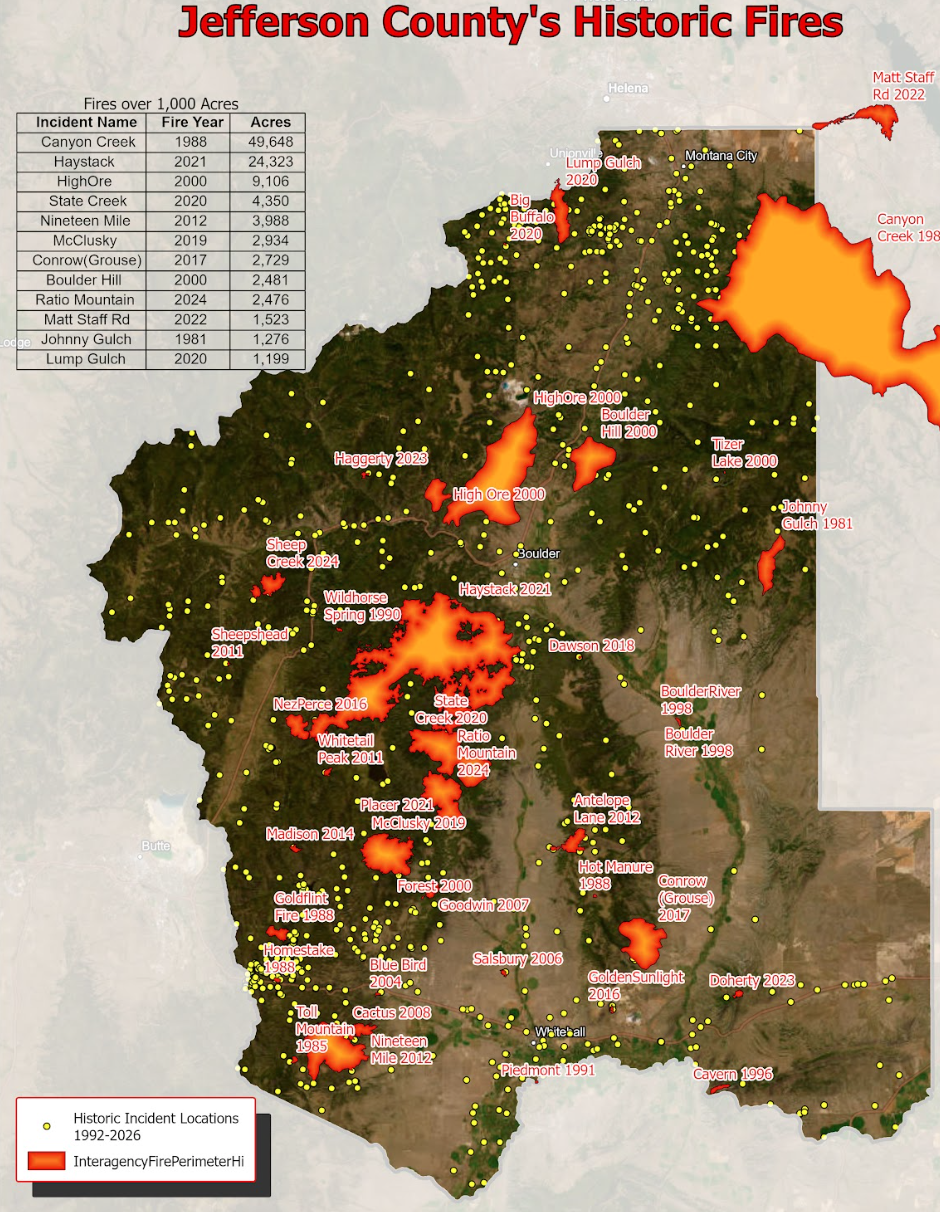
The National Interagency Fire Center (NIFC) serves as an authoritative steward of historic fire data, and though the 2026 fire season seems to have started early and won’t necessarily align with the season of sunshine, these records show that fire has long been a part of our county.
NIFC data, a conglomeration of different sources (and the data source for the accompanying map), is imperfect, and likely under-represents fire on our landscape. Yet if, for the sake of this analysis, we treat it as mildly reliable, we see that some 112,000 acres of Jefferson County (more than 10%) have burned to some degree since 1980.
Fire perimeters are tricky insofar as not everything within a perimeter may burn, but statistics tend to assume so. The largest fire in that time period was the 1988 Canyon Creek Fire, also called the Elkhorns Burn, marking one of Montana’s driest recent seasons. That same summer a large blaze burned much of Yellowstone park.
A respectable second place is the 2021 Haystack Fire, which many readers are likely to recall. Lasting from late July to early October, that wildfire burned more than 24,000 acres in the Boulder Mountains. Some 450 personnel descended on Boulder and a tent city sprung up on the fairgrounds. Driven by great winds, the conflagration at one point torched 10,000 acres in a single afternoon. Nearly five years later, one can still hike through the aftermath of ash and lodgepole bones, where a triangle of fuel, heat, and oxygen became an isosceles, and the gale took over – dang near to Boulder.
The first round of fire suppression is referred to as initial attack, and when we look at a fire’s perimeters over time, we are really looking at the “ones that got away.” Be it due to fuelscape, topography, or weather conditions, some fires are too dangerous or difficult to catch early. That said, depending on the source, more than 94% of Montana wildfires are extinguished in the initial attack, and Jefferson County is no different.
The yellow dots on the map represent fire starts brought to heel by federal and state agencies and local volunteer units, working together, before they grew large. Who responds to and takes over a fire is linked to its Fire Protection Area, or official administrative boundaries. But all wildland firefighters serve to protect life, property, and the environment, and they work together.
Jefferson County has seen more than 1,000 fires since 1992, dozens a year on average. More than two-thirds of them are started by people – and even a larger percentage of those that harm people or property. These fire-starting mistakes are often the product of misguided judgement, and a philosophically-minded person might observe that we treat fire as an enemy, which may not be an impartial stance.
Perhaps because wildfires hungrily consume oxygen and grow – and if you squint your eyes you might mistake them for living things that devour other life – our default position to fire is as foe. Like many forms of life, though, not all fire is created equal, nor is all fire all bad.
It’s just a chemical reaction that heats and shines and reaches out for more, which I suppose mirrors a fair bit of souls out there.
Bret Lian grew up in Clancy and lives in Jefferson City (where he serves with the local volunteer fire department) with his wife Lisa, their three children and a dog. The places and histories of Jefferson County and beyond have always provided endless daydreaming material to this geography-minded Montanan and Monitor columnist.