
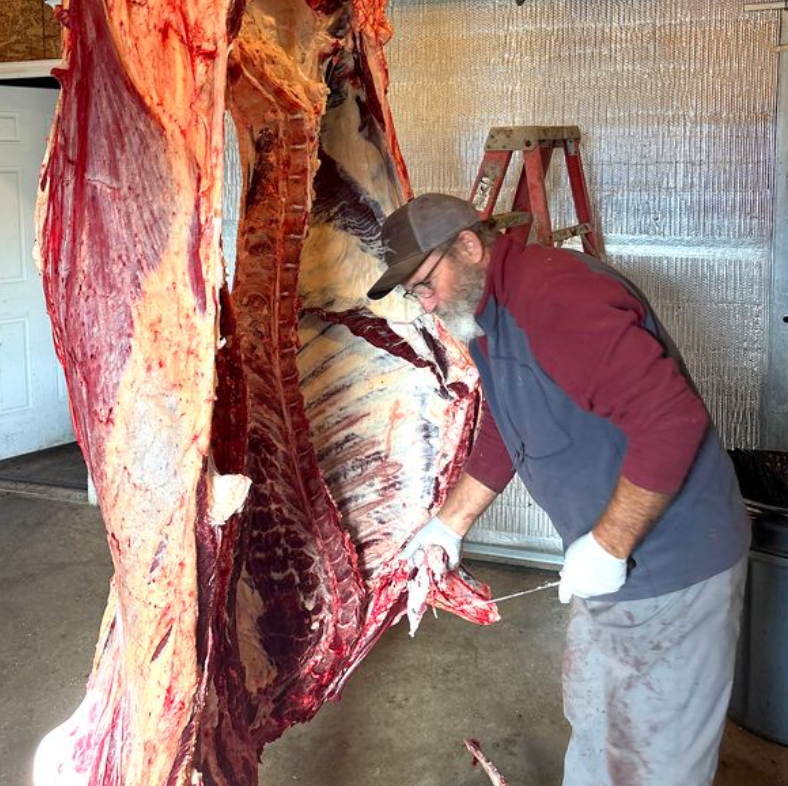
It’s hunting season, which means Josh “Fuzzy” Pallister is working almost nonstop. “I’m here every day, all day,” he says on a recent morning, looking around his white-walled packinghouse from his customary position next to the cutting board.
Under hanging green and black hoses in his custom-built shop along Upper Valley Road, bloody elk ribs spill out of a wheelbarrow along one wall. Inside a freezer, rows of white-paper wrapped meats present a label and year (“Polish 25” or “Tenderloin 24”). One room over is Pallister’s taxidermy gallery: pronghorn, mountain lion, black bear, bighorn sheep, mountain goat, moose, and more.
One room further, next to the walk-in fridge, cattle and game are hung by their haunches for carving. And so ever-present they’re part of the scenery are Ken Jonasen and Frank “Stormy” Knight, Pallister’s hunting buddies for some 40 years. Once he opened the facility, his two friends just started pitching in, without pay, and have returned every year since.
“I can’t complain about either of them,” says Pallister, wondering how long he’d had his shop. “I think we’re pushing 18 to 20 years. Is that right Ken, about 20 years?”
That’s about right, if you’re just counting the time they’ve been butchering professionally. But really, Pallister has been carving up game for some 60 years. Now, finally, he’s begun to slow down. So, if you’re hoping to sink your teeth into some of the county’s best home-cut venison meats, you may want to act fast.
“I’m not accepting a lot of game any more because I’m trying to quit,” says the bright-eyed, gray-bearded Pallister, who turns 69 in January. “I’m an old bastard and it’s time to get out.”
Pallister’s life has been steeped in game. His parents, Philip, an avid outdoorsman, and Blanche, moved to Boulder in the late 1940s partially because of the trout stream running through town. The couple had 14 children – 13 boys and a girl – and hunting became much more than a hobby.
Fuzzy, the ninth child, recalls taking down his first deer, a two-point buck along Brown’s Gulch, at 12 years old. But long before that, the culture and ritual of hunting had become deeply ingrained, starting in his pre-school years.
“I loved hunting way before I was able to go. It was part of our lives from a very young age,” he says. “We salivated for it. We lived for hearing our older brothers and our dad come in with their stories.”
The Pallister brood took whatever sustenance they could from the land, and part of that was harvesting game. The family almost never bought meat. “We weren’t out there to have fun, though we enjoyed it, we were out there to fill the freezer,” he says. “We lived on game, 100 percent. We didn’t have [store-bought] meat unless it was a turkey or something like that.”
Befitting the times, the family did all of its own game processing. As a result, large animal carcasses were often hanging about, with hunks getting carved up and stuffed into the freezer.
“Back in those days you never heard of anybody taking their game to a butcher shop. We didn’t have that luxury,” he says. “We would grind and pack it, we would do the clean up. We were indentured into hard work at a very early age in that family.”
Pallister thinks he probably first cut into a game animal more than 60 years ago. “I’ve always enjoyed processing game because it turns into something good to eat,” he says. “It’s satisfying to sit down at the table and eat your own stuff.”
After decades of work as a general contractor, Pallister decided to commit to butchering and open his own shop – a multi-room facility that towers over his home. “I just got tired of traveling and contracting work,” he says. “And it’s been much more enjoyable. Everybody that comes through here really appreciates our work and that’s the opposite of the contracting world.”
All the years of practice seemed to have paid off. “He does a great job and he’s one of the nicest guys I ever met,” says Raymond Hays, who lives on Boulder Hill and has been taking his game to Pallister since he moved to the area 20 years ago from Oregon.
Hays’ daughter-in-law last week brought a four-point mule deer buck to Pallister, who turned it into Polish sausage and other cuts in a few days. Hays is convinced Fuzzy is just as good as or better than other area butchers – and he can be trusted with your game.
“You don’t have to worry about getting all your meat back,” says Hays. “I’ve been to other places and sometimes I didn’t get all my meat back.”
Clint Rieder, a third-generation Boulder rancher, has been taking his animals to Pallister for 10 or 12 years, and recently brought him a couple of cattle. “He does one helluva good job on wild game and beef and he’s always good for a laugh,” says Rieder. “I’ve had different people butcher our beef, and on hamburger he’s second to none.”
Past the taxidermy room, Jonasen eyes an elk carcass hanging from its hind legs. It’s a cow he’d shot a few days before, somewhere in Jefferson County – “we don’t say where,” he clarifies – and he’s mulling which cuts to focus on.
“We’ll make a lot of cube steaks and roasts and hamburger from this, and lately we’ve been doing brisket,” says Jonason, adding that with a fat animal like this the meat would be particularly juicy. “Elk burger is absolutely the best.”
Pallister says the biggest animal he ever butchered was an Angus bull of 2400 pounds. That one beast produced 930 pounds of ground beef, or enough burgers to feed a small army. From this cow, he expects 180 to 200 pounds of meat.
“This is about as nice an elk as you can get right here,” says Pallister, clearing away fat to cut out a tenderloin for a friend. “It’s a cow, first of all. They tend to be more tender. The bulls, they’re tougher.”
Unlike beef, elk is a lean meat with very little marbling. But this is a hefty cow. Moving to the cutting board to ready the tenderloin, Pallister trims away more creamy white hunks of fat, as well as the fascia, or protective layer.
Of all his cuts and prepared meats, his personal favorite may be chicken-fried elk cube steak. Or elk loin chops, or venison brisket. Depends on the day. And he’s OK with custom orders: one patron enjoys elk liver; another recently ordered 20 pounds of cheese Polish sausage.
Over the years Pallister has perfected a number of sausages, from breakfast and Polish to summer sausage and salami. Above his cutting board, he keeps a list of how much suet, or beef fat, to add to each, but beyond that he’s mum on his recipes. “If I told you I’d probably have to kill you,” he grins.
Montana outlawed new game farms in 2000, so Pallister is barred from selling game meat to customers. Still, processing is a service in real demand, which he learned after he spread the word in 2015. “I made a mistake and advertised,” he recalls. “We got a lot of recognition from that and we were swamped for years after.”
Then came the pandemic, which gave do-it-yourself game processors like Pallister a boost. After COVID shut down a lot of commerce, top beef-packing plants took control of the supply chain, driving up meat prices and prompting consumers to turn to local and amateur butchers. Pallister upped his prices and still took in more animals, as many as 120 just a few years ago. “I had to turn down so much game during COVID,” he says.
These days he charges $300 for elk processing, $175 for a deer – more affordable than other area butchers. Montana City Meats and Helena’s Tizer Meats, for instance, both charge around $400 for elk processing. (Pallister urges would-be customers not to skin their game. “I charge more if they come in with the skin off because I can do it cleaner,” he says.)
Still, the recent bump in business has failed to tempt him to stick around. He’s curbed his game butchering the last two years, shifting toward processing his own beef and that of a handful of area ranchers. Last year he butchered about a dozen elk and the same number of deer, and expects to handle that many again this year. These days he only occasionally accepts game from non-regulars.
“I’ve probably turned down 10 or 12 elk already this year,” he says. “I’ll still do some, but it will be for a select few customers.” He was OK with the trade-off of less income, but more time for himself. “I’d like to have that back,” he says. “I’ve got a lot of stuff to do.”
Rieder, the Boulder rancher, heard the rumors about Pallister retiring. “I hope he never does because he’s such a good staple for this community,” he says. “There’s not a lot of people who do it any more. They’re hard to find, and it’s harder to find people who do it well.”
Pallister knows a few Boulder-area butchers who do a good job, but only privately, for their families. He can’t think of another local doing what he does. “I’m trying to get out of the game,” he reiterates. “Somebody else has gotta do it. I’m more than happy to show people how to do this.”
Within a year or two, local hunters may need to leave the county to process their game. “I would miss him greatly,” says Hays. “I don’t know where else to go that I really trust.”