
Have you ever said something you wish you could take back? Pretty much all of us are familiar with foot-in-mouth disease.
But that, apparently, is not how former U.S. Congressman Steve Pearce feels about calling, in 2012, for the sale of public lands in the West, arguing “most of it we do not even need.”
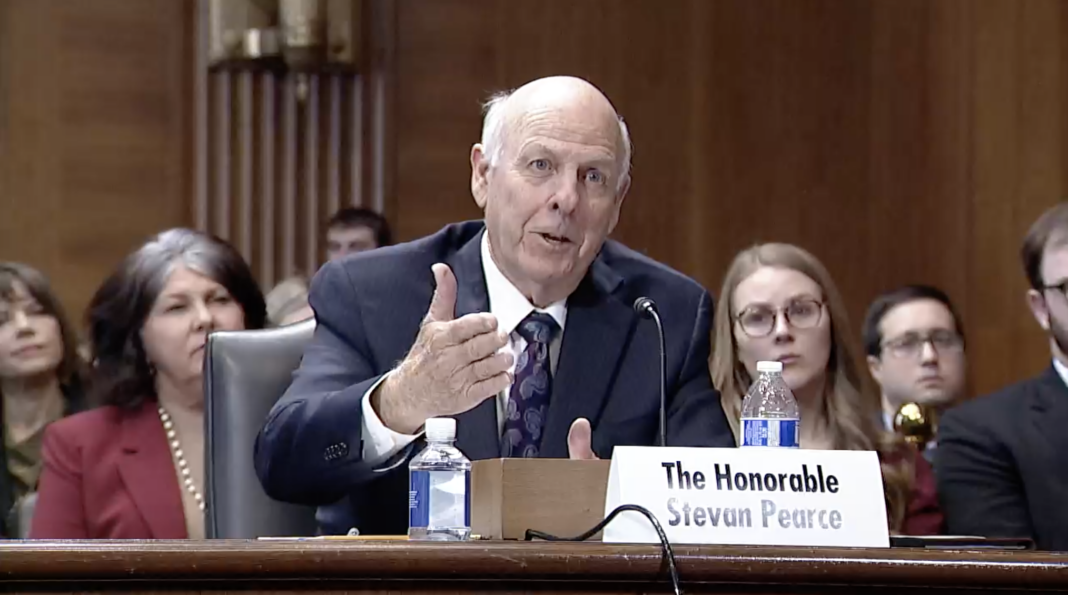
Despite his vast experience in the extraction industry, or perhaps because of it, Pearce is President Donald Trump’s nominee for director of the U.S. Bureau of Land Management, which oversees 245 million acres, a 10th of the country. At his confirmation hearing with the Senate Energy and Natural Resources Committee last week, the most aggressive questioner may have been Oregon Sen. Ron Wyden, who asked Pearce about his 2012 comment.
“You no longer agree with the statement you made years ago?” Wyden queried.
“Senator,” Pearce responded, “I’m not so sure that I’ve changed.”
The former Congressman’s current mindset may soon be of real concern to Montanans, who enjoy more than 8 million acres of BLM land. Jefferson County is home to more than 92,000 of those acres (9% of the county), with parcels stretching from Montana City to south of Cardwell.
Some are forgettable, but many are locally cherished hunting, fishing, grazing, and recreating destinations, like the Clancy Creek pond where young anglers catch their first fish, or the Elkhorns lowlands where Lazy T Ranch cattle enjoy a seasonal nibble.
Already more than 100 BLM parcels in Jefferson County have been marked “available for disposal” and may soon be up for sale, as The Monitor reported in September. The clearest insight into Pearce’s plan for Montana’s BLM lands may be a look at his record.
Highly decorated for his Air Force service in Vietnam, Pearce owned an oil and gas services company in New Mexico before selling it upon winning office and representing the state’s 2nd District from 2003 to 2009 and 2011 to 2019.
In 2005 he supported a budget bill provision to allow the BLM to sell mineral-rich lands for below market value. He criticized Teddy Roosevelt’s “big forests,” and in the 2012 letter mentioned above, called for the selling off of public lands to pay down the deficit.
Four years later he co-sponsored a bill to speed up the sale of BLM lands, though he’s also made a few public lands-friendly moves. In 2012, Pearce introduced legislation to protect New Mexico’s Organ Mountains with a national monument designation. The next year he publicly called for greater recreation access to BLM lands.
In his hearing, he talked about helping ranchers navigate BLM permitting and vowed that local input would be his guiding light. “I don’t visualize selling large swaths of land,” Pearce added, pointing out that the law bars such sales.
That’s true: the Federal Land Policy and Management Act (FLPMA) stipulates that the sale of any parcels larger than 2500 acres must gain Congressional approval. Yet the FLPMA empowers the BLM chief to make smaller discretionary sales and places no limit on how many under 2500-acre parcels the bureau can sell.
Each must meet one of three criteria: difficult or uneconomic to manage; no longer needed for the purpose for which it was acquired; or its disposal will serve an important public objective, such as economic development.
With the committee (11 Republicans, 9 Dems) expected to vote on his nomination Wednesday morning, those bars would seem within reach of a future director Pearce. The League of Conservation Voters, which ranks lawmakers’ voting records on a land conservation scale of 0 to 100, gives him a lifetime rating of four.
Given a chance to query the nominee, Montana Senator Steve Daines posed just two questions. He asked Pearce whether he’d continue to support hunting, fishing and recreation access on BLM lands and, hinting at logging projects, whether the U.S. should increase the scale of forest management on BLM lands. In both cases, Pearce said only: “Absolutely, Senator.”
If confirmed, Pearce has vowed to hand over control of his oil fracking services company, Trinity Industries, to his wife. Yet with the Senate expected to vote on his nomination this week, many hunters, veterans, and environmental activists remain dubious. The Vet Voice Foundation, a veterans advocacy group, is spearheading a campaign against Pearce’s confirmation with a website that dubs him “Selloff Steve.”
“Pearce’s record makes him profoundly unfit to lead the BLM,” Ben Super, Montana Conservation Voters’ Education Fund executive director, said in a statement. “For decades, he has worked to weaken public-land protections, promote the sale and transfer of federal lands, and advance the interests of the oil and gas industry over the interests of the American people.”
Super pointed to January Raba Research polling which found that 75 percent of Montanans oppose Pearce’s BLM nomination. “Montanans will hold members of Montana’s congressional delegation accountable for this decision and for the impacts it has on our lands, waters, and outdoor way of life,” he added.
Montana Wildlife Federation President Mike Mershon attended Pearce’s hearing and also cited Raba’s survey results. “We ask Senator Steve Daines and Senator Tim Sheehy to reflect the will of Montanans.”
In addition, 97% of the Raba survey participants described Montana’s public lands as either very or somewhat important to the state and their community, while 90% expressed concern about losing cattle grazing leases and fishing and hunting access on BLM lands under Pearce.
This seems reasonable, given the Trump administration’s view of extraction. At a December meeting of the Elkhorn Working Group, BLM Butte Field Manager Lindsey Babcock outlined a planned exploratory project for gold on BLM land east of Jefferson City, explaining that it aligned with White House policy.
“The president has declared that gold is a critical mineral, regardless of the size of the operation,” said Babcock. “In Interior, our number one priority is minerals.”
Her boss, the Secretary of the Interior, which includes the BLM, visited Butte last Friday. After touring Montana Tech’s mineral labs, Interior Secretary Doug Burgum vowed to “restore America’s mining legacy by cutting red tape, streamlining permitting and ensuring critical minerals are produced here at home.”
This came a few days after his agency rescinded more than 80% of the regulations within the National Environmental Policy Act (NEPA), a trailblazing, 1970 environmental law requiring federal agencies to assess the environmental impact of proposed projects.
The department has said it hopes “to cut red tape [and] speed up approvals.” Indeed, the move creates an advisory, not mandatory, NEPA handbook and sharply reduces the need for public weigh-in and governmental study before a public lands project gains approval.
Back at the hearing, the most revealing moment may have come when Wyden first brought up Pearce’s 2012 land sales idea and asked if he thought the West had too much public land.
“The management of those lands is sometimes not as well done as it should be,” Pearce explained. “And local people pay the price.”
OK, but might not a wiser response to mismanagement be finding better stewards? Rather than appreciating their inherent value, Pearce appears to take a predatory view of the lands that may soon be under his control, lands that Jefferson County folk enjoy for fishing, hunting, and hiking, rely on for grazing, and appreciate as much-needed open spaces.
They say when someone shows you who they are, you should believe them. Pearce seems to have done that again and again.
Lepeska is The Monitor’s editor. Contact him at david@boulder-monitor.com.