
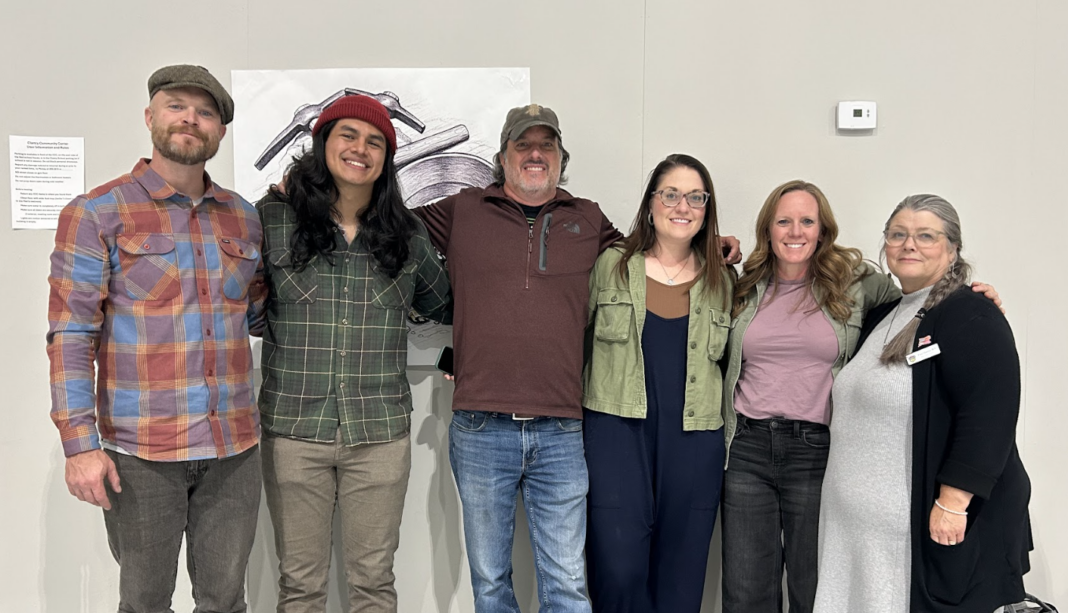
A dozen Jefferson County residents spent an evening last week writing postcards to lonely strangers, offering advice to a grieving father, and singing along to the Beatles.
This was no town hall meeting, but State of Mind, an interactive show from the University of Montana’s Co-Lab for Civic Imagination and Montana Repertory Theater. Using theater and dialogue to address mental health stigmas, the production has made nearly 20 stops across the state over the past year, with the latest coming Oct. 8 at Clancy’s new community center.
“It made me think of our actions as parents,” said Boulder resident Nicole Palmer, a prevention specialist who enjoyed the event. “You have to think outside of the box when it comes to your kids.”
State of Mind lacks a traditional script, but is instead structured like an album with 14 tracks. Audience members call out which track they would like to see next. Some are monologues. Others are games or songs. All invite participation. The track that resonated with Palmer featured a father struggling to communicate with his son, who’s friend had recently died by suicide.
Frustrated, the father turns to the audience for advice. “Don’t be afraid to talk about death,” someone in the crowd suggested. “Keep knocking, just start casual,” offered another.
In another track, the audience played “ABC’s,” presenting reasons people fail to seek mental health care starting with each letter of the alphabet. In a third, audience members described the feeling of loneliness (“empty,” “despair,” “an ache”) then drafted postcards to strangers with messages they’d like to hear if they were lonely.
Before the show, interested Jefferson High School students took part in teacher-free, State of Mind-run workshops. They talked about feeling isolated, their teachers’ risk of burnout, and the fear of mistakes leading to lasting grudges, before drafting “care commitments.”
“It’s their statement to the adults in the community, not just the school, but the entire community of what they need to feel safe and healthy and secure, with a focus on mental health,” said Doug Cook, a State of Mind facilitator and therapist at Meadowlark Counseling and Neurofeedback, who described the exercise as also encompassing social support.
The statements were then incorporated into the evening’s performance. Marlee Sarchet, a JHS freshman who took part in the workshops before attending the show with her mother, said her group’s commitment urged teachers to be more fun and engaging, and to create a safe space for all.
The evening opened with a mental health check: audience members were encouraged to check their heartbeats, notice their surroundings, and take deep breaths. Then the tracks began, mixing storytelling with interactivity. One featured a conversation with Erin Ritchie, a Jefferson County school and public health nurse.
Ritchie talked about the area’s high suicide rate, persistent stigmas around seeking help, and resources like 988, a state crisis line to trained responders. Another track followed a couple navigating family deaths and their grandson’s drug addiction, showing how they eventually found support from a community health worker.
To close out the evening, the performers asked the audience what they do when they want to be happy, then turned the responses into an interpretive dance. Barb Reiter, a prevention specialist, said she appreciated the reminders about how to seek help. “I liked that we looked at what resources are available,” she said. “I think we’ve got more than we realize.”
The show intentionally balanced heavy subject matter with lighter moments, such as the audience singing The Beatles “Help” with the actors. State of Mind performers Octavio Jimenez, Zac Thomas, and Jackie Vetter, along with Cook, oversaw the show, which was attended by Melissa Clater, a licensed clinical social worker who was available to talk if needed.
Jimenez said parents and teachers often express surprise at how articulate and insightful students can be about community problems. “A lot of people cry, a lot of people come up and say, ‘Thank you, we need to talk about this more,’ because everyone understands that mental health is not talked about enough in Montana,” he said.
The State of Mind team has discovered clear patterns in what young people seek: more recognition and engagement from adults, better mental health support within law enforcement crisis response, and more funding for health workers and prevention specialists.
Sarchet, the JHS student, enjoyed the workshops and evening show. “It was very fun, they were very interactive,” she said.
Her mother Andrea hoped the event might point toward a brighter future. “The more we can support each other, the stronger that we can be as a community,” she said.