
“I got twenty, yup, twenty, thank you, sir! Now thirty, and thirty! Now forty, forty, and fifty…”
Dan McGowan’s voice rose and fell in that distinctive auctioneer’s cadence, words tumbling over each other so fast they became almost rhythmic, a verbal rollercoaster that carried the packed room along with it.
Every seat was filled at the Windsor Bar Saturday night, leaving patrons spilling into walkways and squeezing past one another with drinks in both hands. After a two-hour delay due to a computer glitch, the bettors’ auction, or Calcutta, for Skijoring the Big Rock had begun.
Fresh off a day of racing at the Jefferson County Fairgrounds, the crowd kept the energy going at the bar, with faces reddened from the warmth of too many bodies in too small a space, from alcohol, or both.
People shouted across the sea of heads, striking up conversations with strangers. Everyone was family here. The Calcutta – held some years at the Windsor, others at Dave’s 32 oz. – was where Saturday’s preview would become Sunday’s gamble.
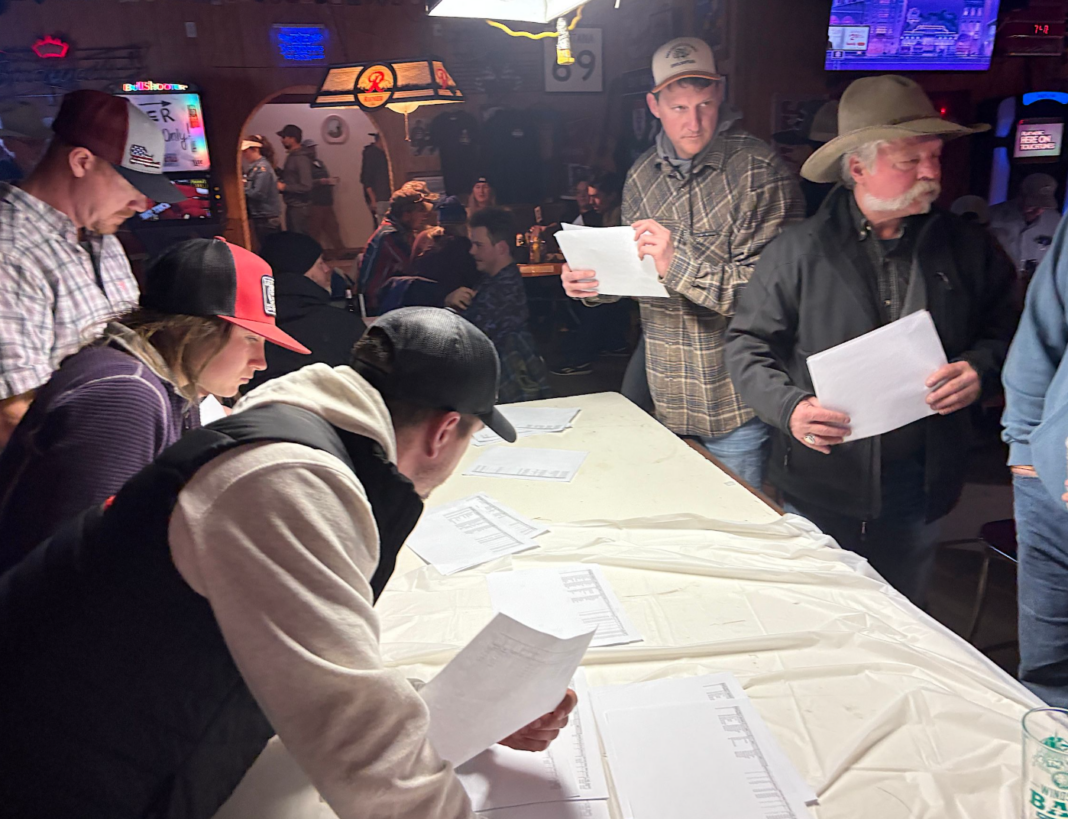
Before the auction, potential bettors crowded around a covered pool table, studying division sheets that showed each team’s rider, skier, horse, raw time and penalties from earlier that day. Teams that failed to finish were listed as DNF (Did Not Finish), making them more difficult to judge – and potential sleepers, according to accomplished skijoring skier David Rizzolo.
In the Calcutta, bettors bid on teams, hoping the ones they buy post a fast enough Sunday time to pay off. The betting is split into seven divisions – 1D through 4D, plus Switcharoo, Snowboard and Beginners – with each having its own pot of money created from all division bets.
Of each pot, 10 percent goes to a yet-to-be-determined charity while the remaining funds are split 50/30/20 for first, second and third place. Cal Douglas, an event organizer and Boulder Valley Skijoring Association (BVSA) board member who competed earlier in the day, put it simply.
“You have to pay attention to the skiers and how they ran today,” he said. “Tomorrow’s a whole other day. The Calcutta is a today pay on tomorrow’s performance.”
Leaning over the pool table, Rizzolo pointed out which teams finished, which fell short, and what it might mean in terms of opportunity. He’d competed earlier with his mother, rider Jennifer Butler, and now he was studying the numbers and names, calculating who might be worth a bet.
Butler and Rizzolo had delivered a clean run on Saturday, posting the fastest time in the first half of racing before other teams surpassed it. Butler bet on her own team that night, figuring that since they’d already been passed in the standings, the bidding might not get too steep.
“The people that are already in first, second or third are gonna go for a lot more money,” she explained before the bidding began. “So it will cost you more to buy those teams.”
That earlier racing was a blur of ski gear and horsepower. From the spectator area near the middle of the track, you could see each team line up, then watch them explode forward. It only took two or three blinks for them to reach mid-course, another two or three to finish.
People sat on benches or in the backs of trucks, drinking and watching, oohing at races well done or sucking their teeth after wipeouts. The track itself was a feat of determination – 900 feet of man-made snow amid a winter that had offered next-to-none naturally.
Christine Meyer, visiting from Butte to watch the event for the first time, had spent the day impressed by what organizers had pulled off. “It’s just fun to see how it works,” she said.
Jazzmunne Thomas, who’d driven down from Helena to sell her pyrography art and other goods, watched the speeds with amazement. “I’m surprised people even can stay on, honestly,” she said. “Some are slow, but most are really fast. And I’m surprised they haven’t just tumbled right off.”
McGowan’s voice rose again over the crowd, calling out teams as bettors raised their assigned numbers to signal a bid. He worked the room with his voice and his eyes, pushing the price ever higher until the bids ceased.
Dan Powell, who drove down from Helena to watch the racing and participate in the evening festivities, had an unusual strategy. He avoided the fastest teams and instead went for the DNFs and no-sales (teams that received no bids), buying them up in lots at the end of the bidding for each division.
“Last year I got six or seven checks for doing that,” said Powell of his winnings, keeping quiet during the bidding, watching others’ interest and calculating when to make his move. “A lot of guys that did not finish are fast.”
Some competitors won’t bet on themselves at all. Connor Dove, who spent the day as pickup man, helping position riders for the race start, said it’s bad luck. “A lot of people do it,” he explained. “But it is bad luck to bid on yourself, is the feeling that I have.”
Others, like Douglas, bet on themselves with faith. “You bet on yourself because you have faith in what you can do,” he said. “Sometimes it works out, sometimes it doesn’t. But that’s the easiest way to guarantee you some money.”
Not everyone keeps it that simple. Sometimes bettors will track every single bid, writing down what each team sold for so they know exactly how much money is in their division’s pot before betting on higher-priced teams.
“They’re literally trying to push more money into the pot so that they can bet later,” Butler said. “And they know exactly how much they can bet and still win a lot of money.”
As an experienced rider, Butler saw a more subtle strategy. “If you can get your competitors really drunk,” Butler said with a laugh, “sometimes you get an advantage the next day.”
Still, everyone had their own idea of how much to risk. Powell set no cap on how much he’d spend, but expected to lay down a few hundred dollars. Butler capped herself at a hundred or two hundred bucks. “I’m not a big gambler,” she said. “That’s enough.”
For Douglas, the Calcutta was less about betting and more about seeing friends he’d been competing with for 10 to 15 years. “It’s like a family reunion every weekend or anytime you get them back in town,” he said. “And it’s such a tight-knit community. What I love about it most is everybody here pretty much loves each other.”
The auction rolled on, McGowan’s voice never faltering, pulling bids out of the crowd. Just down Main Street, the slushy course that had hosted Saturday’s racing sat ready for another day of competition.
By Sunday afternoon, the bets would be settled, revealing who’d played it smart and who’d been a fool. But Saturday night was just for the gamble.