
Excerpted from Boulder: Its Friends and Neighbors, written by Boulder’s only female mayor, Olive Hagadone, and originally published serially in The Monitor in 1985-86.
In the election of 1892, of even more interest than the candidates was the question of the location of the permanent capitol of the State of Montana.
This area had been served by many capitols. It became part of the Louisiana Territory in 1699. The first capitol was Biloxi, Mississippi, but in 1725 the capitol of the territory became New Orleans. Subsequent seats of government for this territory were Vincennes, St. Louis, Shampeg City and Salem, Oregon, the latter in 1853. Bellevue, Nebraska territory, was the capital in 1854; Omaha in 1855, and Yankton, Dakota territory, in 1861.
Part of Montana territory was in Washington territory in 1843 with the capitol in Olympia. In 1863, Idaho territory took it over with its capitol at Lewiston. When the Montana Territory was formed in 1864, Bannack became the capitol. Virginia City claimed that honor the next year.
In 1875, the capitol was moved to Helena temporarily, and the date to establish a permanent capitol was set for 1892. The state’s seven major towns – Anaconda, Boulder, Bozeman, Butte, Deer Lodge, Great Falls, and Helena – all were vying for the honor.
The two Boulder newspapers carried on an active and enthusiastic campaign for its location in Boulder. The Jefferson County Sentinel carried lengthy articles expounding the advantages of this location. The Boulder Age masthead substituted a huge rock for the word “Boulder” with the words “Capitol in 1892” printed on the rock.
Almost every resident had visions of the beautiful new building sitting on Capitol Hill overlooking the town. There was a lot of political horse-trading for support going on. Helena had already entrenched itself in government during the many years it had been the temporary capitol and by the time of the election the field had narrowed to Helena and Anaconda as the heading contenders.
Realizing that Boulder did not command sufficient following for the location of the capitol, the local newspaper finally threw their support to Helena, mainly because of its proximity to Boulder. Helena was deemed to have better hotel facilities and sufficient buildings to house a capitol until such time as proper government buildings could be erected.
On the other hand, Anaconda was not the center of population; the only railroad communication was a spur from the Montana Union. She had only one good hotel, The Montana, and was without accommodations for sessions of the Assembly or quarters for state officers, making an immense appropriation at once necessary to build a capitol building. Besides, The Age predicted, Helena will continue to grow and prosper in exact proportion to the advancement of the State.
Today, it would seem that Boulder was quite presumptuous to aspire to capitol status. Not so. Nearly a hundred years ago when all this was taking place, Boulder was one of the major towns in the state. Boulder was the center of a mining industry with production second to none, reaching from Basin to Elkhorn to the Wickes-Corbin area.
It was on the through line of the Great Northern, with passenger trains running twice daily and freights more often. The Northern Pacific spur line from Prickley Pear junction (East Helena) ran to Elkhorn. Wagon freight was still hauled from the southern part of the state and from Bozeman.
The Boulder Hot Springs resort had just opened its new Hotel May and was patronized by guests from Butte, Helena and other parts of the state, as well as mining people from the eastern U.S.
Boulder had a two-story schoolhouse with seating for an estimated 200 students, and the fine, new county courthouse towered over the town. Buildings were going up at the rate of about twenty a year, and the old log and frame buildings on Main Street had mostly been replaced with modem brick and stone buildings, and the businesses provided all the necessities of life and many of the pleasures.
The Baptists, Methodists, Presbyterians, Episcopalians and Catholics all held regular services. For those interested, there were several fraternal organizations. Boulder had its Coronet Band, as well as other musical and theatrical groups. There was an adequate supply of medical and legal services.
About the only thing that Helena had that Boulder did not was money. From the time that Helena was designated the temporary capitol of Montana Territory, the wealthier citizens of the state, many of whom had made a great deal of money in Jefferson County mines, chose to settle in Helena and were willing to gamble that the capitol would remain there. This foresight paid off.
In Nov. 1892, the final vote gave Anaconda 10,172, Bozeman 7,636, Butte 7757, Deer Lodge 983, Great Falls 5,056, and Helena 14,032. Although Boulder had dropped out of the campaign a few months before, its name still appeared on the ballot and received 295 votes.
———-
…meanwhile, at the World’s Fair
People in the East were beginning to treat this growing western country with distrust and total misunderstanding. When Edward J. Murray of Boulder visited his home in Malden, Massachusetts, he wrote back that there was something strange and queer about the manner in which he was received. Boyhood friends would stare at him and ask such questions as “Aren’t the people in Montana a tough class?”
As soon as he started reading the daily newspapers, he found a solution to his treatment. Newspapers wrote editorials about the “Silver Brigands of the West, “or the “Silver Pirates of the Rocky Mountains,”or that the “Grinding Millionaire Silver Owners are Crushing out the Nation’s Life.
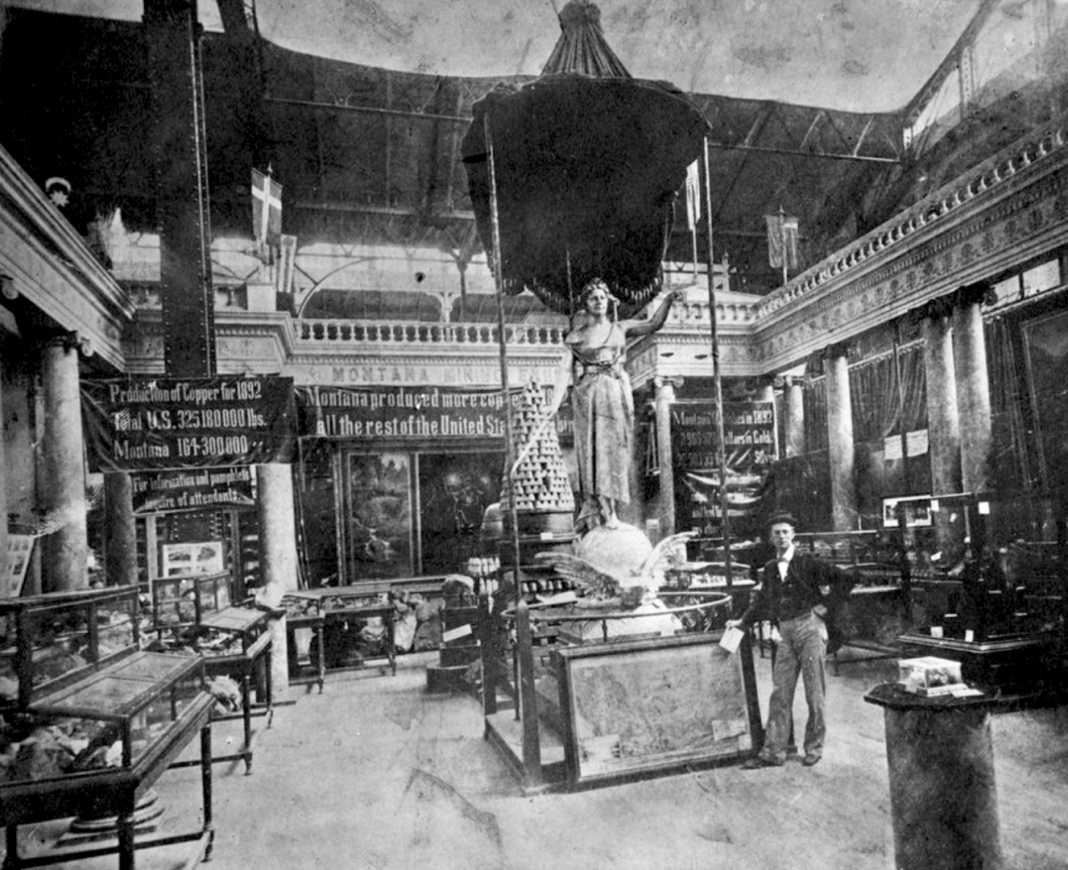
Partly to dispel this attitude and partly to brag about the resources of this new state, the Montana legislature appropriated $50,000 to set up an exhibit at the World’s Fair in Chicago in 1893.
A board of World’s Fair Managers was established and a canvass was started to collect exhibits.
Clyde J. Tooker who was furnishing granite to line the Amazon tunnel offered all the granite necessary for the building steps or pillars from the granite quarry west of Boulder. Everyone started saving for the trip to the fair and a chance to visit relatives in the area.
Karl M. Hansen, a reporter for the Boulder Age, started out on his bicycle which he used in combination with railroad travel by special round trip fare of $70 on the Union Pacific. Karl also kept track of his expenses, which he itemized as follows:
Round Trip Railroad fare$70.00
Admission (30 days @50 cents) $15.00
Admittance to Midway$14.50
Car Fare (30 days@ 20 cents)$6.00
Room (4 2 weeks @3.50)15.75
90 restaurant meals @25 cents$22.50
Total$143.75
Near the entrance of the fairgrounds was a small building labeled “Montana,” which consisted mainly of stuffed animals and skins. There was a model of a house made out of small pieces of quartz from Jefferson County and above it a large crayon photograph of Boulder Springs and vicinity done by John Berkin, Boulder, and Robert Swaim, Helena. Swaim was to the miners what Charles Russell was to the cowboys.
A school exhibit from the Boulder school was in the education building. Also, a picture of the courthouse with D. G. Warner’s residence in the background, looking very life-like with a figure of D. G. walking through the field smoking his pipe.
In the mining building was an exhibit of crystallized silver from the Elkhorn mine, as well as a silver candlestick presented by the ladies of that camp, behind which was a large photograph of the Elkhorn townsite also donated by the ladies of Elkhorn. There was also a large exhibit of copper ingots from the Parrot and Anaconda mines at Butte in native form and also refined.
Karl decided not to return to Boulder and went to work for a mercantile establishment owned by his brother-in-law in Thief River Falls, Minnesota.