
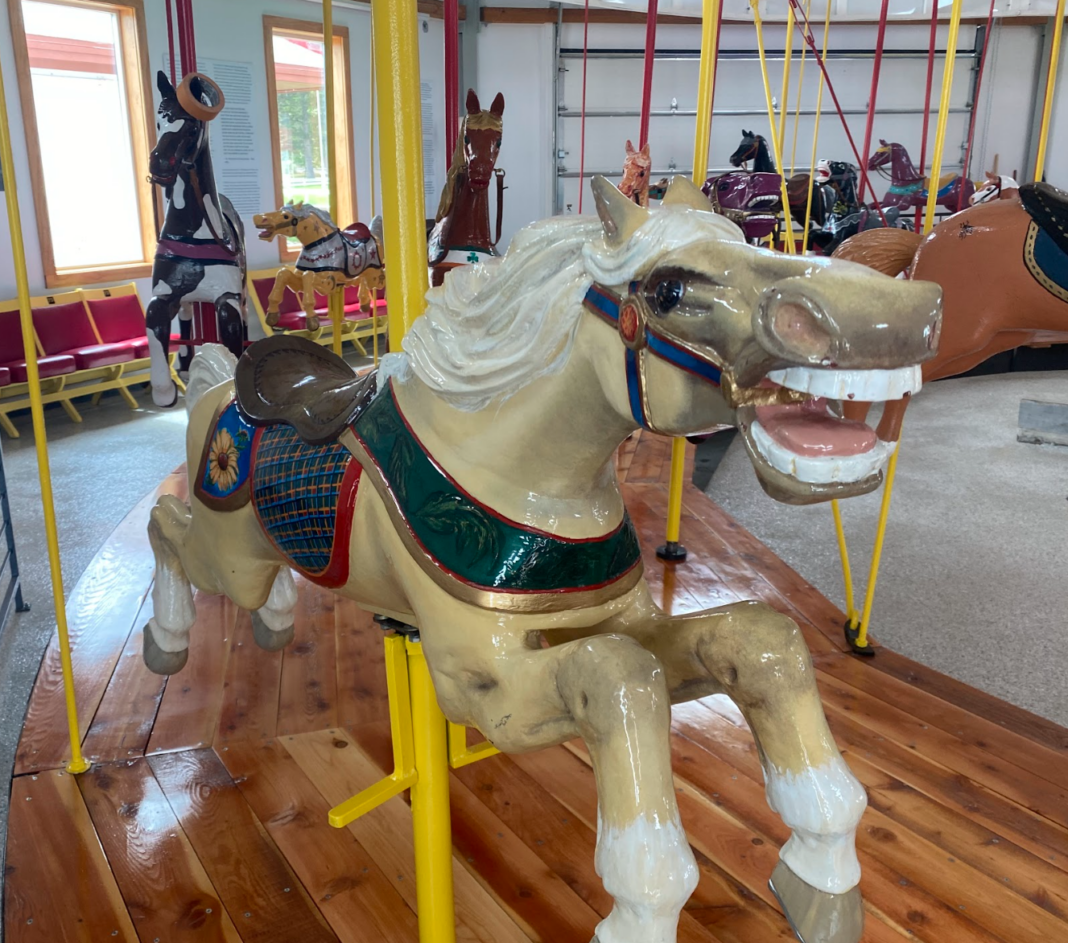
When the Jefferson County Fair and Rodeo opens Aug. 21, excited youngsters will surely rush to the round white building to the right of the entrance for a bracing ride on a shiny, colorful pony.
But few will be aware that they are spinning through an emblem of Montana’s proud history of ingenuity and persistence. “It is a true treasure to this community,” said Donna Gilmer of the nonprofit Boulder River Carousel group.
The story starts in the 1950s, when Dr. Arthur Westwell, superintendent of the Boulder-based Montana School for the Deaf and Dumb (later the Montana State Training School), decided the school’s students would enjoy an amusement park. Westwell tapped the school’s maintenance foreman, Harold Jessen, to build a ferris wheel, swan boat, and road-ready choo-choo train.
But the duo needed help when it came to their ambitious, 40-foot carousel. The school couldn’t afford all the parts from the Allan Herschell Company, one of the era’s top carousel makers. Innovating and improvising, Westwell found a more affordable path.
Using the Columbia Gardens carousel in Butte as a blueprint, he decided to have the machine built locally. Jessen and his team, thoroughly inexperienced in carousel construction, worked nights and weekends to build the pieces, according to the National Carousel Association.
Next, the operation cut costs by persuading Boulder residents to hand over their old pots and pans, which were then melted down for the aluminum to be used for the animals and chariots, in addition to scrap aluminum from a nearby mining company.
Finally, enter the renowned Aaron “Scoops” Brill, who had established a national reputation via catalogs peddling carnival attractions. His A. Brill Enterprises molds were widely seen as the best around – and are still cherished today. Westwell wrote to Brill, detailing their plight, and soon got his hands on discounted Brill molds to cast the carousel horses.
In the end, Westwell, Jessen, and the workers crafted a stunning carousel for just $2,430, or the equivalent of about $27,000 today. Once you consider that Carousel Works’s 2010 construction of a wooden carousel in Florida ran to $400,000, you begin to appreciate the ingenuity of this crew. They got the job done for maybe one-tenth the expected cost.
The carousel first started spinning in 1959, when the institution still housed mainly children. The school soon began sending child students to group homes and by the 1970s its residents were mostly adults, according to Gilmer, who worked for years in human resources at the compound.
The amusement park fell into disrepair. The ferris wheel was dismantled and shipped away, never to be ridden again. The swan boat seems to have disappeared. The train still today features in Boulder parades, but the carousel sat dormant, aging fast.
Renamed the Montana Developmental Center in 1985, the compound decided it was time for a redesign, which meant getting rid of the carousel. A group of volunteer firefighters stepped up, including Gilmer’s late husband, Bruce, and asked the state if they could move it to the then-state-owned fairgrounds, known as Jefferson County Recreation Park. [Added to the National Register of Historic Places in 1985, the Montana State Training School building has been vacant since the state shuttered the MDC in 2017.]
Bruce, the former Boulder Volunteer Fire Department chief who passed away in 2023, fought to preserve this small piece of Boulder history along with his crew. “He remembered as a kid being able to go out there and ride this merry-go-round,” Donna told The Monitor. “He just thought that it was worth saving.”
Securing approval from the state in 1995, the firefighters and Jim Stout Excavation transported the carousel to the fairgrounds and Gilmer and his carousel crew got down to fundraising. To pitch in, Boulder residents started purchasing carousel horses to paint themselves and send back to the carousel.
Ponies too damaged to repair were recast just as Jessen had done it 40 years before. With the help of Caird Engineering molder Bob Clearman, the same Brill molds and furnace system were used to recast 10 new replacement horses.
In 1996, Boulder welcomed Gov. Mark Racicot to cut the ribbon on the lovingly restored carousel. But back then, the carousel remained outside and uncovered, exposed to all the elements of Montana’s brutal winters. This meant that volunteers with the recently founded Boulder River Carousel had to laboriously remove and store the horses after each use.
This went on for a dozen years until Bruce Gilmer and a team of volunteers built the carousel a wood roof in 2008. Echoing the carousel’s initial construction, the structure was built by volunteers and with community-donated materials.
Then-NCA President Bette Largent visited Boulder in 2010 and found herself so inspired she wrote a short history of the carousel, which she believes outshines all others made from Brill molds. “How the community stepped up… moving it, supporting it,” she told The Monitor. “There isn’t another Brill that has been supported like that.”
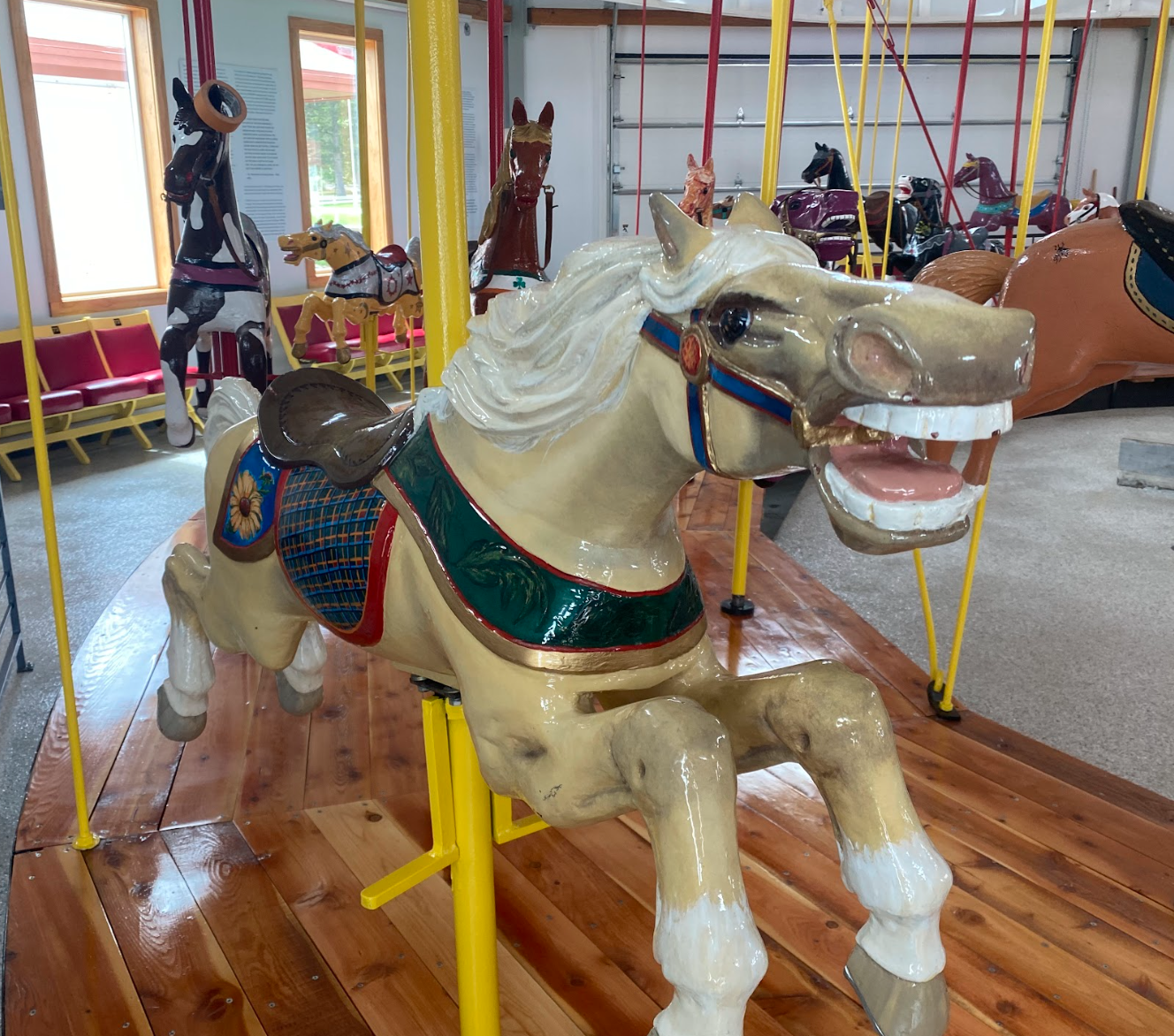
A decade ago, another team of volunteers led by Gilmer and locals like Bud and Paulette Smith, Bill Crenshaw, Greg Gill, Lester and Shirley Vossler, Jim Richardson, and Lottie Vossler, added wooden walls to the roof, completing the building.
They have since repainted the carousel’s yellow and red poles, refinished the deck, and added a reflection bench. Today, the carousel serves all comers during the county fair and for weddings, birthdays, and other events. Bookings can be made via Donna Gilmer at (406) 459-4316.
Those interested in the carousel’s history might examine its building’s inner walls, which detail its construction, abandonment, and revitalization. Every August, as the carousel welcomes revelers to the county fair, it carries not just young riders – but also the legacy of a community that refused to let its history rust away.