
The warm summer days bring life to its peak in many local gardens and fields in Montana. Beautiful bitterroot, gorgeous glacier lily, and the ever so lovely lupine fill the landscape with stunning color. There is something amiss, however. Something is spreading rapidly, consuming fields, and taking valuable space away from our beloved native species.
Its clustered stems, expanding root system, milky white sap, narrow leaves, and bright green flowers encased in a yellow-green bract are characteristic of one of Montana’s most notorious noxious weeds, the leafy spurge (Euphorbia esula).
This species, like many other noxious weeds, is native to Eurasia. It was most likely brought to North America via contaminated ship ballasts; the earliest record of its presence in North America dates to 1827. This herbaceous perennial is a threatening weed that dominates pastures and roadsides. Its success lies in its ability to reproduce by seed and spread its root system, which makes hand pulling less efficient, due to the need to remove all of its deep roots.
Peak germination occurs in April and May, when the sticky leafy spurge seeds are able to travel via waterways or by hitching a ride on humans and other animals. Their seeds are viable for up to 8 years in the soil, making this weed a very difficult one to conquer.
Thankfully, we have two types of very effective biocontrol agents that can help: several species of leafy spurge flea beetles (Aphthona spp.); and the red-headed leafy spurge borer beetle (Oberea erythrocephala).
Two of the more common species of flea beetle are the brown legged leafy spurge flea beetle (Aphthona lacertosa) and the black dot leafy spurge flea beetle (Aphthona nigriscutis). Both are strong, capable insects that specialize in consuming this weed and this weed only.
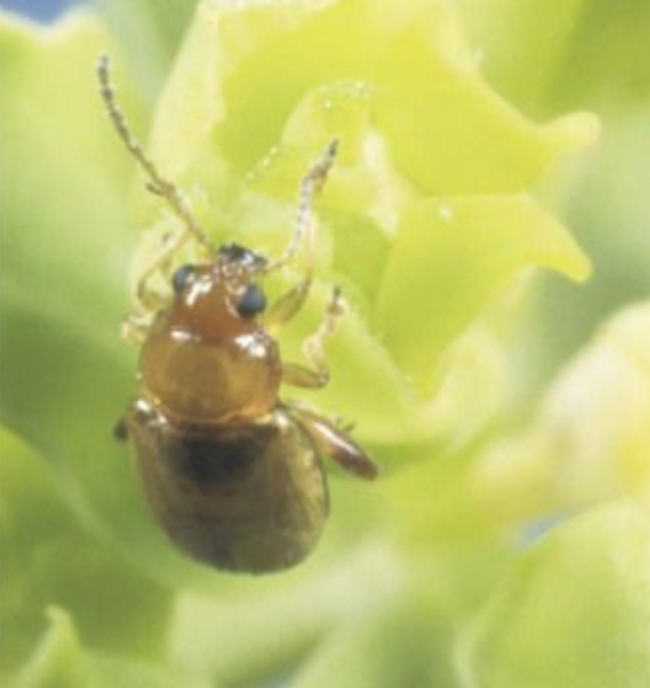
The brown-legged leafy spurge flea beetle adult has a shiny, black body with reddish-brown legs. The larvae are slender, with an off-white color and brown head. An adult black dot leafy spurge flea beetle has an orangish-brown body with a black dot near the edge of its wings.
Their larvae look almost identical to the brown flea beetle. Both species emerge as adults from the soil in the early summer months to feed on the plant material and mate. The female flea beetles lay their eggs at the stem base or near the roots within the soil. As they hatch, the minute larvae feed on the root system (doing the majority of this beetle’s plant damage) throughout the fall and into the early spring, when they begin to pupate. The larvae easily survive Montana’s winters underground, and this cycle repeats itself as pupated larvae turn into adults that feed on the leafy spurge leaves.
These two species of flea beetles cause severe damage to roots, preventing the plant from taking in adequate nutrients, and to the leaves as adults, which makes it difficult for the plant to photosynthesize. These flea beetles work best on dry, open, hot sites. They do not work next to ponds, streams, or flood irrigation, where the larvae are likely to drown. Slowly, as the years pass, the flea beetles will reduce the presence of leafy spurge.
The red-headed leafy spurge borer beetle is slender, with long antennae and dark wings contrasting their red heads. In spring and summer, as temperatures rise, the adults emerge from the soil surrounding the leafy spurge. After mating, the females lay their eggs (one per stem) near the bottom of the leafy spurge stem.
As the larvae grow and hatch they eat their way down the stem and into the spurge’s root system. They survive the winter within the root system or the stem and emerge in the spring as adults to start the cycle again. These beetles are fantastic fliers, and we’ve found them all over Montana. We no longer release them due to their prevalence throughout Montana.
Using biocontrol agents may be a slow process, but it is also natural, completely safe, and with the Whitehall Project, totally free (donations welcome). We collect, study and rear all sorts of biocontrol agents, including for weeds like Dalmatian toadflax, yellow toadflax, leafy spurge, spotted knapweed, Russian knapweed, whitetop, and Canada thistle.
The season for Dalmatian toadflax insects has ended, which leads us to the season where leafy spurge insects begin to emerge. With that, we will collect them from known sites for local redistribution. They should be available from late June to mid-July. These specialized insects know what they are doing, and our goal is to help them help you to the best of their ability.
Any questions, comments, or concerns? Contact Ava Balough at (703) 870-5696 or Whitehall Project Coordinator Todd Breitenfeld at (406) 498-5236 during normal business hours.
Ava Balough is a conservation intern for the Whitehall Biological Weed Control Project.