
Last month in Yellowstone National Park my young daughter barreled down a roadside bank to see bison in the Hayden Valley. She tripped, and I held my breath as she hung airborne for a moment, then slammed hard on her belly and skidded downhill, plowing dirt with her face, her legs curled up over her head like a scorpion tail.
I cuddled her bruised body and pride on the hillside. She spat grit from her teeth while tourists stampeded past to get their outdoor fix in a place that protects wildness by prohibiting most forms of development and resource extraction.
Where we live, near Whitehall, there are no bison. But we know a good many places in the forest to camp and fish and explore because there are few roads, few people, and ridge after ridge of elk tracks and headwater creeks.
In 2001, the federal government protected these forests by enacting the Roadless Rule. Decades of logging and recreational travel had taken its toll on our national forests, and the Forest Service saw a need for a safer, more affordable and environmentally sound road system and grew that need into a policy to preserve ecological integrity.
The Roadless Rule prohibits road-building and timber harvesting in what are known as inventoried roadless areas (IRAs) covering almost 59 million acres across the country. Of Montana’s 18 million acres of public lands, one third, or about 6M acres, are designated as roadless. Jefferson County has more than 76,000 acres of IRA between Whitehall and Boulder, 80,000 more in the Elkhorn Mountains, and a bit more acreage in the Boulder Mountains north of Basin.
In June, U.S. Secretary of Agriculture Brooke Rollins, who as head of the USDA oversees the Forest Service, announced her intent to rescind the Roadless Rule, allowing road construction and timber harvest in IRAs. This would give Forest Service personnel greater management leeway to confront wildfire risk and boost timber production to benefit forest health and economies. In addition, decision-making could revert to local experts who know how to tackle modern conditions like dense tress stands, insects, disease, and wildfire.
But the rollback would expose critical areas. Lumber-hauling vehicles, heavy equipment and traffic and more recreation could follow new logging roads. Besides, the Forest Service can’t afford new roads: it already has a huge maintenance backlog on existing roads.
Many IRAs are so rugged or lack trees with timber value that it makes no sense to expand access there. The current rule already allows logging of smaller trees to reduce fire risk, improve habitat, or aid endangered species recovery. And some analysts say existing, accessible forest areas can handle the 25% increase in timber production ordered by President Trump in March.
Meanwhile, pressures like human development and a changing climate are already fragmenting key, undeveloped land tracts that have withstood transformation caused by roads and resource extraction.
So is it a good idea to rescind the rule? Like my daughter who launched off from the roadside to see bison in their home range, how we land depends on our approach. Across the nation and even Montana, not all IRAs are the same, nor are our communities.
Some IRAs near large population centers buffer wilderness from human demands; some IRAs dense with deadfall unnerve residents with the threat of wildfire. Other IRAs near surviving timber infrastructure could support a vital economy struggling to survive across the region.
Local forest conditions, predominant pressures, and key vulnerabilities influence what a community values. How do we value roadless areas and their influence on our economies, public safety, and habitat? Throw increasing human development and climate change into the mix and we hang airborne for a moment, surveying the land.
Here in Jefferson County, outdoor recreation is a magnet for tourism. Pipestone’s popular motorized trail system attracts surging forest visitation along the Whitetail IRA; new campground and vehicle rental businesses are sparking a local economy, but the Forest Service has no travel regulation.
Increasing traffic spills into the roadless area without oversight or enforcement; lost riders and traumatic injuries in rugged terrain are straining first responders. Meanwhile, local groups have been pushing for solutions that consider all interests.
Lifting the Roadless Rule could expand recreational road access here. But many riders ignore safety risks and erosion while local services are strained. Can Pipestone handle more roads for recreation? Would removing roadless protections undermine management efforts?
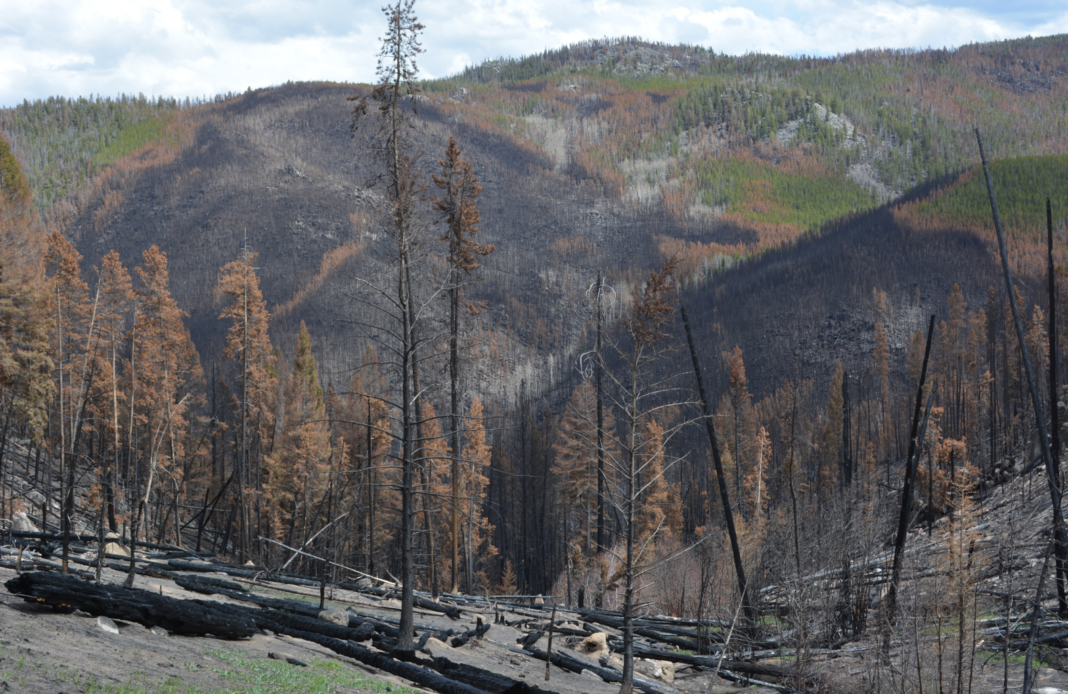
A 2021 wildfire west of Boulder burned a sizable chunk of IRA. Residents surely recall the smoke and evacuation notices. But the fire reshaped the forest. Before, the IRA was dense with snags poised to burn. Today, the burn is regrowing a new forest. A road corridor traces steep slopes along the Little Boulder River where post-fire erosion plunged boulders and ash into impassable washouts that complicated access and were costly for the Forest Service and county to repair. Even experts are unsure of the best management approach to this area now, though most agree that ecological assessments and monitoring could help determine appropriate use.
In the Elkhorn Mountains, wildlife is king. One of the largest roadless areas in southwest Montana stretches across the heart of the Elkhorn Wildlife Management Unit, unique on Forest Service lands across the nation for its core focus on habitat management for elk and other wildlife. This IRA is in a premier hunting district renowned for trophy bull elk. Local hunters and grazers have spent decades coming together to hash out issues of elk population and forage competition with livestock.
Now, Helena’s thriving mountain biking scene wants a piece of this prized land with a new trail system. And recent sightings of grizzly bears, threatened under the Endangered Species Act, draw conservation attention for their potential to genetically connect divided populations.
But the Elkhorns’ wildlife priority seems to have lost some of its management focus. How will wildlife protections, hunting plans, and recreational economics be impacted if road construction is allowed throughout the Elkhorns?
I hold the position of vice-chair of Jefferson County’s Parks, Trails, and Recreation Commission, but I’m writing this article not as a representative of any county body, but as a concerned resident who cherishes wildlife and wild lands. Roadless Rule protections took decades to achieve, and the policy is entrenched in other regulations, complicating rollback.
With simultaneous reforms to other federal protections, we’re blasting full-tilt at major change. The chaos has left many of us who love America’s revered national forests shellshocked. In this ambitious charge for efficient management, we could trip and, like my daughter, land face-first.
Her flexibility saved her, but she wasn’t happy eating dirt. I prize the passion that drove her headlong rush. But passion can be reckless. We need targets and details and specifics.
But what we may need even more are those brief moments where we hang between one path and another, asking: What do we value in our wild lands? How can we protect them while considering local needs?
If I do things right by my daughter, the bison she wants to see will be there, thriving for many decades to come, and so will the land they need.