

We’re very pleased to provide you with the annual Water Quality Report. We want to keep you informed about the excellent water and services we have delivered to you over the past year. Our goal is and always has been, to provide to you a safe and dependable supply of drinking water. Our water source is groundwater from two active wells in the Boulder River alluvial aquifer. A source water assessment will be provided when it is completed.
This report is a snapshot of last year’s water quality. Included are details about where your water comes from, what it contains, and how it compares to standards set by regulatory agencies. We are committed to providing you with information because informed customers are our best allies.
If you have any questions about this report or concerning your water, please contact Dennis Wortman, Water Operator, or City Hall at 225-3381. We want our valued customers to be informed about their water utility. If you want to learn more, please attend any of our regularly scheduled meetings. They are held on the third Monday of the month at 6:30 pm.
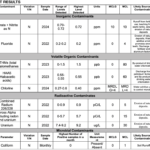
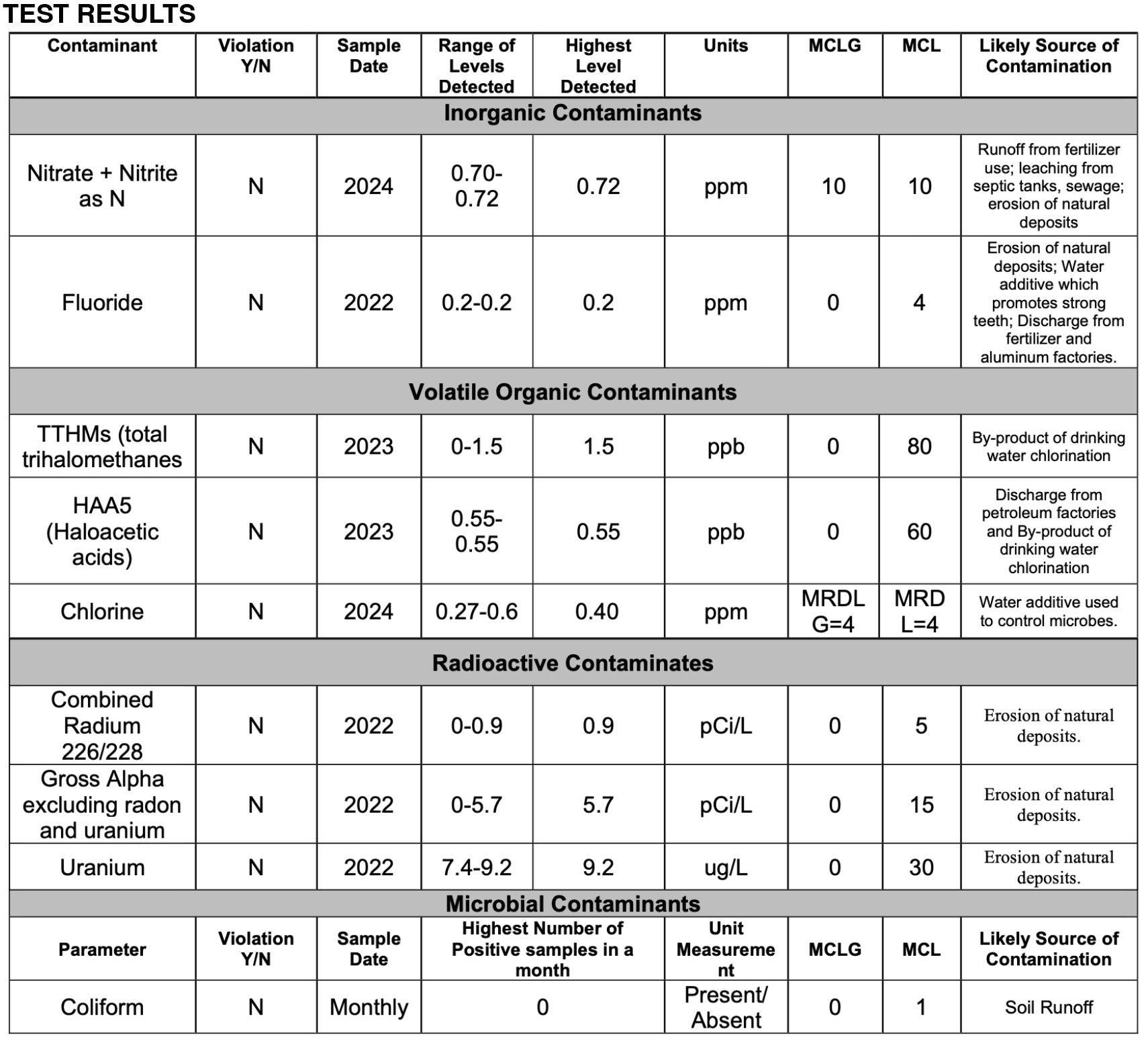
The Boulder Water Treatment Plant routinely monitors for constituents in your drinking water according to Federal and State laws. The following table shows the results of any detects in our monitoring for the period of January 1st to December 31st, 2024. For constituents that are not monitored yearly, we have reviewed our records back to the last time the constituent was monitored.

In the tables above and below you will find many terms and abbreviations you might not be familiar with. To help you better understand these terms we’ve provided the following definitions:
Parts per billion (ppb) or Micrograms per liter (ug/l) – one part per billion corresponds to one minute in 2000 years or a single penny in $10,000,000.
Parts per million (ppm) or Milligrams per liter (mg/l) – one part per million corresponds to one minute in two years or a single penny in $10,000.
Action Level – the concentration of a contaminant, which, if exceeded, triggers treatment or other requirements, which a water system must follow.
Treatment Technique (TT) – A treatment technique is a required process intended to reduce the level of a contaminant in drinking water.
Maximum Contaminant Level – The “Maximum Allowed” (MCL) is the highest level of a contaminant that is allowed in drinking water. MCLs are set as close to the MCLGs as feasible using the best available treatment technology.
Maximum Contaminant Level Goal – The “Goal” (MCLG) is the level of a contaminant in drinking water below which there is no known or expected risk to health. MCLGs allow for a margin of safety.
Maximum Residual Disinfectant Level (MRDL)-The Highest level of a disinfectant allowed in drinking water. There is convincing evidence that addition of a disinfectant is necessary for control of microbial contaminants.
Maximum Residual Detection Limit Goal or MRDLG-The level of a drinking water disinfectant below which there is no known or expected risk to health. MRDLGs do not reflect the benefits of the use of disinfectants to control microbial contaminants.
Picocuries per liter (pCi/L)-picocuries per liter is a measure of the radioactivity in water.
Level 1 Assessment- A Level 1 assessment is a study of the water system to identify potential problems and determine (if possible) why total coliform bacteria have been found in our water system.
Level 2 Assessment- A Level 2 assessment is a very detailed study of the water system to identify potential problems and determine (if possible) why an E. coli MCL violation has occurred and/or why total coliform bacteria have been found in our water system on multiple occasions.
Violations: Our system failed to test our drinking water for the contaminant period 01/01/2024 through 12/31/2024. Because of this failure, we cannot be sure of the quality of our drinking water during the period indicated. An acceptable DBP sample report has not been submitted to the State of Montana DEQ so the violation is still outstanding.
Our system failed to monitor and record the daily minimum entry point chlorine residuals and report them to DEQ for the period of 04/01/2024 through 04/30/2024. Because of this, we cannot be sure of the water quality at this time. The violation was returned to compliance once the system submitted one full month’s of data by 10th of the following month, and for said month, the system did not have any days with a chlorine residual below the mandatory level.
Nitrate: In drinking water, a nitrate level above 10 ppm is a health risk for infants of less than six months of age. High nitrate levels in drinking water can cause blue baby syndrome. Nitrate levels may rise quickly for short periods of time because of rainfall or agricultural activity. If you are caring for an infant, you should ask advice from your health care provider. As a precaution we always notify physicians and health care providers in this area if there is ever a higher than normal level of nitrates in the water supply.
Fluoride: Some people who drink water that contains fluoride in excess of the MCL over many years could get bone disease, including pain and tenderness of the bones. Fluoride in drinking water at half the MCL or more may cause mottling of children’s teeth, usually in children less than nine years old. Mottling, also known as dental fluorosis, may include brown staining and/or pitting of the teeth, and occurs only in developing teeth before they erupt from the gums.
Chlorine: Some people who use water containing chlorine well in excess of the MRDL could experience irritating effects to their eyes and nose. Some people who drink water containing chlorine well in excess of the MRDL could experience stomach discomfort.
TTHMs [Total Trihalomethanes]: Some people who drink water that contains trihalomethanes in excess of the MCL over many years may experience problems with their liver, kidneys, or central nervous systems, and may have an increased risk of getting cancer.
HAA5 (Haloacetic Acids): Some people who drink water containing Haloacetic Acids in excess of the MCL over many years may have an increased risk of getting cancer.
Copper: Copper is an essential nutrient, but some people who drink water containing copper in excess of the action level over a relatively short amount of time could experience gastrointestinal distress. Some people who drink that water contains copper in excess of the action level over many years could suffer liver or kidney damage. People with Wilson’s Disease should consult their personal doctor.
Lead: Infants and children who drink water that contains lead in excess of the action level could experience delays in their physical or mental development. Children could show slight deficits in attention span and learning abilities. Adults who drink this water over many years could develop kidney problems or high blood pressure.
Uranium: Some people who drink water containing uranium in excess of the MCL over many years have increased risk of getting cancer and kidney toxicity.
If present, elevated levels of Lead can cause serious health problems, especially for pregnant women and young children. Lead in drinking water is primarily from materials and components associated with service lines and home plumbing. City of Boulder is responsible for providing high quality drinking water but cannot control the variety of materials used in plumbing components. When your water has been sitting for several hours, you can minimize the potential for lead exposure by flushing your tap for 30 seconds to 2 minutes before using water for drinking or cooking. If you are concerned about the lead in drinking water, testing methods and steps you can take to minimize exposure is available from the Safe Drinking Water Hotline or at http://www.epa.gov/safewater/lead.
All sources of drinking water are subject to potential contamination by constituents that are naturally occurring or are man made. Those constituents can be microbes, organic or inorganic chemicals, or radioactive materials.
All drinking water, including bottled water, may reasonably be expected to contain at least small amounts of some contaminants. The presence of contaminants does not necessarily indicate that the water poses a health risk. More information about contaminants and potential health effects can be obtained by calling the Environmental Protection Agency’s Safe Drinking Water Hotline at 1-800-426-4791.
MCL’s are set at very stringent levels. To understand the possible health effects described for many regulated constituents, a person would have to drink 2 liters of water every day at the MCL level for a lifetime to have a one-in-a-million chance of having the described health effect.
Some people may be more vulnerable to contaminants in drinking water than the general population. Immuno-compromised persons such as persons with cancer undergoing chemotherapy, persons who have undergone organ transplants, people with HIV/AIDS or other immune system disorders, some elderly, and infants can be particularly at risk from infections. These people should seek advice about drinking water from their health care providers. EPA/CDC guidelines on appropriate means to lessen the risk of infection by cryptosporidium and other microbiological contaminants are available from the Safe Drinking Water Hotline (800-426-4791).
We ask that all our customers help us protect our water sources, which are the heart of our community, our way of life and our children’s future.
Legal 25-064 Published in the Boulder Monitor June 11, 2025 MNAXLP