
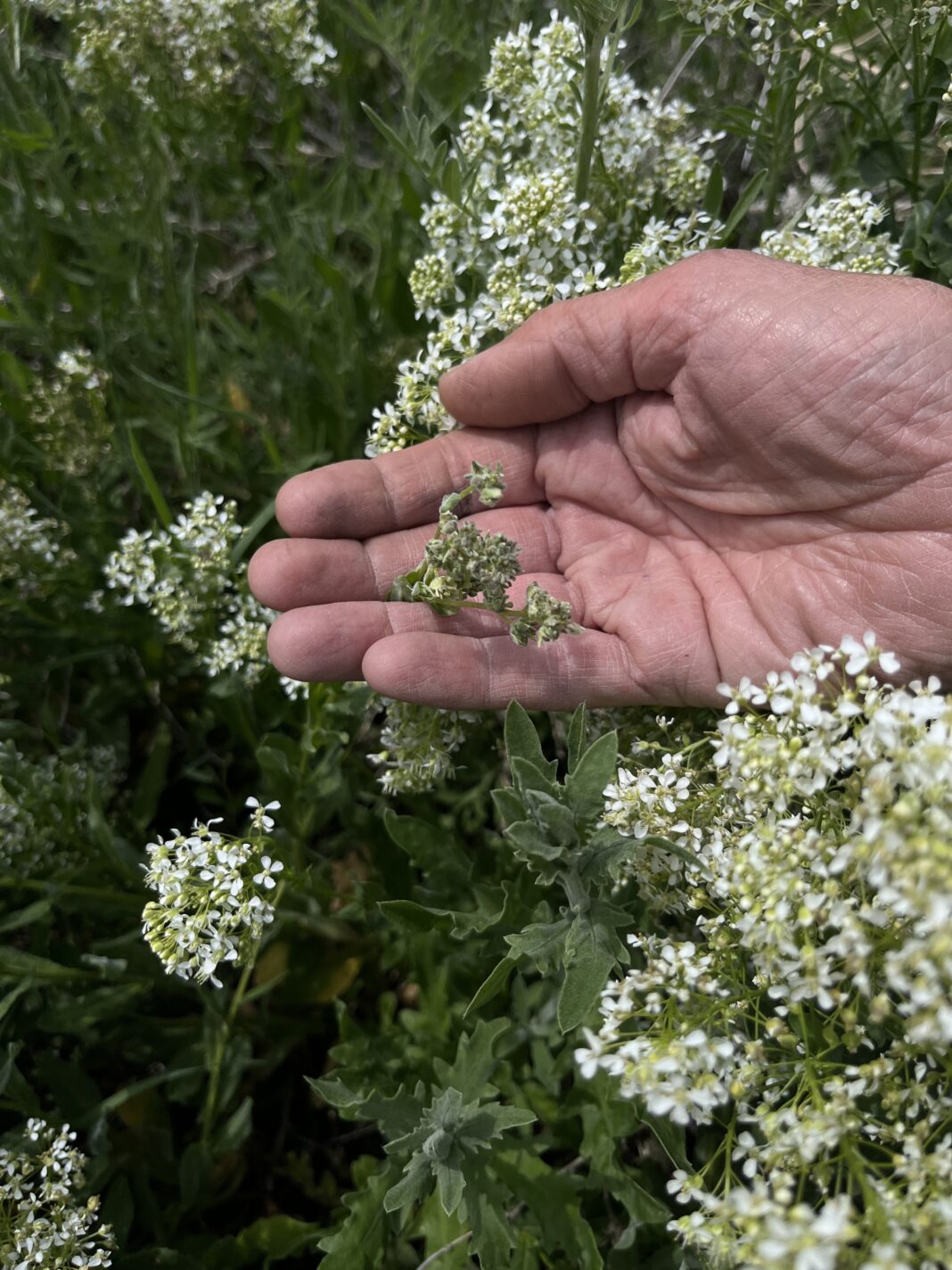
As you drive along your hometown roads and gaze out your window, you might notice clusters of small white flowers. This persistent perennial, known as whitetop, or hoary cresses (Lepidium drabae), is not welcome in the state of Montana, and it is categorized as a noxious weed in 23 other states as well.
Brought here from Eurasia in the 19th century, whitetop continues to infiltrate crop lands, open fields, and heavily irrigated areas. It is deep rooted and aggressive, making it the perfect disaster amid your nicely designed gardens. As it increases in prevalence, we encourage you to explore an interesting method of whitetop control.
That would be the whitetop gall mite (Aceria drabae). This elusive, almost microscopic arachnid specializes in whitetop, making it a safe critter to have on your land. It survives the winter within the dormant root buds, located at the base of the whitetop stem. As spring approaches, the mites migrate out of the base and up throughout the growing plant tissue. This is where they feed and lay their eggs. Their feedings create galls, a swelling often seen along the developing stem and the flower buds. This turns the pristine white flower clusters into a green clustered mess, closely resembling broccoli. Most of the damaged flowers will not produce seeds. This also weakens the plant.
Although the galls created from the whitetop gall mite don’t kill the whitetop outright, we believe that utilizing these mites is a good addition to other methods of weed reduction and management. Just note that it can take a few years before there is a noticeable difference in the whitetop prevalence.
If you have whitetop on your land and would be interested in this method of weed control, please contact me at (703) 870-5696, or Todd Breitenfeldt at (406) 498-5236 during normal business hours. We most likely will not have enough mites to release this year, but stay tuned for the future. It is very helpful for us to have planned release sites for when we can release these mites, so please let us know if you would like to be included in our future site list.
Ava Balough is a conservation Intern for the Jefferson County Weed District’s Whitehall Project.