
A test question I will never forget from a Montana Geography class I took is that the source of the Yellowstone River is a trickle on Younts Peak. That answer has followed me to every river, stream or backyard ditch I have gandered upon ever since: Where is its source?
The source of a river is defined as the original point from which the river flows. Yet this is one of those instances where the dictionary leaves you knowing less than when you started. Is it the furthest reach of the stream itself, and goes no further than the confluence of tributaries that result in the actual named feature? Does it have to be perennial, or do intermittent streams count? What of ephemeral drainages, like those that run full when the gully washers of June pour over the Continental Divide?
The primary drainage of northern Jefferson County is Prickly Pear Creek, which consolidates the catchments of the northern Elkhorns and Boulder Mountains and guides them to the Missouri River. As a 10-year-old kid trying to hook a brookie near Clancy, I could look south to Elkhorn Peak and its volcanic silhouette and know that the water I stood in came from somewhere up there. In fact, the furthest reaches of Prickly Pear Creek can be found in the snowmelt-fed springs of Rabbit Gulch, high on the northern flank of Elkhorn Peak.
It’s likely that at some point many Montanans have told someone from outside the state (or even inside) that they were from Boulder or going there, and that someone replied, “Colorado?” A similar instance of dueling Boulder identities exists within the state’s boundaries, not of cities but of waterways.
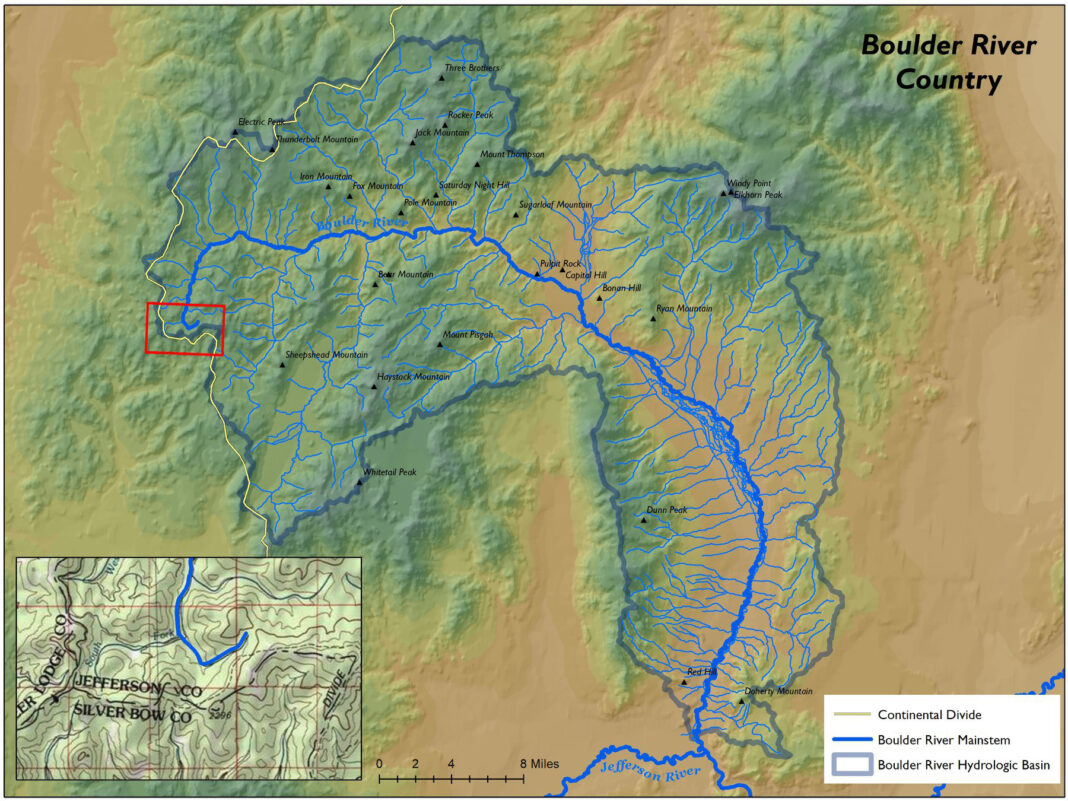
Yes, two Boulder Rivers flow in Montana. One starts high and flows north, demarcates the boundary between the Absaroka and Beartooth mountain ranges, and is picturesque and popular, eventually flowing into the Yellowstone near Big Timber. The other we in Jefferson County know well: it starts north of Butte, flows east then south, where it deals with a bit of yesteryear’s mine waste, sucks up next to I-15 and shortly after departing that corridor meanders through the Boulder Valley and ends up in the Jefferson River near Cardwell.
One could argue that the source of Jefferson County’s Boulder River is the upper reach of Bison Creek, at the extreme southern end of Elk Park, as it is the furthest perennial stream from the mouth of the Boulder. I instead have settled on a mix of answers to the question of what a source is, taking the furthest reach of the named Boulder River, and looking at the most distant perennial stream that flows into that named reach.
And so in the inset of the accompanying map you can see that the source of the Boulder River is the South Fork, a hundred feet below the Continental Divide where three counties meet. You could hop over it, but try not to trip on a beetle-killed lodgepole when you land.
Bret Lian grew up in Clancy and lives in Jefferson City with his wife Lisa, their three children and a dog. The places and histories of Jefferson County and beyond have always provided endless daydreaming material to this geography-minded Montanan, who provides this column monthly to the Monitor.