It has been quite a month here at The Monitor’s world headquarters. As you may remember, our Mar. 5 issue featured an “editor’s note” by Conor Reilley, who opined in favor of the federal government cuts engineered by Elon Musk’s Department of Government Efficiency. A week later, we published two guest columns critiquing Conor’s piece.
Unusually, both of those “Response” pages sparked demands from readers to cancel their subscriptions. Some were upset by what they saw as Conor’s recklessness, and by The Monitor’s lack of accountability in publishing his note. Another was put off by the subsequent criticism of DOGE, and by our (ok, my) scribbled-in devil horns on the accompanying sketch of Musk.
I’ll return to those critiques in a moment. For now, let me say that, while I hate losing subscribers — it’s bad for The Monitor, and it’s terrible for civic function — you could argue that this episode played out more or less as it should have.
To be reductionist about it: Writers with opposing perspectives were free to say what they wanted about an issue that mattered to them, as long as what they said wasn’t hateful or anchored in falsehoods. The Monitor was free to publish those opinions, as long as they weren’t libelous or defamatory.
And readers were free to stop buying our product to demonstrate their dissatisfaction. Money does talk, up to a point.
But this is an unsatisfying and, I’d say, dangerous logic. To understand why, let’s consider the assault on free speech currently being engineered by the Trump administration.
In an executive order issued on his first day in office, the President rightly declared that “government censorship of speech is intolerable in a free society.” His actions since, though, have betrayed the unspoken footnote: “unless I decide otherwise.”
In February, Trump barred the Associated Press from White House events, after the AP opted not to parrot his official renaming of the Gulf of Mexico — an exchange that would have seemed ripped out of The Onion were it not actually, incredibly, true. Two weeks later, the White House announced that it would determine which news organizations comprised its press pool, seizing that prerogative from the White House Correspondents Association and promptly installing Trump-friendly outlets.
Which some have justified as fair play. After all, the AP and other media establishments have been free to print what they want, and the Trump administration has been free to punish reporting or perspective it didn’t like.
But as many had feared, those were just warm-up acts before the main show. On Mar. 17, federal agents arrested Mahmoud Khalil, a Columbia University graduate student and legal permanent resident who has helped lead pro-Palestinian campus protests. Secretary of State Marco Rubio told reporters afterward, “this is not about free speech.” But Khalil was in the U.S. legally, and he had committed no crime. His offense, if you will, was to engage in public demonstrations that opposed Israeli policy, a position the administration has deemed seditious.
As conservative commentator Ann Coulter wrote starkly on X: “There’s almost no one I don’t want to deport, but, unless they’ve committed a crime, isn’t this a violation of the first amendment?”
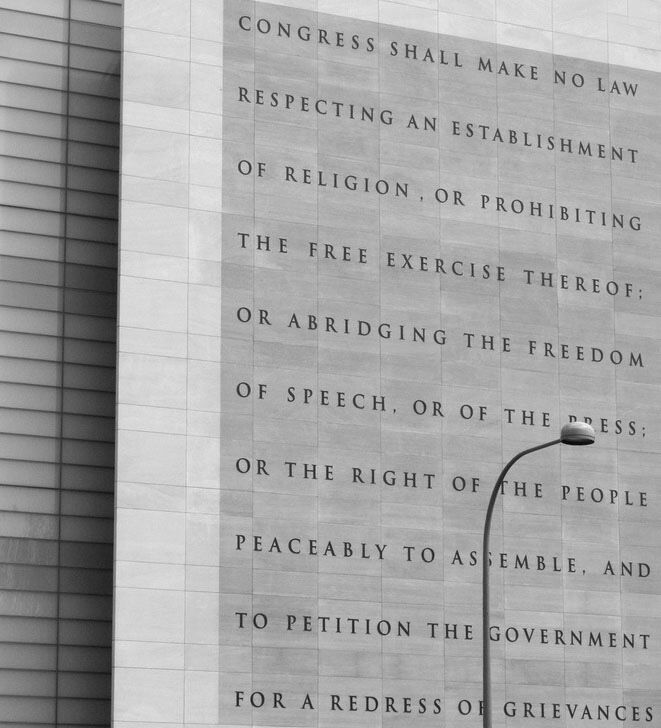
It very much is. Let’s repeat together: “Congress shall make no law…abridging the freedom of speech.” Even if your livelihood does not, like mine, literally depend on the viability of free expression, you should be troubled by this downward spiral. The implication is that we are free to say what we think as long as what we say is deemed acceptable by the President — who may decide, with his next executive order, that it’s not.
To be sure, President Trump is not the first to attempt to silence critics; just look at pretty much every previous administration, not least Biden’s. Most egregiously, Woodrow Wilson’s Sedition Act of 1918, targeting socialists, pacifists, and other anti-war activists, aimed to punish those who “shall willfully utter, print, write, or publish any disloyal, profane, scurrilous, or abusive language about the form of government of the United States, or the Constitution of the United States, or the military or naval forces of the United States.”
But the Supreme Court eventually reversed that act and the similar 1917 Espionage Act, and since the 1960s, U.S law has broadly protected speech freedom. President Trump’s early actions threaten to corrode, if not abandon, decades of legal precedent, and to dismantle a pillar of democratic function.
OK. Let’s return to our local matter of the pro- and anti-DOGE pieces that appeared in The Monitor.
Critics of Conor Reilley’s note argue that it perpetuated misinformation. This is fair: Conor wrote, “DOGE claims to have already saved $65 billion by facilitating the elimination of thousands of pending grants.” He hedged this statement with the word “claims” — but the fact is that, by then, the $65 billion figure had been widely discredited, and the piece should have noted that.
And while I will defend to the death (as Voltaire may or may not have said) Conor’s right to write what he did, and The Monitor’s right to publish it, I do take seriously what a few readers have pointed out: It means something different when the editor of the paper says something. While Conor’s note technically didn’t count as an editorial, it can be perceived with a certain weight that doesn’t attach to other writers — and that suggests a higher level of accountability as publisher. In the future, I will consider that more carefully.
As for the complaint about the devil-horned Musk: We ran the same image of Musk, sans horns, with Conor’s piece the week before — so this was just a riff on that original art, re-geared to a different editorial slant. Was it sophomoric? Amateurish? Perhaps. To me, though, it counts as political cartooning, a well-established American tradition and well within our rights.
But there’s a bigger question at stake here. While I will defend to…well, not the death, but perhaps to my last dollar people’s right to cancel their subscriptions to protest perspectives they don’t like, wouldn’t it be better for them to listen instead? And talk and understand? I get that these opinion pieces landed at an especially raw moment for many — but it strikes me that that’s also exactly the right moment to hear out the people we don’t agree with. And that just turning the channel, as it were, isn’t doing much good.
In fact, a new study from More in Common, a non-partisan research group that I have borrowed from incessantly over the years, reveals that 70% of Americans “feel that they have a sense of responsibility to connect with people whose backgrounds and viewpoints are different from their own.” That large majority cut across political affiliations. But respondents cited many barriers that they felt got in the way of such interactions: lack of opportunity, but also fears of feeling uncomfortable, of being misunderstood, of offending others.
President Trump is pointing his administration in a direction that amplifies those barriers and weakens what we hold in common. Illegal or not, his emerging policy threatens to officially sanction political illiberality. I’m concerned his attempt to stamp intolerance into the national culture will increasingly feed narrowness of thinking here in Montana. And vice versa.
I doubt that’s what most of us want. And I believe we can be better.
Contact Hammonds at keith@boulder-monitor.com.