
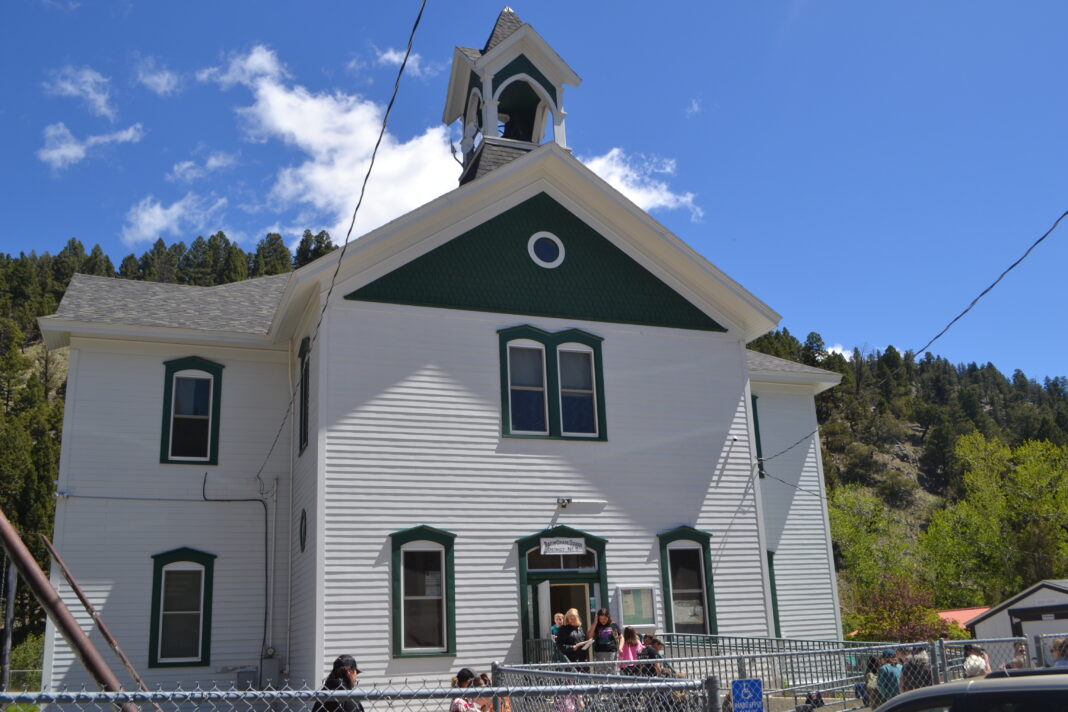


The Basin Elementary Board of Trustees announced at its March 12 meeting that they are considering shifting the school to non-operating status in 2025. While no formal decision has been made, Basin Elementary, according to the board, is unlikely to be able to remain open due to low enrollment.
“As much as you guys want to support this place, the reality is that the community is not sending their kids to school here,” said Jefferson County Superintendent Sarah Eyer during the board meeting. “Nobody wants to close a beautiful, important place like this, but, given our current student count, it’s clear that what we’re doing right now isn’t sustainable.”
There are currently three students enrolled at Basin Elementary, of 19 elementary and middle school-aged children living in Basin. In 2020, there were 20 students enrolled. According to Basin Elementary parent Faith McCulloch, who recently withdrew her three children from the school, Basin has been operating on a limited schedule since January, with students only receiving roughly three hours of in-classroom instruction a day.
Eyer acknowledged that, faced with a staffing emergency, the school had shifted to a rotating schedule, with additional services from a special education cooperative, to meet state instruction requirements.
“As someone who went to that school for all my elementary years, it was a very painful decision to take our kids out,” said McCulloch in an interview with The Monitor. “But our kids are not receiving the public education they’re entitled to there. And I think it’s hard to get the community to support a school when parents aren’t confident that their kids are being properly prepared.”
Low enrollment impacts Basin Elementary’s ability to operate because Montana public schools receive a significant portion of their budget from per student entitlements. Basin presently operates on a budget of $180,000 a year, largely from area property taxes. This budget covers the salary of a single teacher, the use and maintenance of the Basin Elementary school house, and various classroom materials.
However, starting in 2025, should Basin continue to operate, it will be required to pay the Boulder School District roughly 10 percent of Basin’s annual budget due to House Bill (HB 203). HB 203, which passed in 2023, allows for parents to freely enroll their children into any public school district adjacent to the one they’re living in. Schools are required to pay the tuition of transfer students to the accepting district. For Basin, this fee includes all 7th and 8th grade students living in the district, even though the school is unable to enroll those students due to certain middle school accreditation requirements, including the hiring of a counselor and providing foreign language instruction.
“Yes, it’s a choice this district makes not to provide those services, but we are bound by our budget,” said Basin District Clerk Britton Mann. “We would never be able to afford a counselor, or another teacher.”
Creating the capacity at Basin for middle school students is not feasible, said board member Scott Brock. “The only way that could ever happen is if taxes in Basin went through the roof,” he said.
The Basin trustees have yet to decide whether or not to declare non-operating status. It announced during its March session that the subject will remain on its meeting agendas until the start of the 2025-2026 school year, and that it intends to hold a number of public meetings to garner community input and concerns. In order to make relevant arrangements for district students and comply with state non-operating procedures, Basin would need to declare its non-operating status no later than its July board meeting.
“I literally only stayed in Basin after having children to put them in this school,” said McColloch. “I wouldn’t be where I am today without Basin Elementary.”
Should Basin decide to shift to non-operating status, it would be required to establish a non-operating fund, where all taxes, non-levy revenues (such as interest), and transportation aid would be held for, at most, for three years. This fund would be used to finance the limited functions of a district not operating a school, including HB 203 tuition obligations and property maintenance.
The Board of Trustees would be required to meet quarterly, as opposed to monthly, and parents would be free to enroll their children in any neighboring school district they so desire. The school could reopen during this period with a minimum of two enrolled students. Should Basin remain non-operating for three consecutive school years, however, the district would be considered abandoned. At that point, all students in Basin, and the historic 1895 school house itself, would be absorbed by Boulder Elementary.
“Non-operational is not shutting the school down,” said Mann. “The reason we’re having these conversations is because we want the community to be aware that non-operational does not mean we’re permanently closing the school at the end of the year, and to be clear that we don’t want to do that. But there are certain things that may put us in a place where we aren’t able to maintain the school.”
The next meeting of the Basin Elementary Board of Trustees is scheduled for 4:30 p.m. on April 2. No additional community hearings have been announced.
“If anyone has solutions, we would love to hear them,” said Eyer. “This is a hard conversation, but it’s really just the beginning.”


