
The snow is melting, our cool season grasses are showing signs of life, and the aspen trees are breaking dormancy — all signs that we are making the turn and spring is around the corner. This has me looking forward to some of my spring tasks, and tree planting is one of my favorites.
I recently attended a lecture at a horticulture conference where the presenter was explaining ideas for tree planting. Parts of the lecture I was able to relate to, based upon my own experiences and what I have learned. But some other ideas left me scratching my head. Has my tree planting been less than ideal the last 20 years?
And so. down the rabbit hole I went, researching and evaluating tree planting techniques.
One thing is certain: All good tree planting starts with the hole. (It also starts with proper tree selection — the right tree for the right place. That’s where your local tree experts and nurseries can be a big help.)
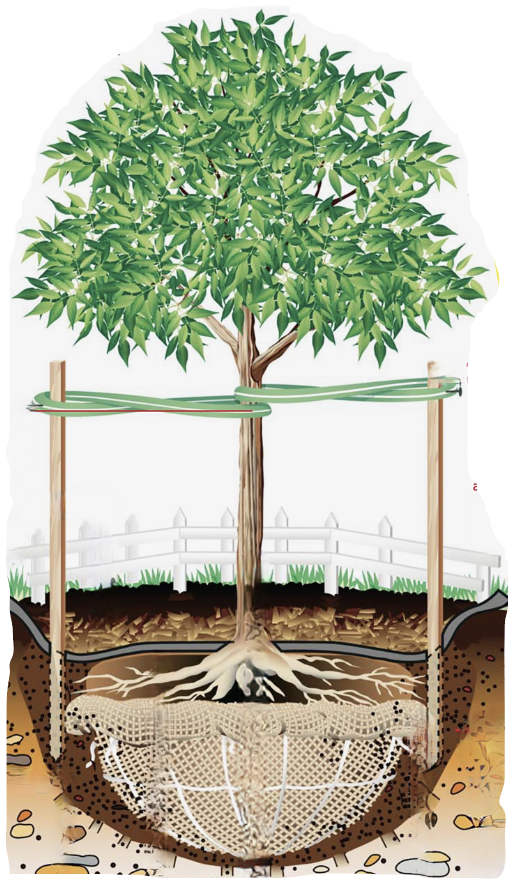
In general, the diameter of the hole should be about twice the diameter of the tree’s root ball. The depth should be the root ball’s height. It is better for the hole to be a little shallow than too deep; planting too deep is one of the biggest causes of newly planted tree failure. If you find you’ve dug too deep, add soil back into the hole — but make sure to lightly compact it; otherwise, the tree will sink down as it is watered.
The sides of the hole should be roughed up with a shovel or pick ax. Or better yet, drill horizontal holes that radiate out into the soil from the hole. This creates spaces that the roots can easily expand into.
Now, what about the root ball? At that conference I attended, the speaker recommended removing all of the soil around a tree’s roots, regardless of species, growing location or time of the year. The idea is that this makes all the roots visible, so you can make corrective pruning cuts prior to planting.
I have never seen this recommendation anywhere else, a big red flag. So, what does the research say? Most folks will be planting either containerized trees — usually, set in plastic pots — or those that have been balled and burlapped (B&B), so I will focus on techniques for these two groups.
Containerized trees will have girdling roots, and those have to be pruned prior to planting; otherwise, they will continue circling inside the planting hole. Edward F. Gilman, professor emeritus of environmental horticulture at the University of Florida, started studying containerized tree planting in the early 2000’s. Up until then, it was common practice to leave the roots be, to make a few vertical cuts on the root ball, or simply try to pull out some of the roots and place it in the hole.
But Gilman’s research demonstrated that all the roots on the outside of the root ball should be shaved off, including the roots on the bottom, so you end up with cut roots that are now facing away from the tree. I do this with a Sawzall and a long wood blade.
B&B trees are wrapped with burlap, sometimes natural and sometimes a synthetic material. They usually have some kind of twine or rope around the burlap and the trunk of the tree, and some have a wire cage on the outside of the burlap.
All of this material should be removed, if possible. But the trick is to do it without much soil to root separation. On his website, Gilman writes: “Root balls with inadequate root systems, or those with very sandy soils may lose soil from the bottom of the ball when the tree is picked up and lowered into the planting hole. The tree is likely to go into shock and could die.”
This has been my experience with all non-dormant trees. If the tree has leaves, and you remove all the soil around those roots prior to planting, the tree will typically drop all of its leaves. Sometimes the leaves will grow back, and sometimes the tree will die. Trees that do grow back leaves will usually have lots of winter die-back, because the late growth leaves it put on did not have time to harden off in our short growing season.
Now that you have the tree in the hole, what comes next? Most research indicates that you should not add anything to the soil when you are back filling around the tree, though some recommend adding a small percentage of compost mixed with the native soil. We have such limited organic matter in our native soils here that I typically add no more than 25% compost. After that, stake the tree for one year, add 3” of mulch, keeping the mulch away from direct contact with the trunk, and water thoroughly and regularly.
All of which is to say that much of what I heard at that horticulture lecture seems not to hold. But it’s important to occasionally reevaluate the things that we hold as facts. Weeding through all the new information we’re bombarded with can be a challenge, but the rewards of knowing with certainty that you are doing something — in this case, tree planting — the correct way is worth the effort.
This reminds me of one of my favorite quotes by Henry Ford: “Anyone who stops learning is old, whether at twenty or eighty. Anyone who keeps learning stays young. The greatest thing in life is to keep your mind young.” And of course my favorite quote, attributed to the ancient Greeks: “A society grows great when old men plant trees in whose shade they shall never sit.”
Happy spring tree planting!
Brent Sarchet, a certified International Society of Arboriculture (ISA) arborist certified crop advisor, runs Finn Creek Farm outside of Boulder with his wife Andrea. Ask him questions at bsarchet@gmail.com.