
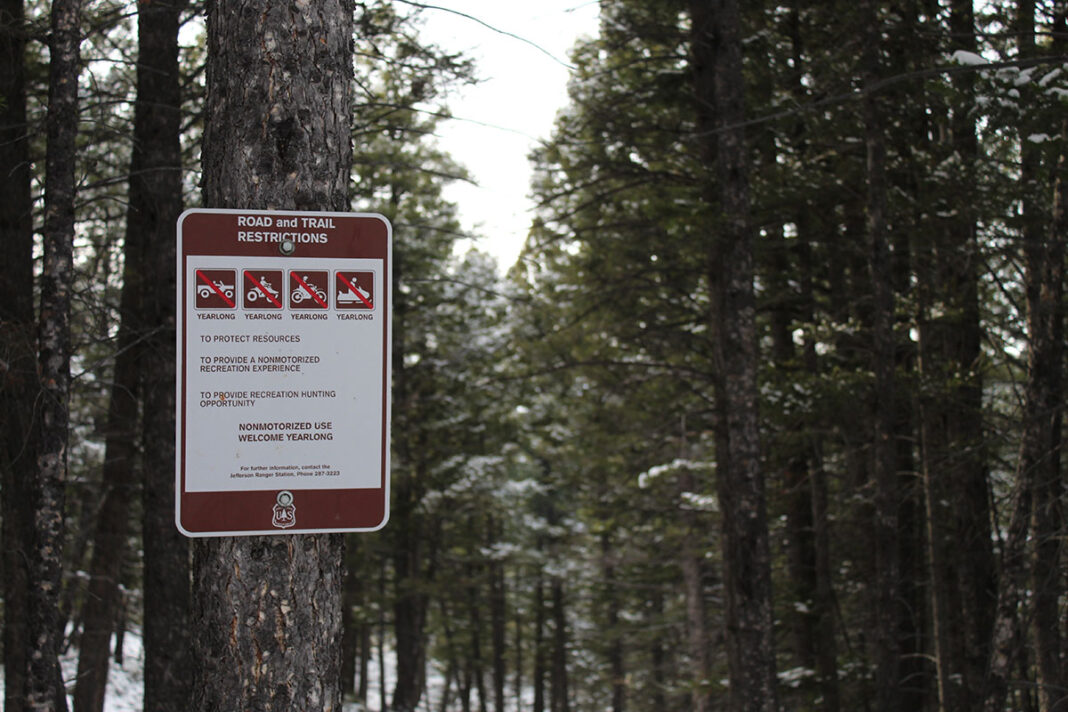
The portion of the Beaverhead-Deerlodge National Forest that lies within the borders of Jefferson County lacks a travel management plan and the county’s Parks, Trails and Recreation Commission wants to get that process started.
Travel management plans identify areas open to motorized usage — as in what, where and when vehicles are allowed on the various roads, trails and areas in the national forest.
The B-D National Forest encompasses about 398,000 acres of land, or 38% of the total land in Jefferson County, according to the Parks, Trails and Recreation Commission.
Of that land, there is about 2,000 miles of road and 350 miles of trail in the county, according to Butte District Ranger Tim Lahey.
The lack of a plan isn’t unique to Jefferson County, and with the exception of portions of the Madison Ranger District, the Beaverhead-Deerlodge National Forest does not yet have one in place, according to Lahey.
Maps do exist for the Gravelly Range and Tobacco Root mountains, said Lahey.
The Commission recently sent a letter to the Jefferson County Commissioners asking for support in getting the process started, and is one that requires public input.
In its letter to the Commissioners, the Parks, Trails and Recreation Commission pointed out that it is seeing increased usage of the forest in Jefferson County — both from new residents and visitors.
“People recreating here frequently choose to patronize and support our local businesses, which is a boon to our local economy … If maintenance and upkeep on our local public roads, trails and lands are neglected and there is no planning, people will choose to go elsewhere,” according to the letter signed by Commission Chairperson Sue Kenyon.
There are several reasons for establishing a travel management plan, such as allowing access to maintenance funding, clearly defining roads and trails, providing a tool for enforcement and giving a map for emergency response, said Parks, Trails and Recreation Commission member Vaia Errett.
With a plan, “law enforcement would have something to stand on,” said Kenyon at the Nov. 10 Commission meeting where the letter was presented.
Without a plan in place, Jefferson County could be also overlooked or be ineligible for funding for maintenance and other tasks necessary to protect natural resources, according to the Commission’s letter.
One area of the Commission’s concern is the Whitetail-Pipestone OHV (off-highway vehicle) area — located west of Whitehall and used heavily by motorized vehicles.
The B-D National Forest has worked with Montana Trail Vehicle Riders Association and Montana State Parks for more than 15 years on projects to improve the trail system at Whitehall-Pipeston and it looks forward to continuing improvements with the support of state and local governments, said Lahey.
There was effort made to implement a travel management plan in the 1990s and in 2004, but it was not successful due to a variety of reasons, including competing priorities such as forest plan revision, other priority projects and adverse decisions on other forests that caused the forest service to pause its efforts, said Lahey.
Lahey said enforcement has been difficult at Pipestone due to a lack of a travel management plan, adding that action would come from Forest Service Law Enforcement and Forest Protection Officers.
Meanwhile, there are some signs currently posted at a limited number of trails and areas in Jefferson County. The brown and white signs indicate what type of usage and when it is allowed.
“The motorized restrictions reflect the forest management plan for seasonal closure dates and the historic use of the roads and trails. One facet of travel management is to analyze the road and trail, reach out for public comment and create a plan that provides public access in a way that also supports best management practices of the resources. Enforcement is difficult without an official travel management plan in place. We know the public desires a travel management plan for the remainder of the forest that is not covered and we look forward to working with various user groups to get this accomplished,” said Lahey.
Part of the process of creating a travel management plan involves completing environmental reviews under the National Environmental Policy Act (NEPA), as well as fulfill requirements under the Endangered Species Act and the National Endangered Species Act and the National Historic Preservation Act, said Lahey.
“These environmental analyses can be complex undertakings as they must consider and disclose the effects of designating motorized roads and trails on all resources, including recreation, socioeconomic, heritage, botany, wildlife, aquatics, etc. The endeavor also includes extensive public involvement from start to finish, beginning with scoping the proposed action, public comment period on the draft EA (environmental assessment) or EIS (environmental impact statement), and an objection process following the draft decision,” said Lahey.
Because this process is generally funded at the local national forest level, there are trade-offs it has to consider in terms of their program of work in a given year, said Lahey.
“If a significant amount of money goes toward travel planning, then other work may have to be put on hold,” he said.