
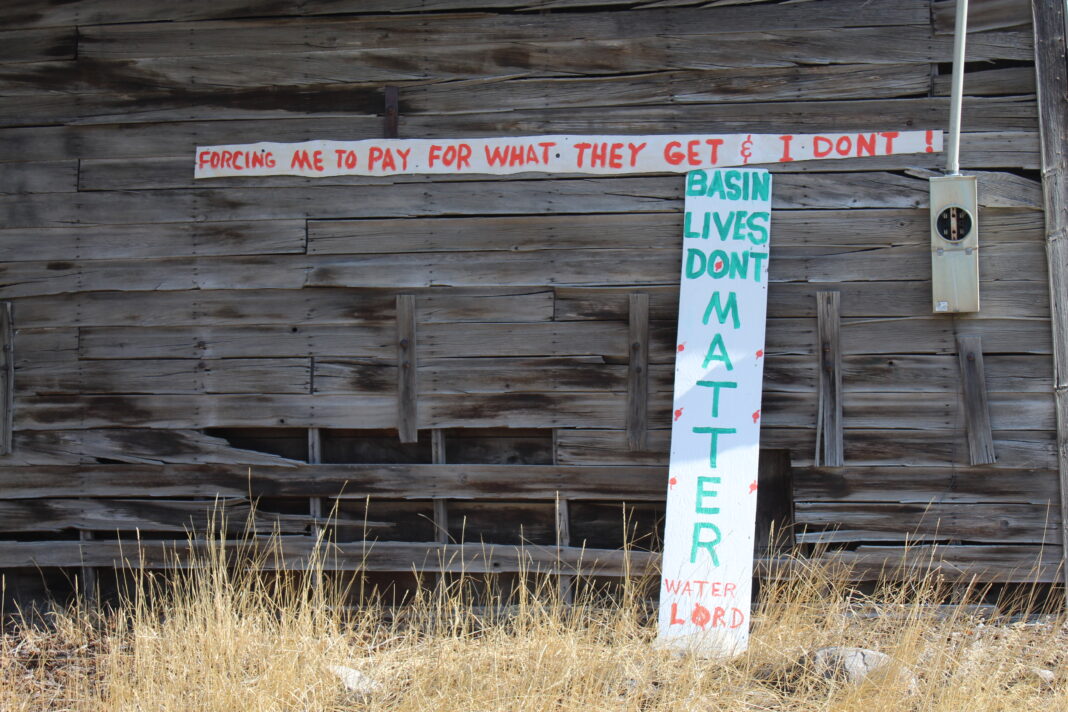
The Basin Water and Sewer District Board has asked the City of Boulder to assist with running its water system after its operator quit in November due to the ongoing controversy over proposed improvements that had included installing water meters.
At Monday’s Boulder City Council meeting, Basin Water and Sewer District Board member Mike Jellison also signaled that the entire board could possibly step down if the tension in the community does not subside.
If so, “I don’t know what would happen to our water system. I hope it doesn’t come to that,” he said. The Board currently has five members.
Board Chairperson MJ Williams on Tuesday said the Board has no unified plan to take such a step, but doesn’t deny it’s possible.
“I suppose that could happen. We’re damn sick and tired of it, but we’re not thinking of that,” said Williams of a group exodus, adding that as the controversy unfolded over the summer and fall, the Board had been accused of many things, including committing tyranny.
“Members are frayed and worn,” she said.
Williams said the latest wrinkle in the Board’s plans of putting the Quartz Avenue pump house back online — a plan that originally included installing water meters — was a recent determination by the Department of Environmental Quality that the well has a lead packer. Williams said that was new information and sort of a relief, because now the option of putting that pump house back online is off the table.
There may be a fix, but it’s so expensive that it’s become virtually a dead issue, she said.
A packer is put in to prevent cross contamination from rainwater and runoff into the aquifer. It is used to seal the well above the well screen and can also be used as a seal between multiple aquifers. A “lead” packer means that the device contains lead, according to DEQ.
With the lead packer, there is potential for some exposure of the water to lead, said Williams.
Jefferson County Commissioner Cory Kirsch, who represents Basin and was at Monday’s City Council meeting, said that if the entire Basin Water and Sewer District Board did resign, then the county would likely step in and appoint replacements.
For Boulder to assist Basin with the day-to-day running its system, an interlocal agreement would need to be drawn up and approved, said Boulder city attorney Jana McGill.
As McGill is leaving her post, Kirsch said he would ask county attorney Steve Haddon to begin drafting the agreement to get the process underway.
Mostly, Basin wants assurance that if an emergency does arise, Boulder would be able to assist, said Boulder Mayor Rusty Giulio.
Meanwhile, the Basin Board has filled its clerk position, but has been looking for a water and sewer operator. Former clerk and operator Nissa Manley had served in both positions.
In Basin, residents had opposed a portion of a new rate structure, charging $12 on lots without a curb stop, and which the Board had recently reversed. The community also took issue with the Board’s plan to take out a loan to reopen the Quartz Avenue pump house, with part of the project including the installation of water meters. Several residents were concerned about the cost of repaying the loan and didn’t believe that water meters would help with finding the many leaks in the system.
Currently, that plan has been put on hold.
Later, the Board learned that water meters were not required for the loan it was to acquire from the state — knowledge that generated more criticism of the project. Discussions between the Board and the community over the past several months had often been quite contentious.
Currently, the Board is looking at having a Preliminary Engineering Report, or PER, conducted, which would provide an analysis of the entire system.
The Board had a technical memorandum completed in 2018, but that was specific to the issues it was trying to resolve at the time.
Ultimately, the Board has to rely on the expertise of its consultants, said Williams.
“It’s extreme now,” said Williams of the climate in the community concerning the water system situation.
“The Board has gone through a lot and the Board is intent on what’s best for the community, and it’s a lot to ask of people who are volunteers and well-intentioned and turning over every rock to make it work in the community — how long can that go on, really?”