
With cases rising in Jefferson County, and some residents still resistant to wearing masks in public places and following other forms of COVID-19 preventative measures, the Commissioners and county attorney on Oct, 27 discussed a range of enforcement mechanisms that could be rolled out to slow the spread of the virus.
Everyone knows what they have to do, such as masks and quarantining, now it’s time for punishment, said Commissioner Cory Kirsch, adding that noncompliance stems from the “rebels” who think the government shouldn’t tell them what to do.
Kirsch was referring to the tools that could be used to crack down on the most severe instances of non-compliance with COVID-19-related orders and directives — and this would not apply to an individual walking down the street without a mask or having a family gathering, he said.
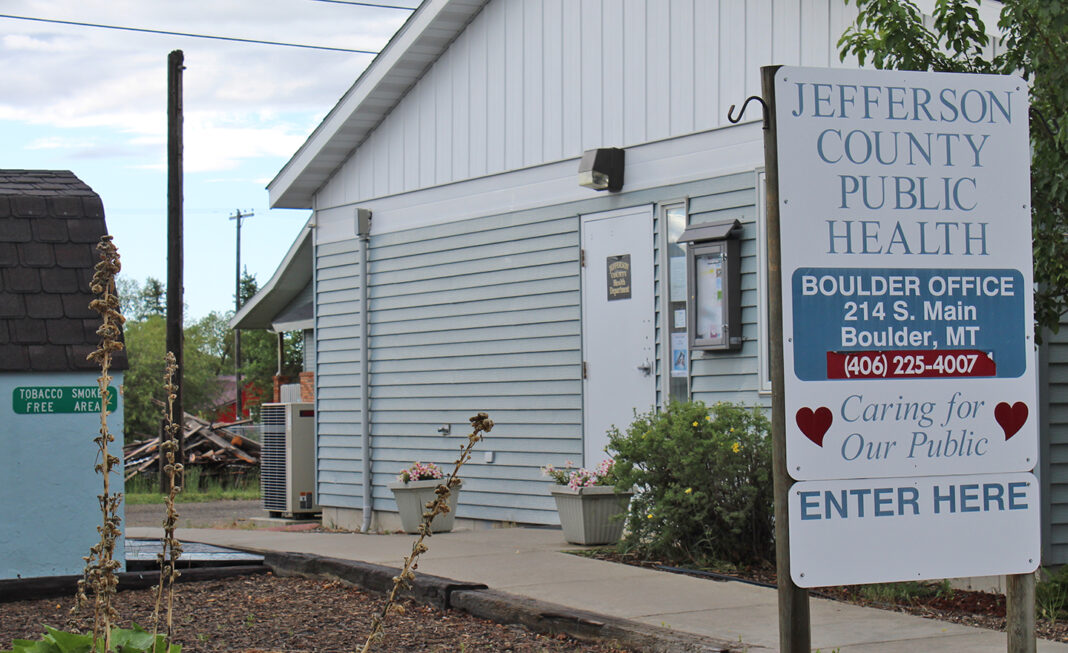
The Jefferson County Public Health Department recently reported that it’s running into non-compliance issues, particularly those who are identified as close contacts of an active case not returning phone calls, or those who are not obeying quarantine orders.
Boulder residents Barb Reiter and Sue Pasini had come to the Oct. 27 Commission meeting to implore the Commissioners to do something about the rising number of cases in the county.
“There seems to be a lack of something … in this county,” said Reiter about the rising cases and lack of compliance.
And cases continue to rise in Jefferson County. On Monday, Nov. 2, the Public Health Department reported an increase of 16 new infections since Saturday, for a total of 35 active cases spread over all age groups, with nine age 19 and under. That is an increase of 43 cases in the past week, according to the Health Department, which is also monitoring 116 active cases and close contacts as of Monday.
Commissioner Bob Mullen said the county is poised to provide the health department with the financial assistance it needs, such as hiring temporary nurses.
“We’re absolutely supportive of the health department. We know the siege they are under,” said Mullen, adding that the bulk of active cases are currently in the northern end of the county, followed by the southern end, with the least number of cases in the middle, such as Boulder.
The Commissioners also pointed out that beyond offering financial support to the Health Board and Public Health Department , they do not have the authority to impose new restrictions and limits to slow the spread of the virus.
The ability to set restrictions on preventing the spread of a communicable disease is granted to county health boards and health officers by state statute. Gov. Steve Bullock’s directive also gives authority for public health enforcement to county attorneys, and that is directed at businesses with indoor spaces open to the public and sponsors of organized outdoor activities.
Recently, the Jefferson County Health Board set a limit of 50 people on events in an effort to control the virus. Other localities in Montana are also beginning to set restrictions as new cases continue to rise. Missoula County recently enacted measures where businesses are being limited to 50% capacity, groups are capped at 25 people, alcohol service stops at 10 p.m. and residents are asked to stay at home voluntarily, according to the Missoulian.
The state has also added COVID-19 violations to its Consumer Complaint Form, found on the Department of Public Health and Human Services website. Concerns submitted through the website will be reviewed by DPHHS and sent to the appropriate local authority for review and investigation.
The Consumer Complaint Form is now available at: https://dphhs.mt.gov/publichealth/ FCSS/ConsumerComplaintForm
County Attorney Steve Haddon said that it’s time for the Jefferson County Health Board to begin using the enforcement tools available, in the form of education to start, followed by fines and injunctions.
This is really targeted at businesses not complying, said Haddon, adding that an injunction is an order to close until the violation has ceased.
The orders issued to individuals by the health officer for isolation and quarantine also carry punishments — fines ranging from $10-$500 or imprisonment for no more than 90 days.
Haddon said that there are two other areas of the law that can be used — violations of the governor’s directives and injunctive relief.
“I pray that we never get there. This is ratcheting up,” he said.
Haddon said there is a reluctance to put people in jail out of a fear that it would cause an outbreak there.
Haddon said he’s been meeting with other county attorneys around the state and all are experiencing similar problems. The conundrum is that this is “entirely uncharted waters,” he said of enforcing punishments pertaining to stopping the spread of a communicable disease.
The attorneys are looking for a consistent approach to this, said Haddon.
“Put on a mask when you go into a business. It’s not hard,” he said.
Jefferson County Health Board Chairperson Christina Binkowski said she, along with the county’s Incident Commander for the Department of Emergency Services, Doug Dodge, as well as Public Health Supervisor Pam Hanna, met with Haddon last week.
“We are investigating all the avenues available to the Health Department/Officer and Health Board in enforcement of several areas of violations. Those would include businesses refusing to follow the Governor’s mandate to wear masks, those violating any event restrictions and those in our county that are positive for COVID-19 and refusing to quarantine and continuing to work outside their home and those refusing to isolate as a close contact, said Binkowski in an email to the Monitor.
“The substantial increase in cases in our county has overloaded our staff at the Health Department and could soon overwhelm our clinics and hospitals. We hope that continued education will prompt everyone to abide by the mandates we have had from our Governor. No one wants to use enforcement as a means to get compliance,” said Binkowski.
During the Oct. 27 Commission meeting, Boulder Community Library Director Jodi Smiley told of repeated conflicts with a patron who refused to wear a mask and would not leave.
“Do we call the police?” asked Smiley.
“Yes,” said Haddon, adding that it would be considered a trespassing offense.
Jefferson County Sheriff Craig Doolittle said a person could be arrested or issued a citation for trespassing if the owner of the property wanted them to wear a mask and they refused and then refused to leave the premises.
“Any injunctions or charges would probably come from the county attorney’s Office although we would serve such documents, if needed,” said Doolittle in an email to the Monitor.
However, there are some that say they have a medical condition that precludes them from wearing a mask and it is presumed they are telling the truth, said Haddon, adding that in those cases, the condition must be honored.
“That’s kind of a get out of jail free card,” he said.
The Centers for Disease Control advise that the following individuals should not wear a mask:
Children younger than two-years old; anyone who has trouble breathing; and anyone who is unconscious, incapacitated or otherwise unable to remove the mask without assistance.
Others who may have difficulty with wearing a mask include those who are deaf or hard of hearing, those with intellectual or developmental disabilities, mental health conditions or other sensory sensitivities and younger children, according to the CDC, whose guidance also provides possible alternatives.