
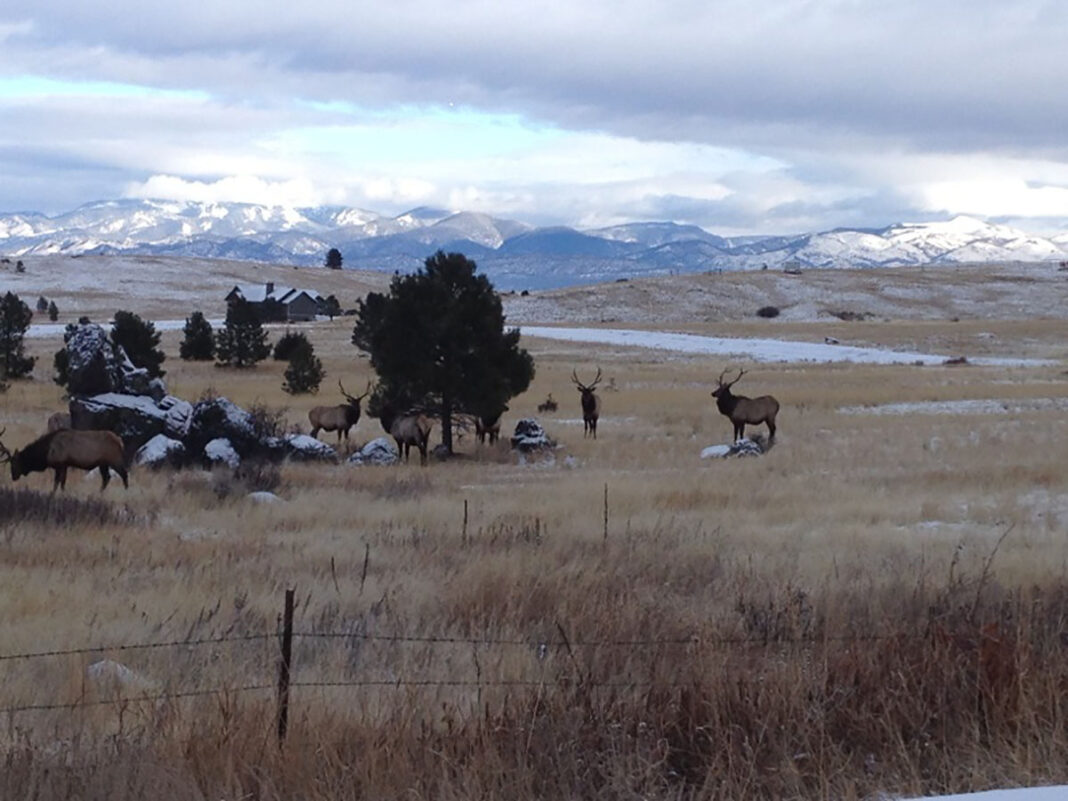
This is the first part of a three-part story on the Elkhorn Working Group (EWG), a citizen advisory body that recommends land use strategies to the public agencies managing the Elkhorn Range. First convened in 2001 to overcome controversy over elk and livestock management, the EWG has evolved their intent as emerging pressures threaten core wildlife and habitat values of the range’s unique Wildlife Management Unit (WMU) and challenge the cultural continuity of surrounding communities.
The Elkhorn Range rises from ranchland between the Missouri, Boulder, and Jefferson Rivers to overcome a history of forage competition between elk and livestock. Collaboration has been key to management of the range’s prime wildlife habitat. As human population renews strain on the landscape, shifting priorities challenge stewardship against an expanding appetite for access, recreation, and development.
Helping to steer the fate of the Elkhorns is the Elkhorn Working Group (EWG), one of Montana’s oldest agency-sanctioned citizen advisory bodies. Other land management groups have drawn scorn for assuming the trendy title of “collaborative” while lacking diversity and transparency. The EWG bucks the buzzword bandwagon, holding true to their roots in information and inclusive citizen consensus to influence management of the Elkhorns.
The Elkhorns are managed cooperatively across public agency boundaries by the U.S. Forest Service (Helena-Lewis and Clark and Beaverhead-Deerlodge National Forests), the Butte Field Office of the U.S. Bureau of Land Management (BLM), and Montana, Fish, Wildlife and Parks (FWP). A unique Wildlife Management Unit, the only designation of its kind on national forest lands across the country, perpetuates stewardship in light of a murky management conundrum that establishes an emphasis on wildlife without formalizing its interpretation through law.
For almost 20 years, 16 citizen members of the EWG have met regularly with representatives of the managing agencies who serve as technical advisors to the group, and agents of additional entities with a stake in the Elkhorns.
Early concern brewed over elk population and forage. Could the landscape sustain both a coveted hunting district and a system of grazing allotments granting permits to ranchers for livestock grazing on designated tracts of public land? Hunters wanted big game bounty; ranchers wanted ample rangeland.
Ongoing dispute moved George Weldon, Townsend District Ranger for the Helena-Lewis and Clark National Forest (HLCNF), and Mike Korn, FWP Helena Area Coordinator, to urge their respective agencies for citizen-driven, collaborative solution that would seek balance and assist public agencies in their planning and policy direction. In 2001, the Montana Fish and Wildlife Commission convened the EWG with Forest Service approval.
“The issue then was, ‘How many elk are there? How many are we going to have?’” says Ron Marcoux, Deputy Director of FWP in the 1980s who first represented the Rocky Mountain Elk Foundation at the EWG table before becoming a citizen member. “There was tension with the agricultural and ranching community and how their allotments were affected. Initially, it was a numbers game.”
“It’s not just about numbers anymore,” explains current vice-chair Korn, former FWP representative as Helena Area Coordinator then Deputy Chief of Law Enforcement. “That’s not the flash point anymore.”
Between private pasture and big game winter range, recreation and regulation, the group’s intent has broadened as themes twine and disperse into renewed areas of concern.
Marcoux telescopes the group’s aim:
“The key is it’s managed with an emphasis for wildlife.”
A Wildlife Priority Like No Other
“One of my big objectives as chair was getting people to understand there is something unique about the Elkhorns,” says David Brown, charter member and original EWG chair.
Wildlife diversity, habitat, and security across the 300,000-acre island range, values long celebrated by the public, have inspired a legacy of wilderness character. Despite enduring human passions following native American inhabitance – from Lewis and Clark’s 1805 expedition up the Missouri River through trapping, mining, homesteading, hunting, grazing, timber harvesting, and, more recently, recreation – the range has escaped heavy development and retains a long-standing, 85,000-acre roadless core.
At the heart of the range lies the Elkhorn Wildlife Management Unit (WMU), 150,000 acres of standout terrain on national forest. Persistent public voice helped to secure this unique identity. Introduced to Congress in 1974 for official wilderness designation, the Elkhorns elicited intense, sustained public debate over environment, productivity and mixed land use from both wilderness proponents and multiple-use advocates.
In 1978, Rupert Cutler, Assistant Secretary of Agriculture, removed the Elkhorns from wilderness consideration and underscored the consensus emerging from divergent parties:
Recognize and retain wildlife values in the Elkhorns including management of supporting habitat.
In 1981, the Helena National Forest recommended a management unit emphasizing high wildlife values over all other uses. Congress failed to act with legislation by 1986 so the WMU was implemented administratively as part of the Forest Plan.
The roundabout route to WMU status presents a significant obstacle to the EWG: Because no congressional designation puts the WMU into law, its guiding values are tricky to impose when making agency recommendations.
Cooperation across agency boundaries is crucial. For years, a patchwork of jurisdictions divided ambitions between the USFS in two National Forests and three Ranger Districts, and the BLM, with wildlife managed by FWP.
In 1992, creation of the Elkhorn Cooperative Management Area (ECMA) consolidated goals. The three primary agencies signed a Memorandum of Understanding (MOU) that emphasized ecosystems management on a landscape scale. Easing communication and promoting key principles of the WMU, the uniquely collaborative approach for a mountain range facilitated the work of a nascent EWG in 2001.
Where hunting meets ranching tradition
Ranchers took pride in their early role to reestablish elk in the Elkhorns when initial overhunting drove a crash in population. In 1939, 38 animals were transferred to Elkhorn Creek from Yellowstone National Park. Today, a stable population of about 2,000 elk across the range often rejects boundaries between public land and private pasture. Especially during hunting season.
The EWG confronts a quandary entertaining ranchers, hunters, and land managers alike: Where are the elk in the Elkhorns?
Underscoring the issue is that the Elkhorns are the only mountain range in Montana contained in a single hunting district (HD 380).
In 1986, a lack of diversity in bull age classes in the HD prompted a novel hunting regulation to promote the survival of older bulls. The change led to a reproductively robust population in one of the most highly subscribed hunting districts in Montana, with over 10,000 applications for about 100 permits.
The thriving population is a boon to elk hunters, but a source of concern for ranchers when elk stray onto their land. Agencies are left to manage population tolerance, which, in the Elkhorns, is not always as challenging as it is in other districts.
“Most of us wish all our hunting districts were like 380,” says Adam Grove, Townsend District Wildlife Biologist for FWP and agency representative at the EWG table since 2014.
In HD 380, public land provides the bulk of elk winter range. Elsewhere across the state, a growing number of private ranches prohibit public access during hunting season, driving the animals from public lands onto inaccessible private land. Hunters find reduced success, elk populations grow, and ranchers resent the animals in their hay bales.
But in HD380, a rare sweet spot prevails where elk distribution, land ownership, and hunter access intersect.
“The Elkhorns area is becoming more and more unique in that it has a large number of public land elk, a large amount of public land winter range, and generally good hunting access throughout the entire HD 380 to both public and private land,” says Grove. Successful Block Management through landowner partnership with FWP along with the substantial cooperation of other landowners have led to impressive hunter access to private land that is the envy of much of the state.
Yet issues persist. Ranchers still experience property damage by big game, challenging their bottom line. Many landowners rely on the lease of public land grazing allotments to support their livelihoods, which impacts their communities – land tracts that overlap the WMU and sustain HD380’s coveted elk herds.
Brud Smith, founding EWG member and past chair, is a grazing permit holder whose family has ranched in the Boulder Valley since the 1860s. He points out the value of ranches to extend wildlife habitat and benefit hunting opportunity. His modern ecological perspective goes beyond forage competition, focusing on landscape management to both satisfy wildlife needs and support a local ranching-based economy.
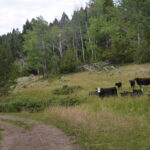
“Cows are an indicator species,” says Smith. “If cows are on the forest, that means there are small ranches. It’s not just subdivisions right up against the forest…It indicates a healthy community and you have open spaces.”
Beyond grazing, other advancing pressures in the Elkhorns demand a deeper examination of management direction. The EWG attempts to learn, adapt, and urge commitment and continuity to balance the habitat needs of the WMU with a culture that shares those resources.
Next: Part II follows the EWG’s evolution of intent, from early years focused on trust and information through the dynamic interplay between habitat health, elk distribution, land use regulation, and the revolving pressures of access, recreation, and policy.