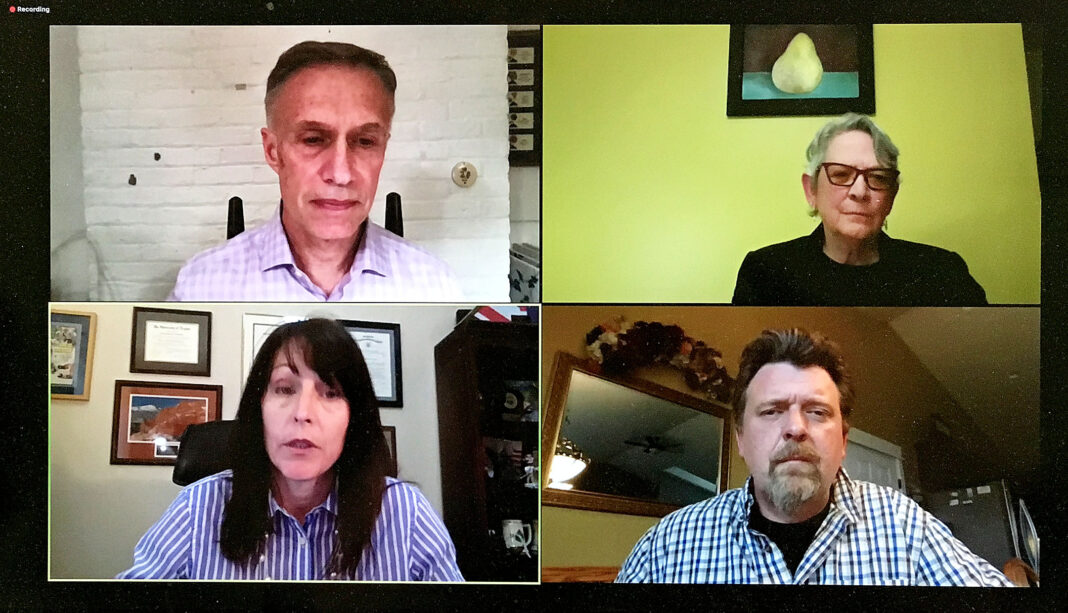
Candidates vying to represent Jefferson County in the Montana Legislature fielded questions ranging from mental health to an aging population to partisanship during a forum April 27, hosted by The Boulder Monitor.
Marta Bertoglio, a Republican, and Bryher Herak, a Democrat, are challenging incumbent Republican Greg DeVries for the 75th House District seat in the Montana House of Representatives.
Bertoglio and DeVries will square off in the June 2 primary to secure the Republican nomination. Herak is the only Democratic candidate running in the primary.
Bertoglio is a former Air Force officer turned real estate broker, who owns her own agency with four other women, Uncommon Ground. A resident of Clancy, Bergoglio sits on the Montana City School Board and describes herself as a life-long Republican and Christian.
Herak is a former mediator in Seattle and with the Montana Human Rights Bureau, as well as a small business owner and a member of the Boulder Development Fund Board. She lives in Basin.
DeVries was elected to the District 75 seat in 2018, having run against Herak, and is self-employed as a painting contractor from Jefferson City. He is married with six children and seven grandchildren.
The forum allowed for a five-minute personal statement, followed by questions from The Boulder Monitor Publisher, Keith Hammonds, and the audience, and ended with one minute closing statements. The order of responses were rotated. The forum was accessible online via Zoom and was broadcast by Jefferson County Radio, Elkhorn Mountain Radio and Whitehall TV.
Personal statements
Bertoglio — Bertoglio started off the forum by noting that she was a former U.S. Air Force officer with extensive leadership training and ability. She met her husband, Joe, in the military, and they have two daughters. A native of Montana, Bertoglio and her family returned in 2007 to be with her aging parents. Prior to becoming a real estate broker, Bertoglio was a stay-at-home mom who was active in the PTA, coached basketball and taught at church.
Bertoglio said she is pro-family and believes in building strong families. She strives to address three “pillars” — jobs and economic development, access to quality health care and education. Bertoglio said she supports the natural resources industry as “it’s critical for good paying jobs.” Bertoglio said the area needs large employers who provide jobs and a significant tax base, and at the same time, the government needs to be efficient.
Bertoglio believes the best way to reduce taxpayer funded health care is to get people back to work and on private insurance, leaving Medicaid for the most vulnerable members of society.
When it comes to education, Bertoglio said that society as a whole has an obligation to have well-educated youth, and parents have the right to choose what is best for their children.
Education is a great equalizer in society, she said.
Finally, as an Air Force officer, she acknowledges the importance of the Second Amendment, especially for Montanans and their way of life.
DeVries — Incumbent Representative DeVries began by declaring why he ran for the job in the first place.
“I ran in the previous election to specifically labor against the evil of abortion,” he said.
DeVries said he sponsored the personhood bill, which would have declared that life begins at conception, but it failed to gain enough support for passage.
“Shockingly, many were vehemently opposed to this,” he said.
DeVries believes that self governance is the best government, as it is set by God.
Liberty is freedom from “our neighbor’s sticky fingers,” he said.
DeVries criticized a government that thinks it can take from one person and give to another, and believes it’s up to churches, communities and individuals to support each other.
Lives, liberty and property are being encroached upon by a class of people who think they know how to spend money better than others and this is funded by the state, he said.
Montanans are put at risk every other year when the legislature meets, said DeVries, adding that he would strive to protect all Montanans.
Herak — Rather than go over her personal qualifications, which have been published in The Boulder Monitor and on her website, Herak decided to use her five minutes to discuss a number of concerns.
Herak said the biggest concern at the moment is getting through the disruption caused by COVID-19, but is pleased to see a high level of cooperation and problem-solving at the local level. She noted that teachers, students and administrators have, almost overnight, created an entirely new way of teaching students.
At the same time, Herak continued, there is a dangerous anti-government movement growing here and throughout the United States.
It’s not the traditional Republican view of limited government, which is part of an ongoing healthy discussion, she said.
“I’m talking about something more extreme,” she said.
It’s a position where the government is the enemy, a refusal to work with others with different viewpoints and a focus on a few ideological issues, said Herak.
DeVries represents this and so do those out-of-county people who support his campaign, she said.
Herak said Jefferson County needs leaders who are knowledgeable about the COVID-19 crisis, but also about specific concerns in each of the county’s communities, such as the water issues in Montana City, the fire department and water concerns in Jefferson City subdivisions, and infrastructure issues and economic challenges in Whitehall caused by work reduction at the Golden Sunlight (mine).
“We need leaders who know how to bring all parts of our state together and think about some big questions. How do we recover from the losses caused by this pandemic, how do we continue with our schools, our health care systems and our economy. How do we prepare for future crises and how do we address the broader crisis of climate change,” she said.
If elected, Herak said she will meet regularly with business owners, law enforcement, community members and officials in each Jefferson County township, and think together on how to nurture the future health, wealth and safety of the residents.
“I will take these concerns to the state level and work in a bipartisan way with other Montana legislators,” she said.
After decades of working as a professional mediator, Herak said she’s found that people can work through conflicts if they consider each other’s viewpoints and listen.
It’s a “mediation miracle,” with surprising results that can emerge and which no one had thought of before, she said.
Questions from the mediator
We are in the middle of a pandemic and Montana has the distinction of having the lowest reported COVID-19 case rate per population in the nation. But limitations on business activity have come at the price of thousands of jobs. Now, six weeks after the first case was reported here in the state, it’s taking the first step to relax restrictions and reopen business. What is the best long term course to insure both public safety and economic vitality for all?
Herak — Herak supports Gov. Steve Bullock’s phased reopening plan and is grateful that Jefferson County has so few cases.
She is also grateful to those who have put their life on the line to take care of those with COVID-19. However, when and how to reopen is an “hour to hour conversation,” and despite those who say it’s a hoax and no worse than the flu, it’s important to follow the guidelines of the experts until heard otherwise, she said.
“We will open our economy again, we will open our businesses again,” said Herak.
Bertoglio — Bertoglio also thanked first responders, grocery workers and others for their service during the crisis, and she thanked Montanans who responded to the call to flatten the curve. She also agrees with the state’s phased-in approach, but not to open so quickly and then fall backwards. Bertoglio understands that going forward involves a certain amount of human health and business risk, but it also accounts for differing county needs.
“Local control is important,” she said, adding that “We must address the fear. It is real.” Testing will help with the fear, as well as more PPE (personal protective equipment), plexiglass and thermometers for those who need it most, but at the same time there must be care taken to use the funds appropriately, said Bertoglio.
DeVries — DeVries said that initially, everyone feared the worst, but it has become apparent that it hasn’t reached the level that the experts predicted with their data and graphs. As more days pass, as more data comes in, seeing that, even in Montana, the last two flu seasons were worse than COVID-19. Now those at the higher level making all the calls are having a hard time backing away from prior statements, he said.
“We could have opened up a few weeks ago. I have no fears of the COVID virus,” said DeVries.
In last year’s community health assessment for the county, access to mental health services was at the top of the list of perceived concerns. In 2017, 28 percent of young people surveyed said they had considered suicide in the last year. But the 2017 legislature actually cut funding for community-based mental health services. should that funding be restored or are there other alternatives to ensure sound mental health in Jefferson and other communities?
DeVries — Many mental health issues stem from spiritual problems and no amount of state funding can solve those, said DeVries. Over a few generations, DeVries said that children are being brought up with the notion that they are descendants of fish and are not being given the dignity that being created by God gives them.
“I think that’s what it boils down to,” he said, adding that that mental health can be addressed through the church, healthy families and communities.
Herak — In the last 30 years, Montana has had one of the highest suicide rates in the U.S. in all age groups and it’s attributable to high rates of alcoholism, underage drinking, drug abuse and economic problems, Herak said. The situation was made even worse in 2017 when millions were cut from mental health programs at the state level to balance the budget.
With COVID-19, the state is seeing a surge in demand for mental health services and it has responded by committing funding to call-in help lines. Herak credits Jefferson County for the DUI Task Force, which works to educate youth and reduce car accidents due to substance abuse. Also, the Jefferson County Local Advisory Committee researches these issues, she said. People need to think personally about how to address this problem, identify those at risk to teach coping skills, and support safe environments, to include storing medications and firearms to reduce risk, said Herak.
Bertoglio — Bertoglio noted that there is a vast difference between the northern and southern ends of Jefferson County when it comes to income and insured versus uninsured individuals,and as the level of poverty. She wants to close those gaps. Bertoglio also recognizes that depression is a problem and access to mental health services, as well as getting rid of the stigma, is key.
“People shouldn’t be penalized for trying to make their life better,” she said, adding that telemedicine is a good option and needs to be further explored,” she said.
Jefferson County’s population is growing older. The percentage of our population older than 65 has grown from 13 percent in 2010 to 20 percent in 2018, a significantly higher increase than for the state as a whole. As in many rural counties, services have not kept up, most health care is far away, there are few public transportation options and there’s little in the way of nursing care or senior living. How should that gap be addressed?
Bertoglio — Bertoglio became aware of this issue as she watched her own parents age and needed more support getting to out-of-town specialists. She knows the importance of a strong support system and access to good, quality health care.
She said that the (2019 Jefferson County) health assessment also pointed out that (nearly) one in five residents in Jefferson County are age 65 or older. The COVID-19 crisis has shown that telemedicine is a good option for health care services, as well as the need for recruiting, training and retaining quality emergency response personnel. Bertoglio wants to work with stakeholders to look into more ways to provide medical care to the elderly population.
Herak — Herak believes that as the population continues to age, and with some projections, 25 percent of the population will be over age 65 in the next 10 years, affordable housing, home health care, transportation and poverty will become key issues.
Another concern is the lack of caregivers who can provide services both at home and at long-term facilities, said Herak. New programs to train those individuals are needed, including good wages and equipment. More people, such as those who work with the Rocky Mountain Development Council, and organizations like the Liberty House in Whitehall, are also needed. Herak said DeVries wanted to cut the Montana Department of Public Health and Human Services budget by 10 percent over the next 10 legislative sessions until it is gone.
“This kind of proposal is irresponsible,” she said, adding that she will work to address the changing needs of the area and make sure people have the services they need.
DeVries — An aging population is a good indicator that people are living longer and leading more healthy lives, he said. “Gray hair is a crown of splendor,” and the older generation should be honored, respected and taken care of, said DeVries.
However, he believes that when his parents need assistance, it’s his responsibility. There is private enterprise that can handle these issues, as well as churches and church families who can step in and help — that is the answer, he said.
In the 2019 legislature a rift emerged between moderate Republicans who were willing to vote on bills with Democrats and more conservative Republicans who thought it was important to keep to the party line. In fact, the website, called Legistats, reported a so-called “loyalty index” for every Republican representative. What is the right balance, do you think, between loyalty to party and legislative effectiveness. How would you navigate that tension?
Herak — Polarization is hurting the country, and is making it hard to listen to each other, said Herak. Trained as an attorney, Herak said she became a mediator because the legal process focuses on divisions, not solutions.
She has worked in seemingly “hopeless” situations, but after carefully listening for areas of agreement, solutions were found for both parties. Fortunately, local elected officials are non-partisan and do not carry the label of Republican or Democrat, and as a result, people tend to trust them more.
“We know how to work together,” she said.
Herak said she ran as a Democrat because the party aligns with her thoughts on how to build community, help children and families and support good public schools.
”If I’m elected to represent you, I will be a legislator who thinks for myself, who stands up when she disagrees with a bill, no matter who proposes it and who wakes up every morning thinking about how to build a strong and vibrant Jefferson County,” she said.
DeVries — It all depends on how you define legislative effectiveness, said DeVries. It’s not always good to get everyone to support a bill if it’s not good, he said.
“I try to measure every bill — does it square with the Bible, and then does it square, as I’m running as a Republican, does it square with the Republican platform,” said DeVries.
There are moderate Republicans in the legislature, but there seem to be more very conservative Republicans up there who are pushing hard for limited government, said DeVries, adding that the moderate members of the party are trying to use the tools of government to address societal issues and that isn’t necessary. “You won’t get rid of partisanship,” he said.
Bertoglio — “We are American first and then Republicans and Democrats secondly,” said Bertoglio. There needs to be a spirit of service in every task taken on, with the goal of helping fellow citizens. What is the end goal, what does everyone have in common, what will make Montana better and how can people compromise to come up with solutions, she said, adding that she will look at both sides of each issue.
Bertoglio said she is more aligned with conservative values and has always voted Republican.
“I will represent the entire district. I will listen to both sides of the issue and make the best, most informed decisions.”
Audience questions
The current erosion of our public education system is being reflected in our current elected officials’ views on tribes and culture. How do you plan on strengthening our public education system to give future generations a better opportunity to learn the diverse culture and history of our state?
DeVries — DeVries doesn’t see a lack of ability to learn about history and culture. “I don’t see the issue there,” he said.
Bertoglio — Bertoglio said her view comes from working with the Montana City School and not the overall system, but thinks the school does a good job and follows the state guidelines about diversity education. She does not find it a problem.
Herak — Herak said Indian education is guaranteed by the Montana Constitution and every school teaches about the state’s tribes and reservations. She supports Indian education for all, hopes it continues to expand and believes the schools are doing a good job.
Do the candidates believe the climate is warming? And, yes or no, what ideas do they have to address the issues of increased weather-related catastrophes, especially forest fires and floods.
Herak — Herak responded that yes, the climate is warming and it is due to how humans are living on the planet. Humans need to change how they live, such as looking at alternative energy sources, figuring out ways to protect the land, animals and water and changing how much we consume.
“That is our job as human beings,” she said.
Bertoglio — Bertoglio thinks weather patterns have been different. She agrees with the need to look into alternative energy sources, but there needs to be a balance between full-on environmental mitigation and closing things down and having jobs. The state also needs to better manage its forests.
DeVries — The planet is probably warming, and this is due to a series of warming and cooling cycles, said DeVries. He doubts that man is contributing to that. Fossil fuels increase the living standard of everyone in the world and it’s misguided to look at drastic measures to avoid what some project could be some warming in the future, he said.
“I don’t think it’s feasible,” he said.
Closing statements
DeVries — DeVries was thankful for the forum and the opportunity to show the differences between the candidates. Whatever the people of the district decide, “that’s excellent,” he said.
“I wouldn’t want to be representing a district where nobody believes the things that I believe. I shouldn’t be up there,” he said, “but if the majority of people see things the way I see them, I would be happy to go up there and represent.”
Herak — Herak said she loves Jefferson County, its people, its small communities and natural beauty. She likes that she can talk with local officials and community members to discuss issues and solutions. COVID-19 has shown how dependent people are on each other, how interconnected and how much they need each other.
It has shown that responsible and compassionate leaders who know how to listen, value many points of view and are skilled at reaching across divides to find solutions are needed, said Herak.
“I learned through years of mediating that solutions will emerge in the most difficult disputes imaginable if we listen and commit to working together in good faith,” she said.
Bertoglio — Bertoglio said that as a proud Montana native and public servant that it would be an honor to serve House District 75. She counts herself as an engaged community leader who listens.
“I have seen all types of leaders throughout my career, and I am here to inspire, not inflame, to unify, not divide and our new COVID reality, the upcoming legislative session will be challenging and we do not have time to dig in our heels and further divide two side. going nowhere is not an option. Our constituents deserve better. It is important to stand for what you believe. civil discourse will happen.”