
Most years, our family goes to Butte on July 3 for fireworks and to experience the American lawlessness that only Butte and her people can provide. Late into the night when the show is over, we point our car north and climb the Continental Divide. There comes a point when we are slightly above most of the city and on contour with hundreds of exploding fireworks that create a ceiling of fire over Butte. Atop the pass we enter Elk Park, and the world outside the car window instantly changes to something darker, silent and more mysterious.
In the western United States, the word “park” is often used to describe a high treeless plain. Elk Park is just that, and is a stretch for daydreaming, consistently providing views of a herd or two of its namesake. The valley is home to around 450 residents, an interstate and a defunct railroad. Geologically it is out of place in the Boulder Mountains, and like all things geological, it’s not the same as it once was.
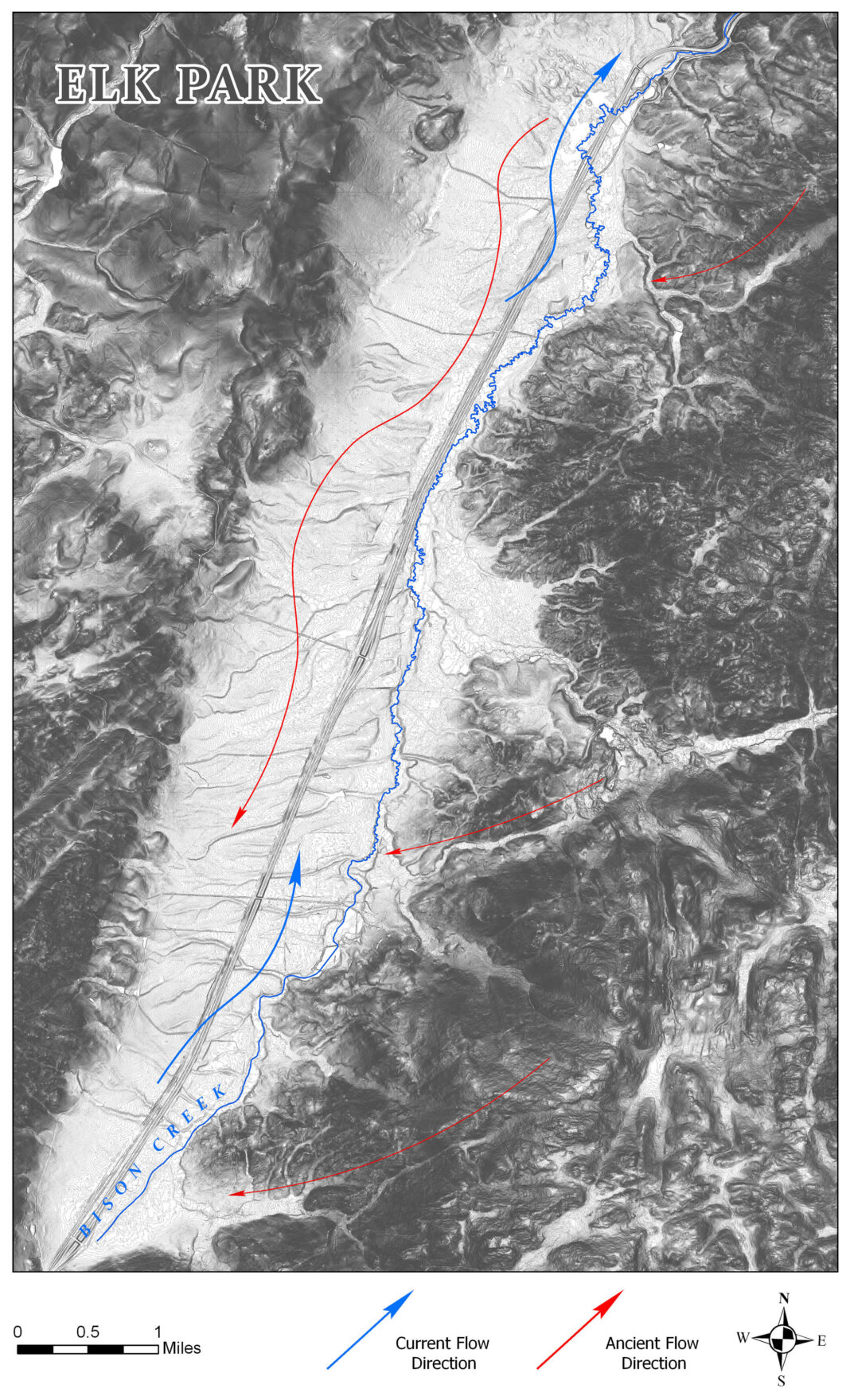
For a place of its elevation, Elk Park is strangely flat. From its southern end at the Woodville exit to where it enters Bison Creek Canyon at its north end is a difference of 107 vertical feet over a distance greater than 47,000 horizontal feet. That’s a grade of .2% over 9 miles. For Elk Park to get this uniform, it took geology, water and the ticking of the clock.
The main drainage of Elk Park is Bison Creek, which starts at its southern end and meanders north to the canyon and the Boulder River beyond. For eons, though, this wasn’t the case. Millions of years ago, precipitation on the flanks of Haystack and Whitetail Peaks ran down into what would become Elk Park, and through the winding erosion of streams on a low gradient, carved and widened the valley out on its way to what is now Butte, and an ancient version of the Clark Fork River. Then, some tens of millions of years ago, earth’s upheaval lifted the southern end of the valley slightly higher than the north end, and the entire basin’s drainage direction switched, reversing the valley’s flow and accelerating the broadening of the watershed more so than if drainage had never diverted 180 degrees. In the surrounding topography, we can see the remnant directions of the ancient drainages still.
One of the only places in Jefferson County you can see Haystack Peak, the high point of the Boulder Mountains, is from Elk Park. From its belly one is surrounded by mountains in a sort of fragmented cathedral, but instead of masonry, the walls are of decomposed granite and dead lodgepole, where long ago the primeval prayers of gravity were answered, and what once flowed to the Pacific now flows to the Atlantic.
Bret Lian grew up in Clancy and lives in Jefferson City with his wife Lisa, their three children and a dog. The places and histories of Jefferson County and beyond have always provided endless daydreaming material to this geography-minded Montanan, who provides this column monthly to the Monitor.