
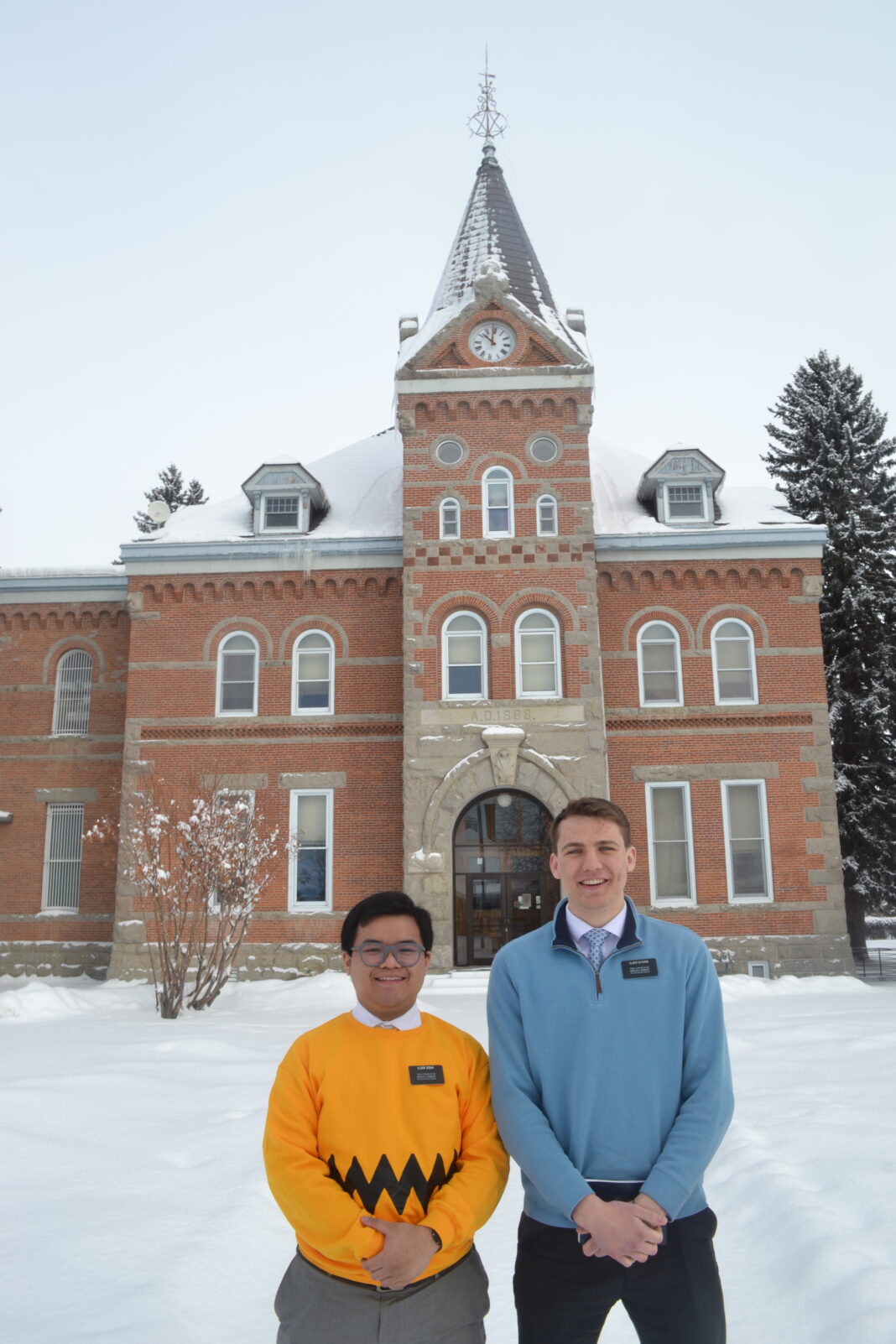
Of the 2.5 million people living in Bekasi, Indonesia, roughly 7500 are practicing Mormons. One such Mormon is Zebua Haga, a bright faced 19-year-old who arrived in Boulder early this February, as a part of his two-year service mission to Western Montana.
Haga will, until 2027, travel throughout Western Montana performing acts of service, spreading the Mormon gospel, and living in a cloistered religious community with his fellow missionaries. Haga, though the first in his family to leave Indonesia in service to The Church of Jesus Christ of Latter-day Saints, joins nearly 70,000 young Mormons, aged 18-25, presently enlisted and deployed as missionaries across the globe.
“I found such joy in learning the gospel of Jesus Christ, and in knowing it well enough to carry it with me through my daily life,” said Haga. “I feel like it would be selfish of me if I don’t share that with as many people as I can.”
Roughly 30% of all 19-year-old Mormon males choose to participate in a service mission. Haga is joined in his daily work by a companion missionary, 20-year old Kyler Kitchen from Utah, who will complete his mission in Jan. 2026. Both are assigned to Boulder’s local Mormon congregation, and must remain within sight and sound of one another at all times while stationed there. Missionaries are often moved throughout their assigned geography multiple times over the course of their service period, and stay with a single congregation anywhere between a few weeks and six months.
“I’m not sure if people understand that we’re not, in any way, here to convert people,” said Kitchen. “It’s about so much more than adding a few names to the congregation, and then moving on completely. We’re here to build relationships, and to help as many people as we can, regardless of what their beliefs are. If they want to convert, obviously we want to and can help with that. But if not, we’re just happy to help people grow closer to Jesus Christ. And shovel snow!”
While serving in Boulder, both Haga and Kitchen are living among their fellow missionaries across a number of apartments in Helena. They each receive a small monthly stipend to support their living expenses, and are provided with a vehicle by their mission office, which is based in Missoula. They have a single day off each week to attend to their personal matters, call their families, and prepare for impending tasks.
“Missionaries used to only be able to call their families on Christmas, and Mother’s Day,” said Kitchen. “But that was a little too hard on parents, so now we call weekly. But the limited contact isn’t a bad thing, or meant to make things harder than they need to be. Our mission years are supposed to be a moment where we give our lives completely to the Lord. To do that, we need to focus on what’s in front of us, and not on anything back home.”
According to Haga and Kitchen, missionaries are expected to abstain from television, video games, and social media during their service. They are also asked to avoid dating, and limit isolated contact with the opposite sex.
“I wouldn’t say the rules are strict,” said Haga. “But they are there to keep us from getting distracted by other things. Of course, if we go to a restaurant and there happens to be a television on, then that’s fine. We go bowling with the other missionaries, and play board games and things. And, in the summer, we’ll be able to do a lot outside. It’s not that any of the things we’re asked to avoid are bad. It’s just that these years are meant for us to focus on Jesus Christ. The rules are helpful, in that.”
The actual work of Haga and Kitchen’s mission is left largely to their own discretion. They field minor chores and other tasks from members of the Boulder congregation, but also from anyone in the community who might benefit from their assistance. Boulder’s Mormon congregation does not, according to branch president Shawn Palmer, have any long-term community programs that missionaries are enlisted to, but claims he and others assist them in finding external opportunities. Palmer himself served as a missionary in the Washington D.C. area, in the early 1990s.
“Personally, my mission was an extremely valuable experience that made a huge difference in my life,” said Palmer. “Zebua and Kyler, like I did, ultimately need to work independently, but if I know of any service opportunities or public forums or the like, I’ll let them know. And all of us at the congregation try to feed them as often as possible, and if members are so inclined to put a little cash in their hands, that’s also just fine.”
Haga and Kitchen’s efforts as Christian educators and Mormon proselytizers are, too, self-directed. Kitchen and Haga use online applications, primarily Area Book and Preach My Gospel, to plan their days, coordinate with other missionaries, identify potential converts and members of any faith community who might be receptive to having a spiritual conversation with them.
“Yes, we use a number of resources to help find people who might be interested in talking with us,” said Kitchen. “But sometimes we take a more spiritual approach. We’ll pray about what we should be doing, and then just see where The Spirit would like us to go. We’ll drive around and sort of just arrive to a random door, and see if they’ll speak with us.”
While Haga has only just started his work as a missionary, Kitchen has already approached hundreds of people. Of those visits, four people have been baptized into The Church of Jesus Christ of Latter-day Saints. Though there are a number of resources available to Haga and Kitchen, making cold-approaches can be risky, and result in angry or confrontational encounters.
“It can sometimes get a little discouraging, when there are unkind moments or when it seems like there isn’t anyone willing to meaningfully talk with us,” said Kitchen. “When someone reacts harshly to us, we just try to love them as much as we can. We’ll make a little note that they’re not interested in talking with us at the moment, but maybe, in the future, they will be.”
“Not everyone wants to hear what we have to say, but that’s why it’s important to talk to lots of people,” said Haga. “And, having just come here, it’s also a challenge to adjust to a new area. Ultimately, what really matters to me is whether or not we can plant a seed of faith, even if its just a tiny one. Sure, maybe someday that person will get baptized, but what really matters is helping people come closer to Christ, however that looks.”
Upon completing their mission, both Haga and Kitchen intend to attend university, and are each attracted to Brigham Young University (BYU), which is sponsored by the Church of Jesus Christ of Latter-day Saints. Of the more than 30,000 undergraduates enrolled at BYU in any given year, roughly 65% are returned Mormon missionaries. Haga hopes to study finance or public planning, while Kitchen is yet undecided.
“Kyler and Zebua have helped many people, and I hope they are able to continue doing so before leaving us,” said Palmer. “I hope they continue to have a positive influence on the communities they enter, and that they can complete their mission in a way that contributes to them having happy lives.”