
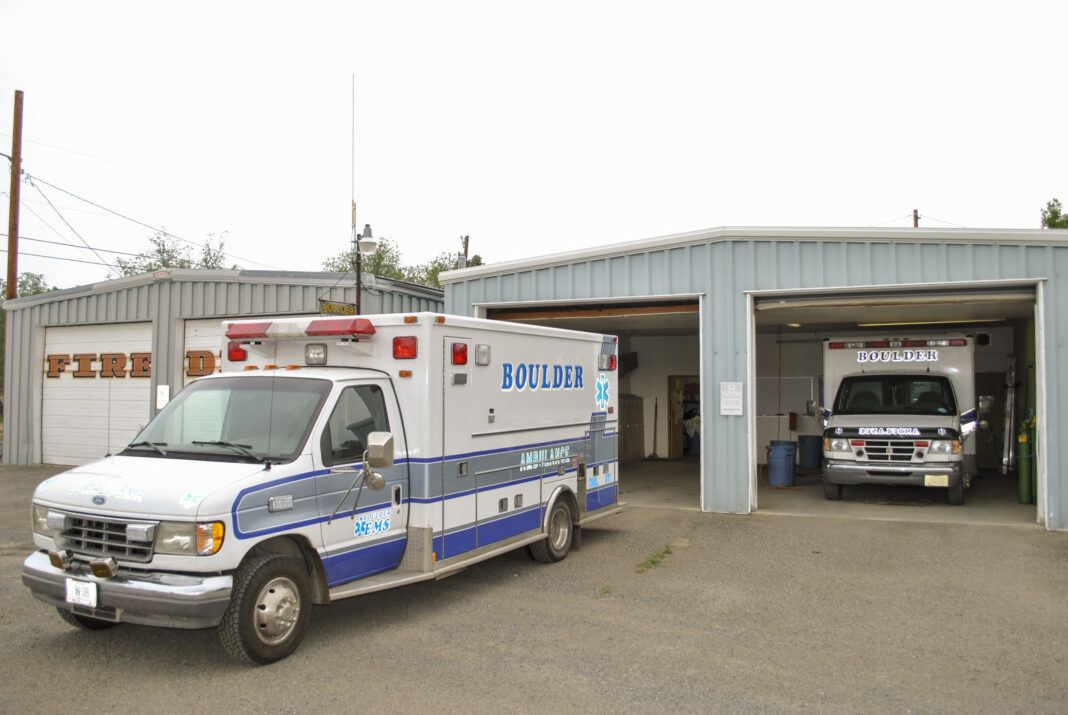
In an effort to recruit more volunteers to its Ambulance Service, the city of Boulder is covering most of participants’ costs to take an upcoming emergency medical technician course scheduled to start in January, and the city will reimburse the remaining costs for participants who go on to volunteer with the service. Now the city just needs people to sign up.
The EMT course will start Jan. 11, 2022, with openings for eight volunteers. The course will cost each registrant $200, according to Ambulance Service Director Michele St. George, and newly minted EMTs who end up serving and running calls with the service will be reimbursed that $200, making the course free for eventual volunteers.
“What we’re going to do is pay the cost, all except the $200, and that may be reimbursed if they take so many calls during the year,” she said, noting that although the course is capped at eight participants, it could be held with as few as one. But “we would prefer to see eight.”
The three-month course will feature interactive classroom sessions via video call on Tuesday and Thursday nights, likely starting at 6 p.m. and lasting 2–4 hours, as well as one or two Saturday sessions each month, St. George said, and classes will likely be split between Boulder’s fire hall downtown and the Boulder-Bull Mountain Rural Volunteer Fire Department facility just south of Boulder.
“All the classroom stuff will be done online and the skills, of course, will be done in person,” she said. “We want them at the fire hall on those Tuesday and Thursdays, but if they miss a class they can absolutely login and make it up.”
Registration is due by Jan. 5. Prospective volunteers can call the city at (406) 225-3381 for more information or to register.
In the past, the city has offered EMT courses about every two years, St. George said, and she taught the classes herself alongside Ambulance Service Deputy Director Molly Carey. With the service’s leaders teaching the course themselves, she said, participants only had to pay for books. This time, the city is paying Bozeman’s Best Practice Medicine to provide the course, which costs a total of $940 per participant, including books. The service will pay $740 of that cost up front, according to City Clerk Ellen Harne, and the department already budgeted to reimburse the remaining $200 to volunteers who go on to run calls.
If eight people complete the course and qualify to be reimbursed for their $200 up-front cost, the city will eventually spend $7,520 on the course—most of the $8,000 the service received for training as part of a larger grant this fall.
The push to recruit and train more volunteer EMTs comes as the city struggles to staff the Ambulance Service, which is a city department but is separate from the city budget’s general fund.
The department operates as an enterprise fund within the city’s annual budget, meaning that it generates revenue primarily through fees it charges for calls it responds to, rather than directly through tax revenue. Department leaders say that only four volunteers are regularly available for calls and a few others bolster the service, but that at least 10–14 regular volunteers are needed to provide adequate staffing. With the current staffing level, many calls are handled instead by Eagle Ambulance in Montana City, meaning a longer wait for patients and less revenue for the Boulder Ambulance Service.
“I can tell you for a fact, in our jurisdiction we have doctors, paramedics, EMTs, nurses, PAs, MPs, and they finish their jobs at the end of the day and go home, and nobody will volunteer,” Carey told Mayor Rusty Giulio and the City Council at an Oct. 18 meeting, using acronyms for physicians assistants, medical practitioners and registered nurses. “We have asked, honestly, we have asked nurse practitioners, we’ve asked RNs, we’ve asked paramedics, we have asked everybody that we know of that has any certification.”
Councilman Bear Taylor said the service’s lack of volunteers mirrored what he views as an overall decline in civic engagement and volunteerism.
“[I]t’s not just an ambulance problem—we have no civic duty in the community in general,” Taylor said. “We don’t have volunteers for [the] fire department, we have very few individuals putting in to run for City Council or mayor, the civic duty is something that is dying in our culture these days.”
In an Oct. 22 interview, City Council President Drew Dawson, who at the Oct. 18 meeting questioned St. George and Carey’s leadership and later apologized, said that “their dilemma certainly is real and their frustration is real, in terms of not having enough volunteers to staff the service.”
“Molly [Carey] is right about people volunteering for the service—that we have to have more people volunteering,” Dawson said. “The trick is, we have to figure out the levers and the incentives to get people to volunteer.”
The city has already pulled one of those levers: Getting new equipment.
Through a grant written by former volunteer grant writer Steve Carey, who remains a volunteer on the service, the city is poised to receive a new $175,000 ambulance, $21,000 Stryker power-cot and $23,000 Stryker power-load. The city originally budgeted more than it needed in matching funds for the grant, and the unused funds could fund a second power-cot and load for whichever of the city’s two current ambulances it keeps once the new one arrives.
Steve Carey said at the Oct. 18 that the new equipment had already proven to be a recruitment tool.
“I was talking to a medic out there on the fire. He’s with Montana City. He wants to move here, he likes it here. He won’t join an EMT unit because he’s broke down at 40 years old, being a combat medic,” Steve Carey recounted. “The second I said, well, we’re getting a new ambulance and a power-load, he’s like, ‘tell me more.’ So that’s what it’s taking to get some of these 40-year-olds to stick around, is something to assist them.”
Steve Carey stepped down from his role as grant writer after the meeting.
Covering the cost of the EMT course is another incentive the city hopes will attract volunteers.
At a Nov. 9 meeting convened to repair the fractured relationship between city leadership and the Ambulance Service, and to plot a course forward for the department, city and department leaders agreed that covering most or all of the course cost for volunteers was a good use for the $8,000 in grant money budgeted for training. A reimbursement scheme requiring volunteers actually participate in the service would help retain volunteers, they agreed.
Dawson also suggested that advertisements for the course, which had yet to be formally scheduled at the time of the meeting, should clearly state the city’s expectations of volunteers, and what being an EMT with the service entails.
“Sometimes people are hesitant to volunteer because they don’t know … they don’t know exactly what they’re volunteering for,” he said.
An advertisement the city placed in this issue of The Monitor (see page 2) states that “Boulder Ambulance Service volunteers are essential! Work beside our experienced staff, participate in trainings, help with community events, and respond to emergency calls.”
Volunteers, the ad continued, must have a “desire to help and serve,” must be 18 or older and have a high school diploma or equivalent, and must possess “strong personal values [and a] desire to grow personally and professionally.”
People already certified as EMTs or greater can inquire about beginning to volunteer immediately, according to the ad, which said that volunteer expectations are a minimum of 24 hours every six months.
The city is just beginning to advertise the course, but St. George said she’s already talked to one woman who expressed an interest in volunteering. But will people actually sign up and become volunteers?
“I sure hope so.”