
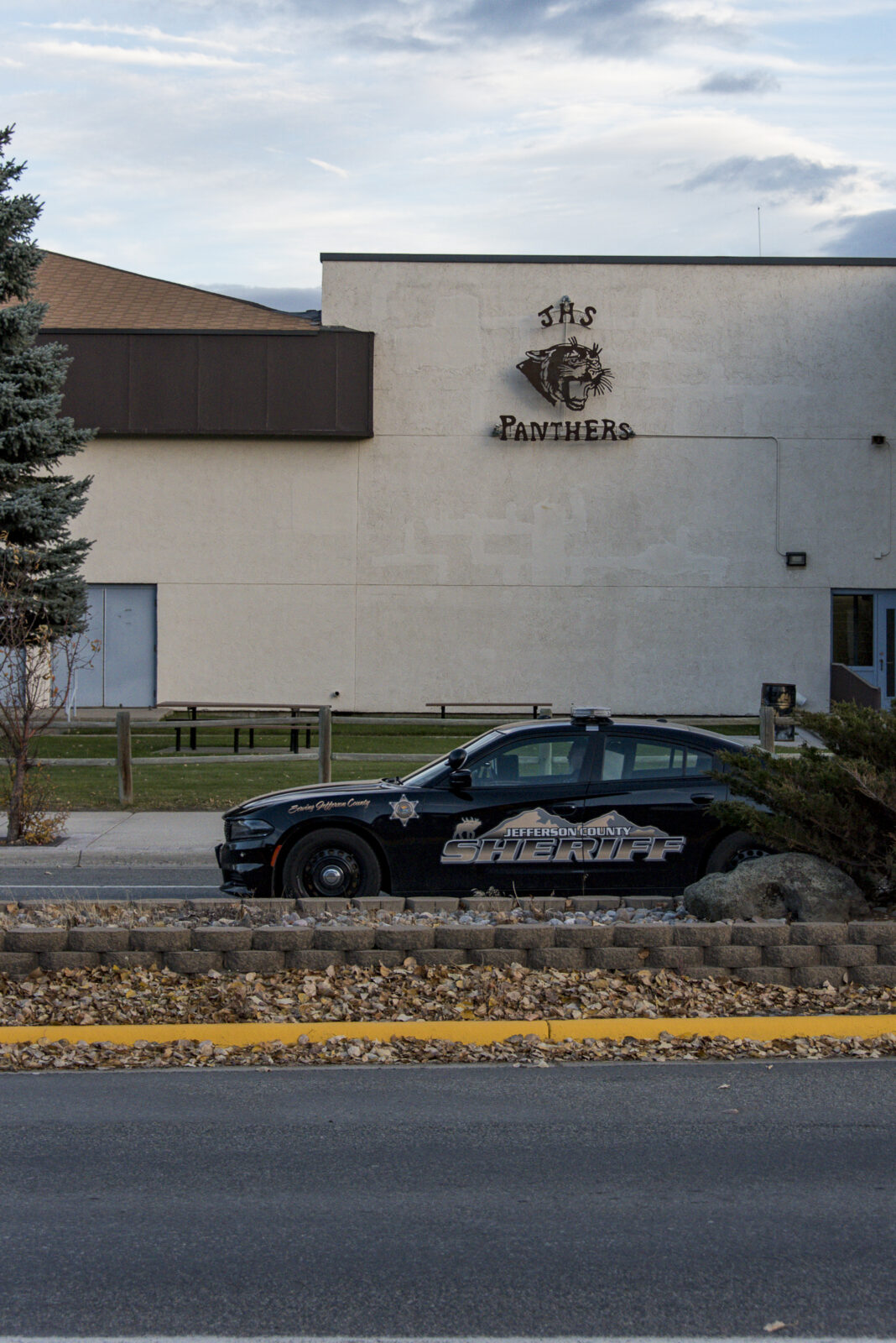
A school-shooting threat shared around the U.S. that mentioned a school with the initials “JHS” led to a lockdown and law-enforcement response at Jefferson High School in Boulder on Oct. 27. The full lockdown was lifted around lunchtime after law enforcement determined there was no threat inside the school, and students and staff completed the day under a partial lockdown.
Superintendent Tim Norbeck said in a phone call that afternoon that administrators were made aware of a “viable threat, went into lockdown, worked with Jefferson County [Sheriff’s Office] and determined it wasn’t viable.”
The threat was shared on the image-based messaging and social media app Snapchat, according to Undersheriff Mike Johnson.
“We were contacted by the school and the initial response was to put the school in lockdown,” he said in a phone call on Oct. 28, explaining that officers checked the perimeter and interior of the high school to ensure there was no threat.
Norbeck said that students informed school staff of the threat in the morning and the school went into lockdown, with students instructed to shelter in place, around 9:30 a.m. High school counselor Joe Michaud said the full lockdown lasted about four hours.
“I appreciate the courage of the students to come forward with something that wasn’t right,” Norbeck said.
The school remained in a partial lockdown with a “closed campus” for the rest of the day, meaning that students were restricted from leaving the campus, according to Norbeck and a Facebook post from JHS. Parents were allowed to meet students in person to take them home, Norbeck said.
Students continued educational activities while locked-down in classrooms, Norbeck said in a text message on Tuesday, and classes resumed in the afternoon.
“Staff and students were good … [we were] trying get out as much information as we could while we were busy,” he said. “They’re doing OK. We met with the staff after, and we sent out an email to all staff and students and parents.”
Norbeck and Johnson said the threat on Snapchat mirrored others that caused lockdowns, police responses and at least one arrest at other schools around the country on Oct. 27. The Sheriff’s Office is investigating the origin of the threat, Johnson said, noting that the threat “didn’t specify Jefferson High School, it specified ‘JHS.'”
“We’re pretty confident that what we dealt with was a spinoff of a Snapchat that originated elsewhere,” Johnson said. “The wording is similar to the other ones.”
In California, sheriff’s deputies were stationed at Jesuit High School in Carmichael, a suburb of Sacramento, after school administrators there were made aware of a similar Snapchat threatening a shooting at “JHS,” according to a report from Sacramento’s Fox 40 (KTXL-TV) television news station.
Police in Jacksonville, Florida, stated in an Oct. 27 Facebook post that they investigated a “JHS” school-shooting threat on Snapchat that was thought to target Jacksonville High School, but they determined the threat was directed at Jupiter High School in Jupiter, Florida, about 250 miles southeast. CBS-12 (WPEC-TV) television news in West Palm Beach reported that one person was arrested for making a threat against Jupiter High School on Oct. 26. The report stated that law enforcement had not released the person’s age or name.
It was unclear how the threat made its way to Boulder and added Jefferson High to a growing list of schools that now share not just their initials, but also the fear of a school-shooting threat.
Norbeck said that the incident showed what worked, and what didn’t, with school procedures and training for handling threats. Modular classrooms, he said, were not as secure as those in the main building.
“That’s why you train, you do all this stuff, and then when something happens you see how well you do with it,” he said. “Some of our communications things we need to work on—notifications within the building.”
Michaud, the school counselor at Jefferson High, said that he “can’t say enough about our kids, or staff, just how well prepared we were, just how kids responded in a calm manner.”
He cleared his schedule to be totally available to students on Oct. 28, the day after the lockdown, but his office was “pretty quiet,” he said in a call on Thursday.
“Today we’re kind of back to normal. There still are some residual effects. Trauma is something that sticks with people a long time,” he said. “Our safety was compromised, or the thought of our safety, and that sticks with you. They’ve done a good job today of rallying around each other.”