
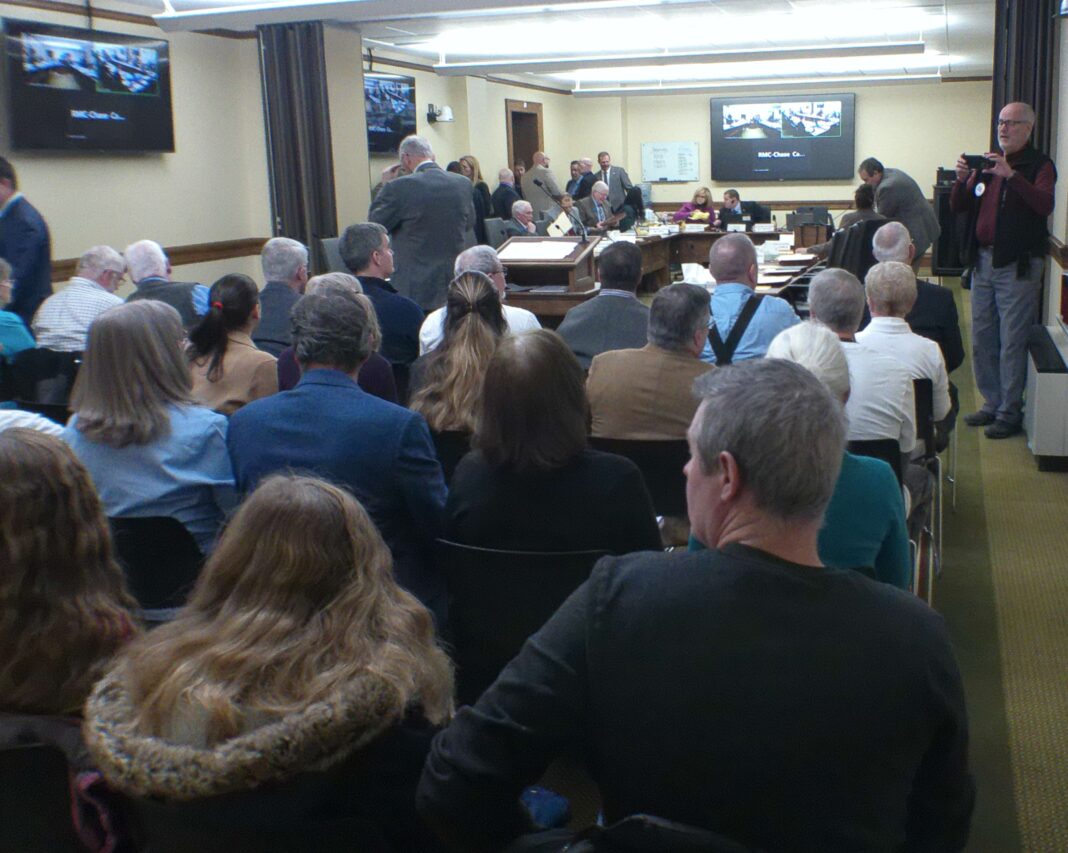

About 30 determined supporters, including several Jefferson County Republican leaders, braved early morning darkness and a snow storm in order to testify at the State Legislature in support of bills that would include Montana in a future Convention Of States.
On Jan. 24, the House Business and Labor Committee heard over three hours of in-person as well as online testimony from about 50 state residents regarding Joint Resolution 5 (HJ5), which seeks to confirm Montana’s participation in a conference of all 50 states aimed at amending the U.S. Constitution.
The Convention Of States, whose proponents tend to be political conservatives, is permitted under Article V of the U.S. constitution, which allows the states an opportunity to check federal powers. Three quarters of the states must approve such a convention. If HJ5 passes, Montana would become the 20th state to pledge its participation.
HJ5, whose language is similar to a bill that died in the 2023 Legislature, was introduced by state Representative Shane Klakken (R-Grass Valley) and Senator Tom McGillvray (R-Billings). Klakken explained the bill was very narrowly tailored to address three specific concerns about how the national government is currently operating, focusing on a balanced federal budget, term limits, and curtailing U.S. Congress powers under the Commerce Clause.
Boulder resident Stu Goodner, who is chair of the Jefferson County Republican Central Committee, was one of the first to testify before the House subcommittee. He outlined what the bill hopes to accomplish, and tried to address opponents’ concerns. “What you will mostly hear,” Goodner told legislators, “is a lot of fear. People are afraid that if all 50 states came together to modify the U.S. Constitution (or demand the U.S. Congress to make the changes themselves) that it will destroy the country.”
Goodner said that by limiting the scope to the three main elements listed in the bill, containment of other issues was possible. But his reassurances didn’t assuage some opponents, who fear a “runaway” convention that might create significant harm to the entire country. Robert Brown, addressing the committee remotely, made a lengthy presentation about the history of the only other previous Convention of States, which occurred in 1787. That convention, Brown said, did bring many changes to the U.S. Constitution, but was greatly feared by President James Madison, who felt the entire government that had been delicately standing for just a few years was at risk.
Since that time, Brown said, the Constitution has been amended many times, but those changes have rarely concerned the core components that the federal government operates under. The closest any changes have been made to federal operations was the 25th Amendment, which limited the presidency to two four-year terms.
Other opponents expressed concern that other states participating in a Convention would bring their own agendas. “You know California would be there, too,” one critic told the committee. “And there goes our second amendment.” Republican leaders from Broadwater and Meagher counties also expressed disapproval for HJ5, arguing that a convention would likely lead to chaos.
Many opponents argued there were other, better ways to address the concerns that HJ5 attempts to remedy. “We already have term limits – vote them out,” one said. Others pointed out that similar legislation has been introduced in the Montana Legislature for at least 10 years, and has been rejected each time.
In his remarks, Goodner tried to reveal some of the common areas of concern. “Where in the constitution does it say Congress can tell us how much water we can use? Nowhere.” Goodner indicated beforehand that he was referring to Congressional mandates on appliance efficiencies for devices sold in the U.S. Congress claims this power under the Commerce Clause, Article 1, Section 8.
Clancy resident Tony Kramer echoed Goodner’s statements. Kramer helped organize the Convention forces in the capital building, keeping track of supporters and their time to speak. He had his work cut out for him: Nearly 30 proponents made their cases in person, and another 11 called in from around the state.
On Jan. 27, the Business and Labor Committee tabled HJ5, leaving its fate unclear. A companion bill, SB120, which would provide for a Convention of States Commissioner and oversight, was passed by the Senate Judiciary Committee.